How Commercial Satellite Ash Threatens the Ozone Layer and Future Space Operations
Washington, D.C., Monday, 9 March 2026.
As companies propose launching millions of satellites, researchers warn that metallic ash from burning spacecraft threatens the ozone layer, sparking urgent calls for costly global space regulations.
The One-Million Satellite Paradigm
The scale of human infrastructure in low Earth orbit is undergoing an unprecedented expansion. As of early 2026, there are roughly 16,000 satellites orbiting Earth, with approximately 14,000 to 15,000 of them actively operating [1][2]. SpaceX alone manages a fleet of more than 8,000 of these active units [2]. However, the aerospace industry is preparing for a paradigm shift that dwarfs current deployment rates. In February 2026, SpaceX submitted an application to the U.S. Federal Communications Commission (FCC) requesting authorization to launch an additional one million satellites [1][2]. These units are intended to function as orbiting “AI data centres,” operating at altitudes ranging from 500 to 5,000 kilometers [1][2].
Atmospheric Crematoriums and the Ozone Threat
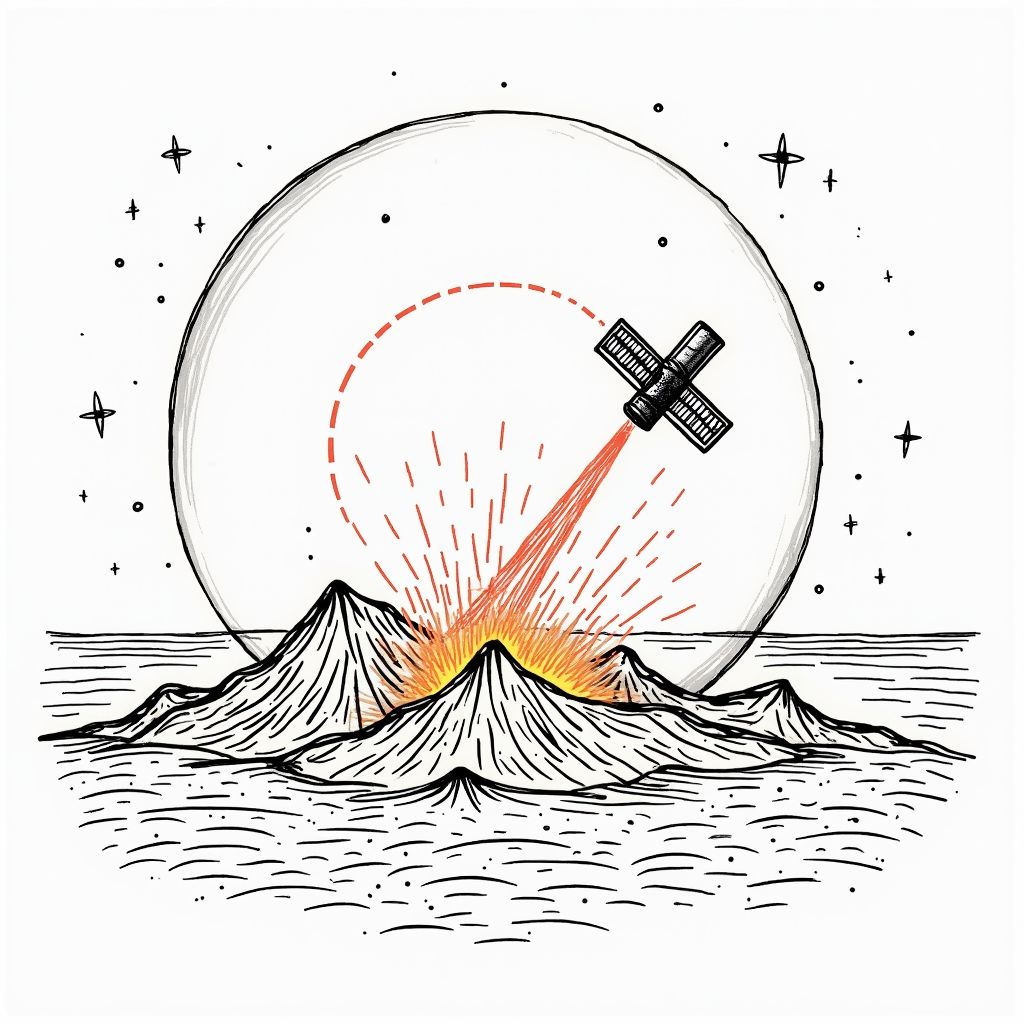
While the logistical challenges of managing millions of satellites are immense, environmental scientists are raising alarms about a less visible but potentially catastrophic consequence: atmospheric pollution from incinerated spacecraft. Because satellite manufacturers are rarely required to disclose the exact material composition of their hardware, the environmental fallout of decommissioned units burning up in the atmosphere remains dangerously understudied [1]. Scientists now estimate that the continuous re-entry of a million-satellite megaconstellation could deposit up to one teragram of alumina into the upper atmosphere [1]. This massive accumulation of metallic ash threatens to alter atmospheric chemistry and induce localized heating, which could severely damage the global ozone layer [1].
Collisions, Debris, and the Loss of the Night Sky
Beyond atmospheric chemistry, the sheer physical volume of hardware planned for low Earth orbit poses severe collision and ground-casualty risks. The orbital environment is already cluttered with over 140 million pieces of space debris ranging from 1 millimeter to 10 centimeters in size [2]. According to the Outer Space Institute’s CRASH Clock, if active satellites suddenly ceased their automated collision avoidance maneuvers, a major orbital collision would occur within just 3.8 days [1]. Furthermore, the threat of surviving debris reaching the Earth’s surface is escalating. In April 2024, debris from a SpaceX Dragon spacecraft crashed onto farmland in Saskatchewan, Canada, and analysts now estimate that the probability of a human casualty from megaconstellation re-entries stands at roughly 40 percent per five-year cycle [1].
The Regulatory Horizon
The escalating environmental and astronomical impacts are now triggering intense public and regulatory backlash. When the public comment period for SpaceX’s one-million-satellite FCC proposal closed on March 6, 2026, the commission had received over 1,000 submissions, the vast majority of which vehemently opposed the plan [2]. Aaron Boley, co-director at the Outer Space Institute, warned that transitioning to millions of satellites is “a bad idea in terms of our long-term use and access to space,” noting that the resulting loss of the natural night sky will be a global effect from which there is no escape [2].