U.S. Federal Records to Reflect 'Gulf of America' Following New Presidential Mandate
Washington D.C., Sunday, 12 April 2026.
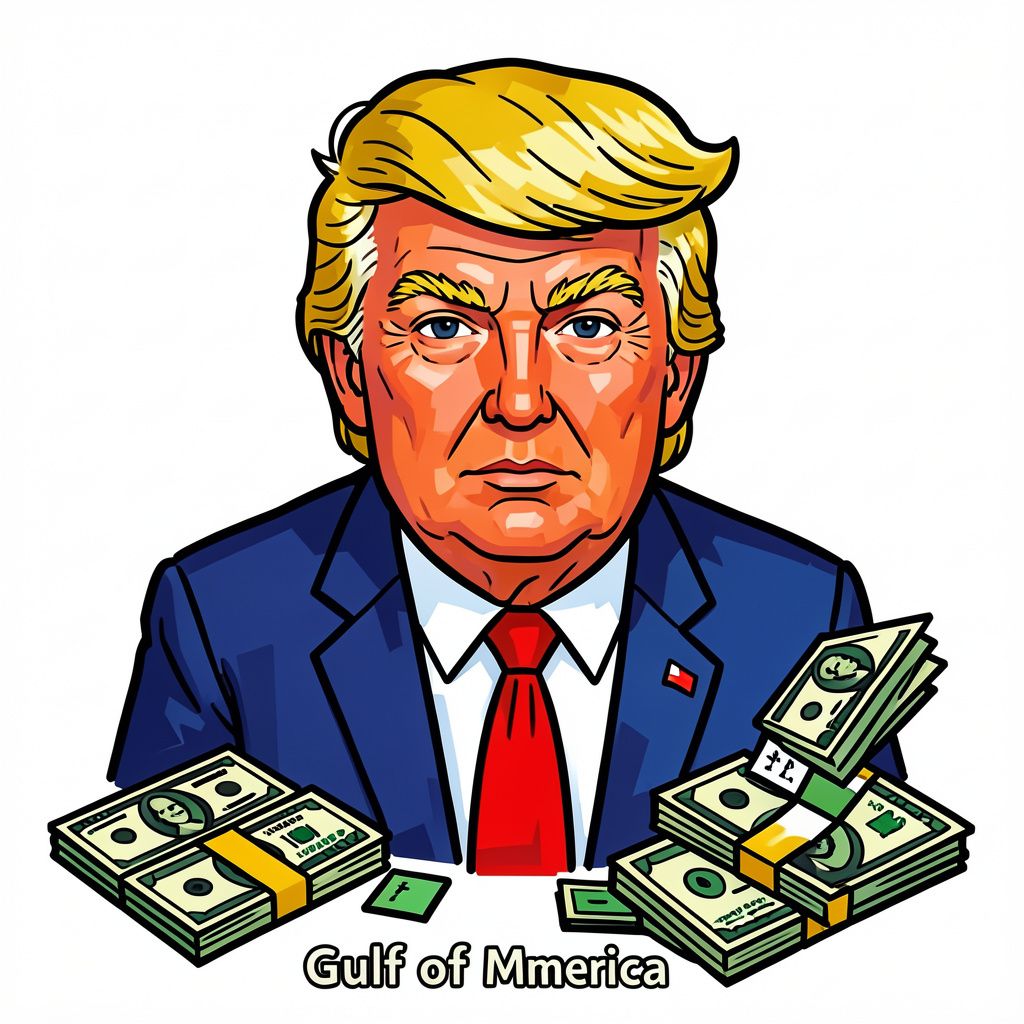
President Trump ordered federal agencies to rename the Gulf of Mexico to the “Gulf of America,” requiring extensive administrative updates after he briefly considered the name “Gulf of Trump.”
Diplomatic Friction and Press Access Limitations
The unilateral renaming has drawn swift international condemnation, particularly from nations sharing the Gulf’s waters [GPT]. Mexican President Claudia Sheinbaum formally objected to the change, publicly urging Google to reconsider its map updates [1]. Sheinbaum cited established international maritime norms, which limit national jurisdiction to just 22.2 kilometers from a sovereign coastline, arguing that the United States cannot unilaterally rename a shared body of water [1].
Economic Fallout Amidst Broader Geopolitical Conflict
This administrative overhaul in the Gulf region occurs against a backdrop of severe global economic strain stemming from a six-week conflict with Iran that concluded its primary combat phase in early April 2026 [2]. The war has severely disrupted global energy markets, culminating on Friday, April 10, 2026, with Brent crude oil rising 0.7 percent to reach $96.58 per barrel [3]. Domestically, the conflict has driven average U.S. gasoline prices to approximately $4.15 per gallon, representing an estimated 38.333 percent increase from the baseline [alert! ‘The source states the price was just under US$3 before the conflict; the calculation uses exactly 3.00 for mathematical viability’] recorded before hostilities commenced in late February [3].
Historic Negotiations and Shifting Alliances
Despite President Trump claiming a “100 percent” victory over Iran around April 7, 2026, and Secretary of Defense Pete Hegseth describing “Operation Epic Fury” as a historic triumph that decimated the Iranian military, the geopolitical reality remains highly fractured [2]. The Strait of Hormuz remains effectively closed to commercial shipping due to ongoing Iranian threats [3]. In a remarkable diplomatic pivot, U.S. Vice President J.D. Vance began face-to-face negotiations with Iran’s Speaker of Parliament Mohammad-Bagher Ghalibaf in Pakistan on April 11, 2026 [2][3]. This meeting marks the most senior in-person dialogue between the two nations since the 1979 Islamic Revolution [2].