US Oil Firm Ignores Greenland Rules to Target One Trillion Dollars in Arctic Oil
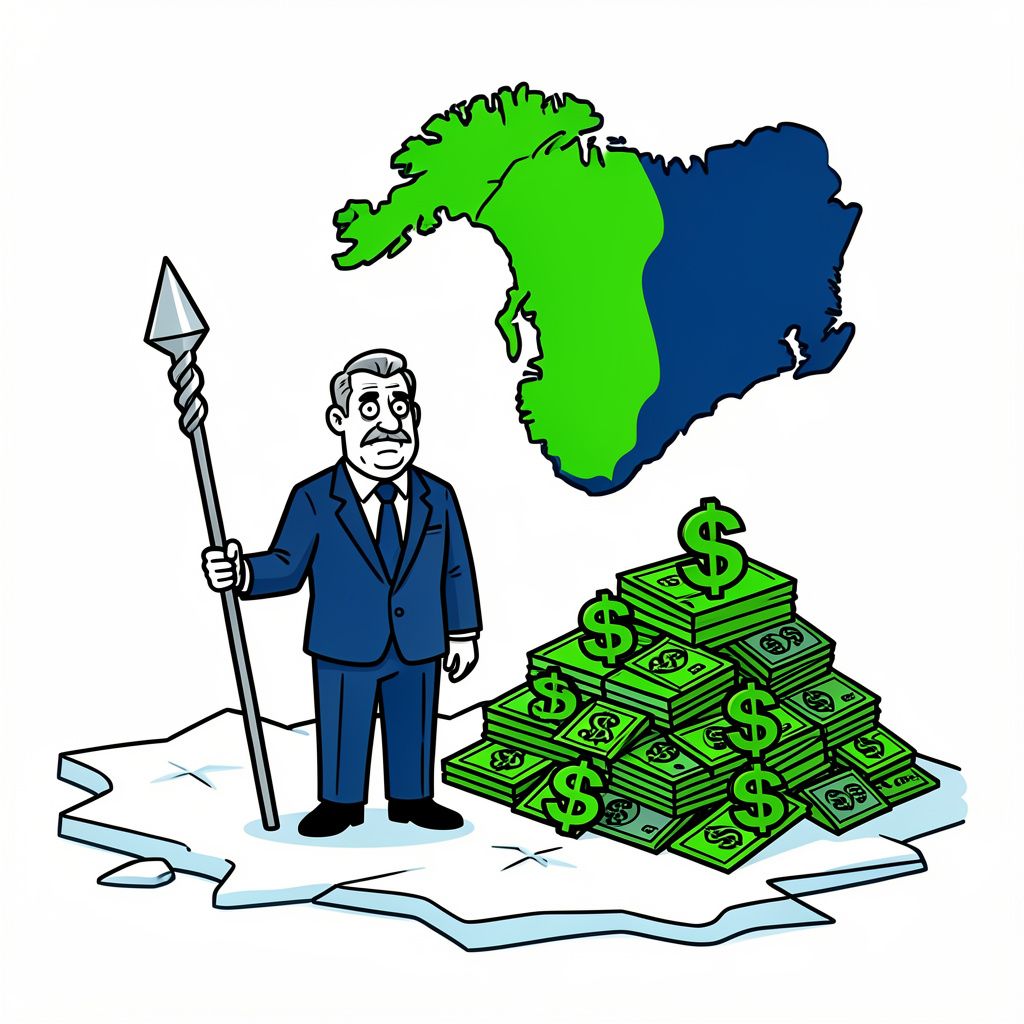
Nuuk, Sunday, 9 August 2026.
Greenland issued a formal warning to a US-backed oil firm after it landed unauthorized drilling equipment to target an estimated $1 trillion in crude, despite a 2021 exploration ban.
Regulatory Standoff in the Frozen North
The remote, icy shores of eastern Greenland have become the latest stage for a high-stakes geopolitical and regulatory standoff. Texas-based developer Greenland Energy, established in 2025, has drawn a sharp rebuke from the Greenlandic government after landing unauthorized oil-drilling equipment in the ecologically sensitive Jameson Land region [1][2][3]. Greenland’s Department of Industry and Minerals issued an initial strong warning on July 30, 2026 [1][3], followed by subsequent official warnings on August 7, 2026, after the firm initiated logistical operations without obtaining the necessary approvals from the mineral resources authority [2]. The company is targeting an estimated $1 trillion in crude oil reserves believed to lie beneath the territory [1][2][3]. While Greenland officially stopped issuing new oil exploration licenses in 2021 due to environmental concerns, Greenland Energy has sought to bypass this restriction by planning to acquire a majority stake in an existing project held by UK-based developer 80 Mile [2]. Tensions had already flared in June 2026 when a company representative falsely informed local residents at a community meeting that the firm possessed official drilling permits, creating regulatory confusion that the company’s chairman later chalked up to over-enthusiasm [1][2].
Logistical Timelines and Environmental Concerns
Despite the lack of formal clearance, the physical footprint of the operation has already begun to materialize on the Greenlandic coast. Greenlandic authorities have opted not to demand the immediate removal of the landed equipment, stating that such an action would not be “proportionate” while the firm’s application remains under official consideration [2][3]. However, the government has strictly mandated that all future logistical matters must be advised and approved by the mineral resources authority before they are carried out [2][3]. The clock is ticking on Greenland Energy’s ambitious timeline; the firm has scheduled a vessel carrying 300 shipping containers of drilling equipment to depart Canada on September 12, 2026, with the expectation of commencing drilling operations in October 2026 [2][3]. The company, which initially intended to drill two wells, has revised its plan to a single well under a $60 million exploration budget [2]. This planned drilling has drawn fierce opposition from environmental groups, who warn that the project’s physical footprint may violate the Ramsar Convention on Wetlands [3].
The Trump Connection and Geopolitical Ambitions
The dispute is heavily intensified by Greenland Energy’s deep political connections to the inner circle of U.S. President Donald Trump [1][2]. The firm is chaired by Larry Swets, a prominent shareholder with close ties to Trump’s political network [1]. Trump has long maintained an intense focus on the 2,165,160-square-kilometer (836,000-square-mile) Arctic territory, having threatened to seize Greenland in January 2025 for national security purposes and his planned “Golden Dome” missile-defense system [1][2]. More recently, on July 31, 2026, Trump publicly predicted during a television interview that Greenland would be under United States control by 2029, calling the island vital for American missile defense and mineral access [3]. Just days later, on August 1 and August 2, 2026, Trump posted an AI-generated image of himself looming over a Greenlandic village on Truth Social with the caption “Hello, Greenland!” following reports of the unauthorized equipment landing [1][3].
Corporate Alignment and Expert Backlash
Greenland Energy’s corporate roster closely mirrors these geopolitical ambitions. In July 2026, the company appointed Carol Craig, a U.S. Navy veteran associated with Trump’s “Golden Dome” missile-defense project, to its board of directors [1][2]. Furthermore, the company hired television personality Phillip McGraw, widely known as “Dr. Phil”—whom Trump appointed to the federal Religious Liberty Commission in May 2025—to anchor a documentary series showcasing the firm’s Arctic exploration [1][2]. These developments have fueled deep anxieties among international observers and foreign policy experts. Former Human Rights Watch executive director Kenneth Roth questioned whether a soft invasion of Greenland had already begun, while historian Ruth Ben-Ghiat warned that territorial encroachments often start under the guise of technical or industrial projects [3]. Jessica Berlin, a senior fellow at the Center for European Policy Analysis, urged Greenlandic authorities to immediately halt the project to prevent opening a geopolitical floodgate [3].
Corporate De-escalation and the Path Forward
In the face of mounting international scrutiny and domestic warnings, Greenland Energy is attempting to de-escalate the rhetoric. On August 6, 2026, the company issued a letter to its shareholders asserting that recent high-level meetings with Greenlandic regulatory and oversight authorities had been “constructive” and that the company remains encouraged by progress toward securing its remaining approvals [1]. Chairman Larry Swets has publicly denied that the commercial drilling project is in any way connected to American annexation plans [1][3]. However, with Greenlandic officials insisting on absolute regulatory compliance before any further equipment is moved, the coming weeks will test whether Greenland can successfully defend its sovereignty against well-connected foreign energy interests [2][3].