Greek Minimum Wage Buying Power Drops to Historic Lows
Athens, Monday, 24 August 2026.
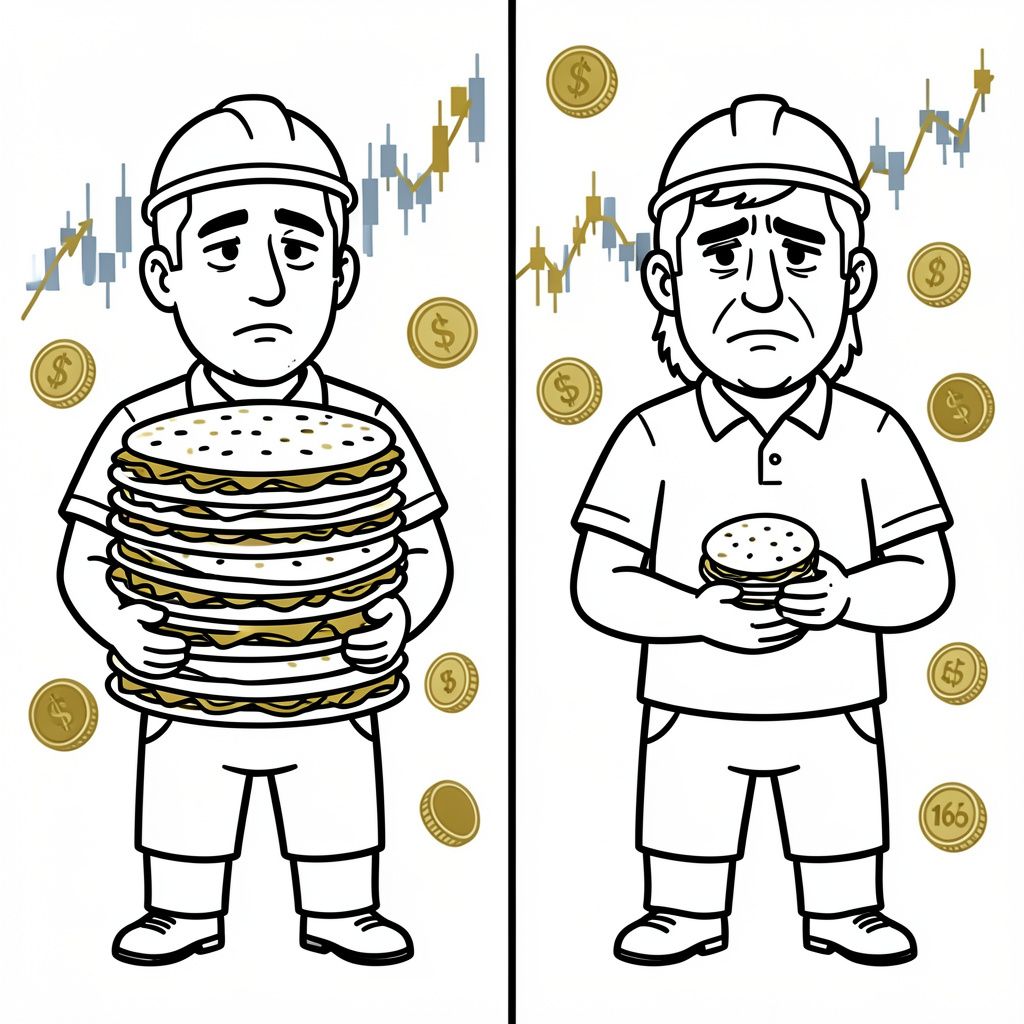
Despite recent economic growth and wage increases, Greek minimum wage purchasing power has collapsed, buying just 165 pita gyros per month in 2026 compared to 597 in 1998.
Gyronomics and the Erosion of Everyday Affordability
To understand the direct impact of inflation on Greek households, local economists and analysts have turned to informal measures of real-world value. The “Gyronomics” index, an experimental purchasing power tracker, measures the value of Greece’s net minimum wage by calculating how many traditional pita gyros a single monthly paycheck can buy [1]. Historically, the results are stark: in 1985, a worker earning the minimum wage could buy approximately 482 pita gyros, with a single gyro costing an average of 60 drachmas, or roughly €0.18 [1]. Purchasing power peaked in 1998, when a month’s minimum wage could buy 597 gyros [1]. By August 2026, however, that figure has plummeted to just 165 gyros, representing a dramatic decline of -72.362% from its historic peak.
The Velocity of Food Inflation
This contraction has accelerated rapidly over the last several years due to a steep rise in basic food costs. In 2019, a pita gyro cost an average of €2.00, rising to €2.50 in 2020, €3.20 in 2022, €3.80 in 2024, and €4.70 by 2025 [1]. This represents a price increase of 135% in just six years. Although the Greek government implemented a new statutory monthly minimum wage of €920 effective April 1, 2026, the nominal salary adjustments have failed to keep pace with the rising costs of basic commodities [1]. Consequently, while workers see larger numbers on their monthly payslips, their actual capacity to purchase everyday food staples has severely diminished [1].
Regional Cost Disparities and Domestic Pressure
The domestic cost-of-living crisis is further highlighted when compared to regional neighbors. Comparative data as of August 23, 2026, reveals that the cost of living in Greece is 27.2% higher than in Bulgaria, excluding rent, and 26.0% higher when rent is factored in [2]. Crucially, local purchasing power in Greece is 22.2% lower than in Bulgaria, showing that Greek consumers face significantly greater financial strain [2]. Key grocery staples in Greece carry substantial price premiums; for example, 500 g of fresh white bread costs 26.9% more in Greece (€1.28) than in Bulgaria (€1.01), while 12 large eggs are 29.7% more expensive (€3.97 compared to €3.06) [2]. Additionally, 1 kg of local cheese in Greece carries a 32.3% premium at €12.30 compared to €9.29 in Bulgaria [2].
High Costs of Utilities and Transport
Beyond food, everyday operational expenses continue to drain household budgets. Greek consumers pay 67.1% more for basic utilities (covering electricity, heating, and water for an 85 m2 apartment) than their Bulgarian counterparts, facing average monthly costs of €194.50 compared to €116.36 [2]. Broadband internet costs €28.25 in Greece, representing a 130.0% markup over Bulgaria’s €12.28 [2]. Transportation costs are also highly inflated: gasoline in Greece averages €1.90 per liter, which is 34.7% higher than the €1.41 per liter recorded in Bulgaria [2]. These compounding expenses mean that discretionary income is virtually non-existent for those on the statutory minimum wage [1][2].
The Youth Crisis: High Housing Costs and Low Wages
The economic squeeze is felt most acutely by the younger demographic. According to data from the Organisation for Economic Co-operation and Development (OECD), young workers under the age of 30 in Greece earn 40% less on average than their international peers in other EU and OECD nations when adjusted for purchasing power [4][5]. Compounding these low wages are exorbitant housing costs, with young Greeks aged 18 to 29 spending more than 60% of their income on housing—nearly double the European Union average [4][5]. In urban centers, approximately 80% of young people spend over 40% of their disposable income on housing, classifying them as heavily overburdened [4][5].
Delayed Independence and High Unemployment
As a direct consequence of these financial barriers, 74% of Greeks aged 20 to 29 continue to live with their parents [4][5]. The average age for young Greeks to leave the parental home has risen to 30.9 years, far exceeding the EU-OECD average of 26.2 years [4][5]. This delay in independence is tied to structural labor market issues: youth unemployment in Greece stood at 16.5% in 2025, the third-highest in the OECD behind Spain and Sweden [4][5]. Even higher education offers little protection, as university graduates aged 25 to 34 faced an unemployment rate of 12.3% in 2024, the highest in the OECD and 2.4 times the OECD average for that specific demographic [4][5].
Macroeconomic Paradox: Growth Amidst Weak Consumer Yields
This widespread consumer struggle presents a sharp paradox against Greece’s broader macroeconomic indicators. In 2025, Greece’s economy grew by 2.1%, comfortably outperforming the eurozone average of 1.3% [4][5]. However, this growth has not translated into improved living standards for ordinary citizens [4][5]. Furthermore, even the vital tourism sector is showing signs of consumer fatigue. While tourist arrivals in June 2026 increased by 6.9% year-on-year to reach 4.9 million, overall tourism revenue rose by a mere 1.2% to €3.29 billion [3]. Individual spending per tourist dropped 6.2% year-on-year in June 2026, reflecting a broader regional and international tightening of consumer purse strings [3].