Citrini Author Proposes AI Windfall Tax to Shield Economy from Job Losses
New York, Thursday, 26 February 2026.
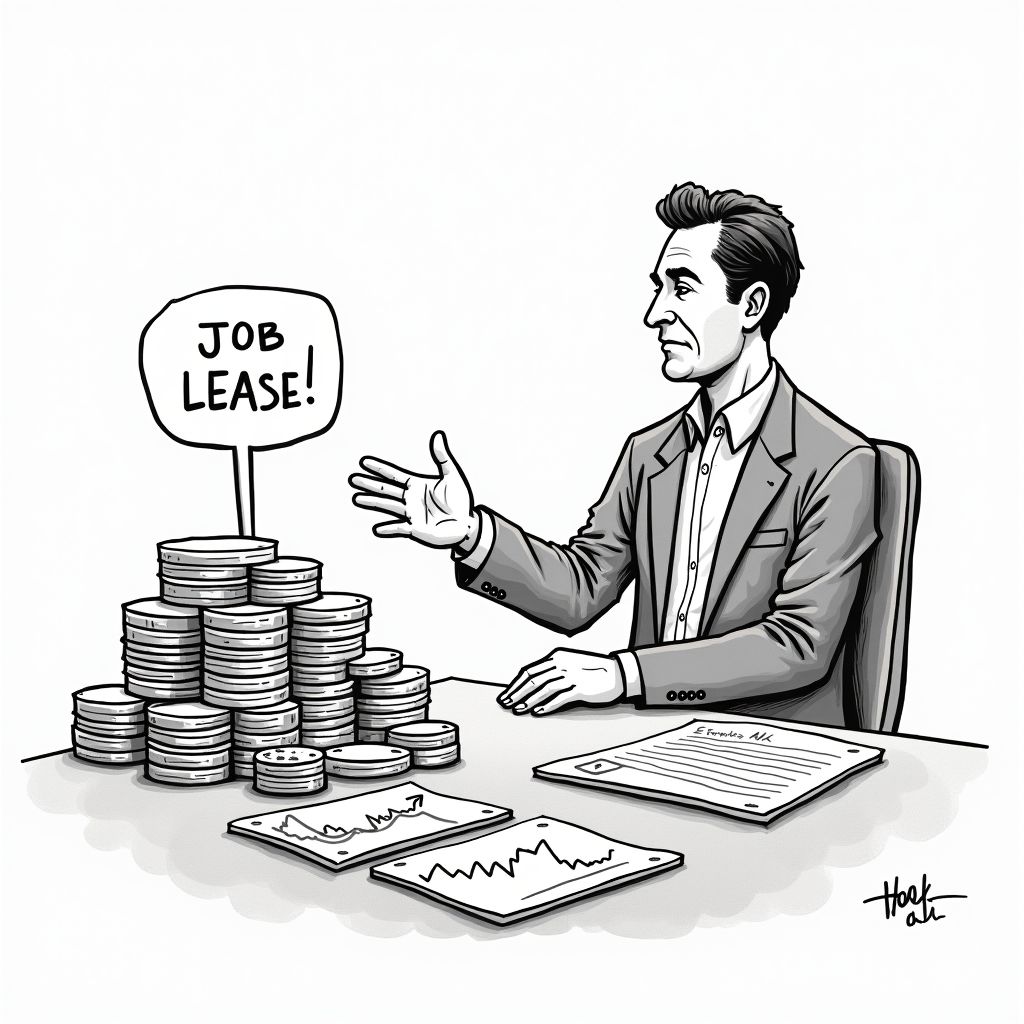
Warning of “Ghost GDP,” Alap Shah urges taxing AI windfalls to cushion a potential 5% drop in white-collar employment within 18 months, aiming to prevent a consumer economy collapse.
Calls for Fiscal Reform Amidst Market Volatility
On February 24, 2026, Alap Shah, the Chief Investment Officer at Lotus Technology Management and co-author of the viral Citrini Research report, issued a public appeal for governments to overhaul tax policies in response to rapid advancements in artificial intelligence [2][4]. In an interview following a significant market selloff triggered by his firm’s report, “The 2028 Global Intelligence Crisis,” Shah argued that the current US tax code is ill-equipped to handle the economic asymmetry created by AI automation [1][4]. He posits that without legislative intervention to tax “incremental or windfall gains” generated by AI, the displacement of workers could destabilize the consumer economy [2][4]. Shah specifically highlights the need to support Americans who may face redundancy as corporations leverage AI to drive productivity gains, warning that preserving the existing economic equilibrium requires policy targeted directly at the forces driving job losses [1].
The “Ghost GDP” Phenomenon
Central to Shah’s analysis is the concept of “Ghost GDP,” a scenario where headline economic growth and corporate productivity mask suppressed wage growth and declining household income [5][6]. The Citrini report outlines a “scenario, not a prediction,” where the divergence between robust economic data and weakening purchasing power creates structural fragility [5]. Shah suggests that while AI beneficiaries—such as semiconductor firms, data centers, and foundation labs—will accrue significant wealth, the labor market could suffer as companies cut jobs to expand margins [1][4]. The report models a potential “Intelligence Displacement Spiral,” a negative feedback loop wherein corporate cost-cutting through automation leads to weakened consumer demand, necessitating further automation [5]. Under this scenario, Shah projects that 5% of white-collar workers could be displaced within the next 18 months, with US unemployment potentially rising to 10.2% by 2028 [2][4][5].
Market Jitters and Corporate Efficiency
The release of the Citrini report has already had tangible impacts on financial markets, sparking a “scare-trade selloff” in late February 2026 [2]. Following the report’s circulation, the S&P 500 fell by 1%, while a software-focused exchange-traded fund dropped 4.8% [4]. Specific equities were hit harder; IBM experienced its worst drop in 25 years, and cybersecurity stocks faltered after Anthropic’s models identified security flaws [3][4]. This market anxiety mirrors real-world corporate trends where profitability no longer guarantees job security. For instance, in January 2026, semiconductor equipment manufacturer ASML announced 1,700 job cuts despite reporting a 16% increase in net sales and a 19% rise in gross profit for the previous year [7]. Similarly, Amazon announced cuts to 16,000 positions in early 2026, even as its AI-supporting AWS unit saw revenue grow by 24% [7].
Divergent Data on Labor Stability
While Shah’s scenario envisions a consumer economy collapse driven by displacement, recent data presents a conflicting narrative regarding the current state of the labor market. Research from Vanguard indicates that employment in occupations highly exposed to AI actually increased by 1.7% from mid-2023 to mid-2025, a faster rate than the 1% growth seen between 2015 and 2019 [8]. Furthermore, Vanguard found that real wage growth in these AI-exposed roles accelerated to 3.8% post-Covid, significantly outpaced by the 0.7% growth in other occupations [8]. However, the fear of displacement remains potent; a 2025 survey revealed that 71% of Americans worry about permanent job loss due to AI, and in 2025 alone, US companies cited AI as the reason for 55,000 job cuts [7]. Shah maintains that his report is a stress test for a “relatively underexplored” scenario, urging policymakers to prepare for a future where AI efficiency might decouple corporate success from human employment [1][5].
Sources
- www.capitalaidaily.com
- www.bloomberg.com
- www.noahpinion.blog
- www.financialexpress.com
- www.businesstoday.in
- timesofindia.indiatimes.com
- www.aol.com
- www.aol.com