Japan Narrowly Escapes Recession as Domestic Spending Counters Export Decline
Tokyo, Monday, 16 February 2026.
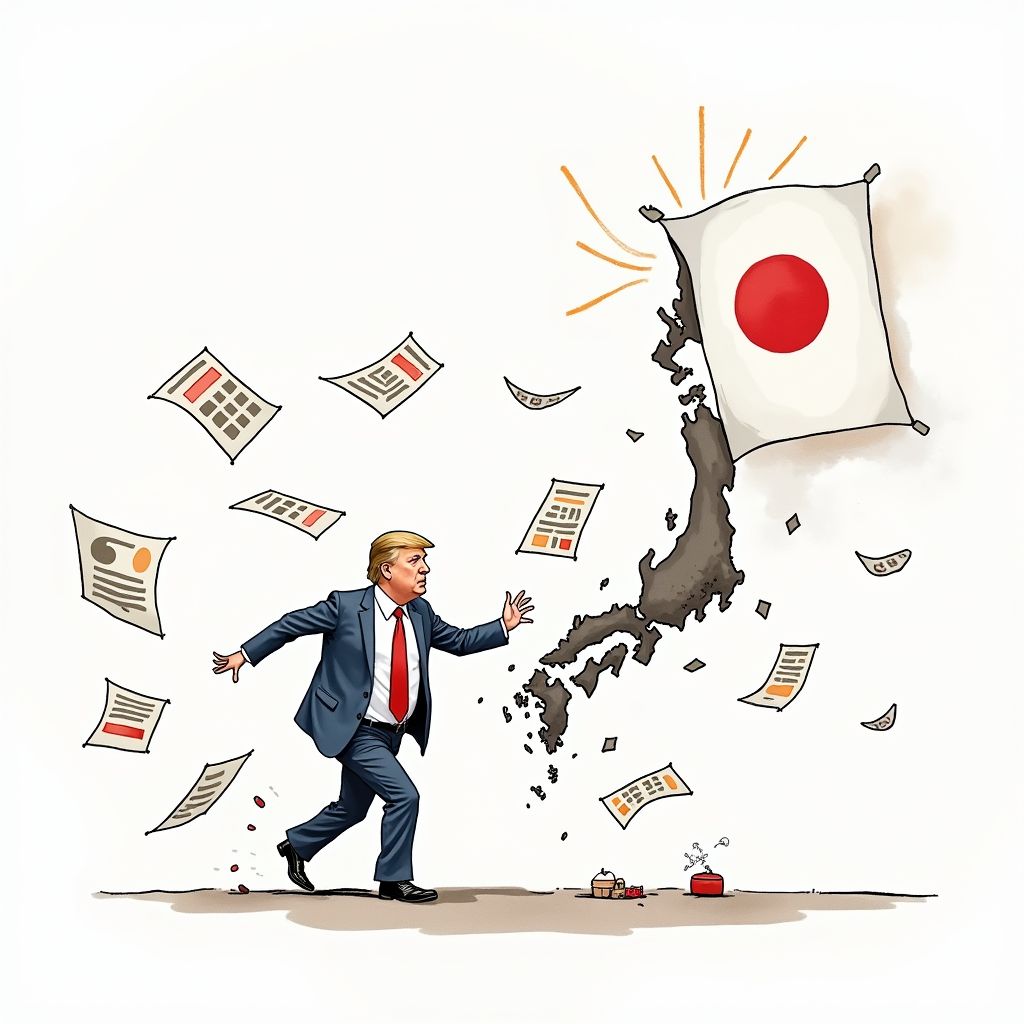
Japan narrowly avoided a technical recession in the final quarter of 2025, posting a fragile 0.2% annualized growth rate reported this Monday, February 16, 2026. While private housing rebounded significantly and AI-driven demand boosted capital expenditure by 0.2%, these domestic gains were nearly erased by a sharp 1.1% drop in exports, exacerbated by ongoing tariff uncertainties under the Trump administration. The most intriguing divergence lies in the data: while real economic activity remains anemic, nominal GDP surged by an annualized 2.3%, driven by inflation and corporate profits. This disconnect highlights the precarious nature of Japan’s recovery, which fell significantly short of the market’s 1.6% growth expectation.
Domestic Demand: A Fragile Lifeline
The avoidance of a technical recession—defined as two consecutive quarters of contraction—offers little cause for celebration when dissecting the underlying data. Following a revised 0.7% contraction in the July-September period, the economy’s return to positive territory was driven largely by idiosyncratic domestic factors rather than broad-based strength [1]. Private residential investment proved to be the quarter’s standout performer, surging 4.8% from the previous quarter [5]. This sharp rebound, however, is largely corrective; it follows a significant slump caused by the introduction of stricter energy efficiency standards in April 2025, which had previously distorted market activity [5]. Business investment also contributed positively, albeit modestly, rising 0.2% as companies ramped up spending on artificial intelligence infrastructure and semiconductor manufacturing equipment [5]. Conversely, private consumption, which accounts for more than half of Japan’s GDP, remained lethargic with a mere 0.1% quarterly increase, as inflation continues to erode purchasing power for goods like automobiles and food [5].
Trade Winds and Tariff Troubles
While domestic activity provided a floor for growth, the external environment has become a significant drag on Japan’s export-reliant model. Exports fell by an annualized 1.1% in the final quarter, a contraction that underscores the growing friction in global trade [1]. On a quarter-over-quarter basis, exports dipped 0.3%, marking the second consecutive quarter of decline [5]. The automotive sector, traditionally a pillar of Japanese trade, led this downturn, struggling under the weight of softer demand and the looming specter of protectionist policies [5]. This weakness is directly linked to the geopolitical economic landscape, specifically the tariffs implemented by the Trump administration, which have shaken supply chains and dampened demand for Japanese goods [1]. With imports also falling by 0.3% due to reduced demand for electronics like computers, the trade balance reflects an economy in a defensive crouch rather than one in expansion mode [5].
The Inflationary Disconnect
A critical insight from this report is the widening chasm between real and nominal growth, a phenomenon that paints a complex picture of the Japanese consumer’s reality. While real GDP barely moved at 0.2%, nominal GDP—which includes the effects of price changes—accelerated to an annualized rate of 2.3% [5]. This gap of 2.1 percentage points indicates that much of the perceived economic activity is simply the result of higher prices rather than increased output. The GDP deflator, a broad measure of inflation, rose 3.4% year-on-year, confirming that inflationary pressures remain sticky [5]. This environment has boosted corporate earnings, reflected in the nominal figures, but has yet to translate into the robust real wage growth needed to stimulate organic consumption. Despite this, the stock market has decoupled from the sluggish real economy; the TOPIX index recently hit a record high on February 12, 2026, driven by these nominal gains and political stability following the recent elections [6].
Policy Response and Future Outlook
The pressure is now squarely on Prime Minister Sanae Takaichi to convert her recent landslide election victory into tangible economic relief. With the full-year 2025 growth finalized at 1.1%—the fastest expansion since the post-pandemic recovery of 2022—the momentum is nevertheless fading [1]. To counter the headwinds of weak consumption and export volatility, Takaichi has pledged aggressive fiscal measures, including a suspension of the sales tax on food [1]. Market analysts remain cautious but hopeful, projecting a 1.0% growth rate for the coming year, contingent on inflation stabilizing and real wages finally turning a corner [6]. However, with the Cabinet Office projecting a modest 0.6% expansion in the near term, the path forward remains fraught with external risks [1]. The disparity between the market’s optimistic 1.6% forecast for this quarter and the actual 0.2% result serves as a stark reminder of the volatility inherent in the current economic landscape [6].
Sources
- apnews.com
- www.tradingview.com
- www.esri.cao.go.jp
- www.esri.cao.go.jp
- www.nikkei.com
- media.monex.co.jp
- www.esri.cao.go.jp
- www.yomiuri.co.jp