The Hidden Danger Zone for Retail Chains: Why Most Fail Between 10 and 30 Stores
New York, Friday, 19 June 2026.
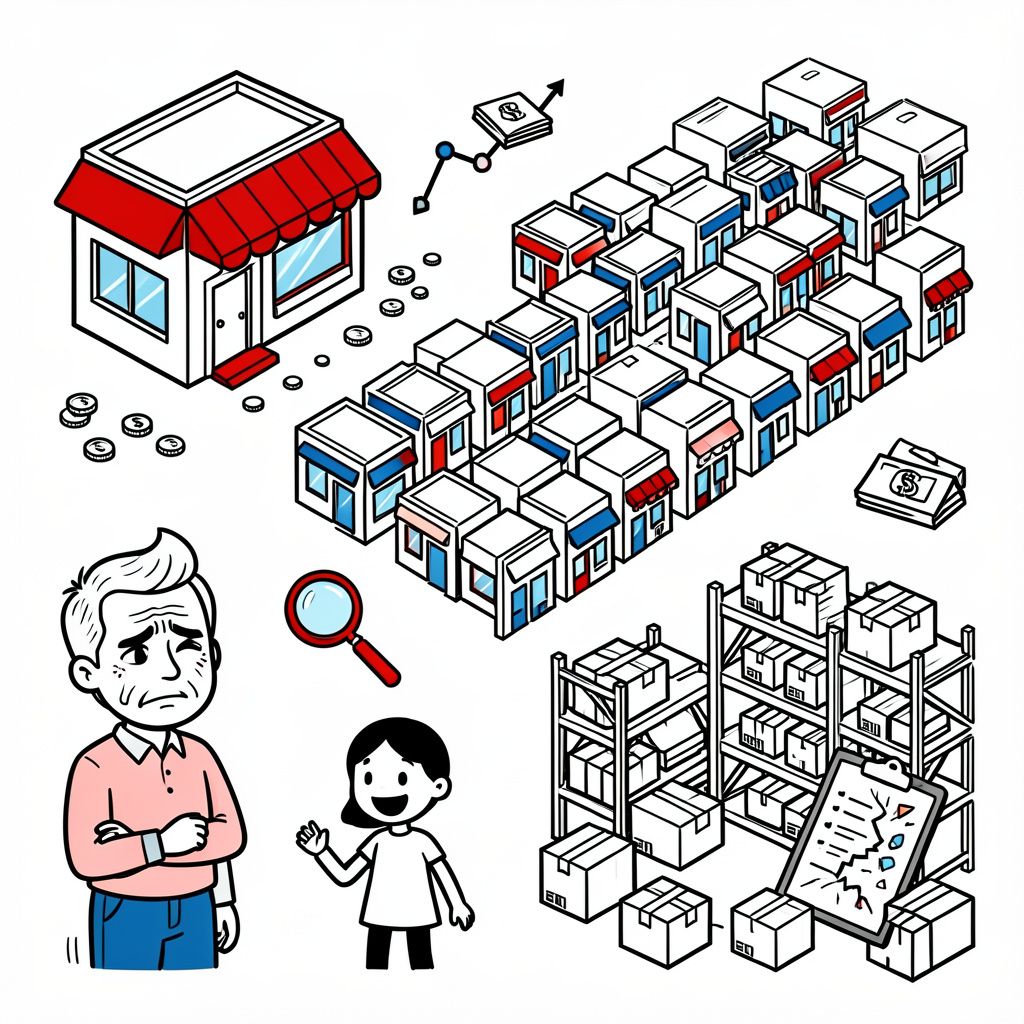
A groundbreaking study reveals a startling trend: most retail chains collapse between their 10th and 30th store opening. The culprit? Governance systems that fail to scale with rapid expansion, leading to catastrophic breakdowns in supply chains, inventory control, and oversight. With global retail losses from mismanagement hitting $1.7 trillion annually, this ‘expansion danger zone’ could be the make-or-break moment for brick-and-mortar survival in an e-commerce-dominated world.
The Retail Expansion Paradox: Growth as a Double-Edged Sword
The retail sector is currently navigating a precarious expansion paradox. While opening new stores represents growth and market penetration, it simultaneously exposes chains to systemic vulnerabilities that often prove fatal. Research by retail consultancy Your Retail Coach (YRC) reveals that most retail chains collapse precisely between their 10th and 30th store opening [1]. This critical window, dubbed the ‘expansion danger zone,’ emerges when governance structures fail to scale in tandem with physical growth, creating operational fault lines that can trigger catastrophic supply chain breakdowns and inventory control failures [1]. The phenomenon is not isolated to specific markets or retail formats - it represents a universal challenge in brick-and-mortar expansion strategies that transcends geographic boundaries and product categories.
The $1.7 Trillion Governance Gap
The financial implications of this governance gap are staggering. Global retail trade losses from inventory mismanagement alone reach approximately $1.7 trillion annually, equivalent to 6.5% of total retail revenues [1]. This figure represents more than just lost sales - it encompasses the compounding effects of out-of-stocks, overstocking, shrinkage, and operational inefficiencies that escalate as chains expand. The National Retail Federation reports that retail inventories average 1.6% annual shrinkage, with this ratio increasing proportionally to chain size [1]. When chains reach the 10-30 store threshold, inventory and supply discipline failures can consume 1.5% or more of total sales, creating a margin erosion that many retailers cannot survive [1]. These statistics underscore why expansion strategies have become the make-or-break factor for brick-and-mortar survival in an era of relentless e-commerce competition.
The Operational Fault Lines: Where Expansion Fails
YRC’s Expansion Control Framework identifies five critical fault lines that emerge during rapid expansion: operational diagnostics, SOP standardization, governance control, inventory discipline, and sales management cadence [1]. Each represents a potential breaking point where growth outpaces governance capacity. The framework reveals that pre-growth audits flag deficiencies in over 60% of core processes before chains open their next location [1]. This failure rate explains why so many retailers stall at the 15-store mark, as noted by YRC Chief Strategy Officer Rupal Agarwal: “Most founders blame the market when a chain stalls at store fifteen. The real failure is governance that never scaled with the store count, and by then it compounds fast” [1]. The compounding effect Agarwal describes manifests in warehouse mismanagement costs that can erode 5-12% of annual margins, according to separate YRC research [2].
Case Study: Tesco’s Lean Transformation
The consequences of operational inefficiencies during expansion are vividly illustrated by Tesco’s experience. The UK supermarket giant faced significant challenges from stock delays and poor inventory management that threatened its expansion strategy [3]. By implementing Lean Six Sigma principles, Tesco achieved measurable improvements across four critical dimensions: reduced stock shortages, improved inventory control, faster replenishment processes, and enhanced customer satisfaction [3]. While the specific financial impact remains undisclosed, similar Lean implementations in retail typically yield 20-40% reductions in inventory holding costs and comparable decreases in stocking errors [4]. These operational improvements directly address the governance gaps that YRC’s framework identifies as the primary cause of retail chain failures during expansion.
The Technology Solution: Unified Inventory Systems
The path to sustainable expansion increasingly runs through technology adoption. Retail management software like LS Central demonstrates how unified inventory systems can transform operational efficiency. When inventory data consolidates into a single platform, retailers achieve 40% fewer stocking errors and 20% lower inventory holding costs while maintaining fuller shelves [4]. These improvements result from automated replenishment and mobile stock-taking capabilities that reduce execution variance across multiple locations. The technology addresses the core challenge identified in YRC’s research: ensuring that the 30th store operates with the same precision as the first store [1]. This operational consistency becomes particularly critical as chains navigate the expansion danger zone between 10 and 30 locations.
The Scale Readiness Scorecard: A Lifeline for Expanding Chains
YRC’s framework introduces a critical tool for navigating the expansion danger zone: the Scale Readiness Scorecard. This diagnostic benchmarks over 15 checkpoints before retailers sign new leases, systematically identifying risk factors that could derail expansion [1]. The scorecard evaluates governance capacity, supply chain resilience, inventory management systems, and operational consistency across existing locations. By implementing this pre-expansion assessment, retailers can address governance gaps before they become fatal. The scorecard represents a proactive approach to the expansion paradox, enabling chains to grow their physical footprint while maintaining the operational integrity that e-commerce competitors cannot replicate. This systematic evaluation becomes particularly crucial as chains approach the 10-30 store threshold where most retail failures occur [1].