How America's National Debt Was Once Its Greatest Strength
Washington, Sunday, 5 July 2026.
While America’s thirty-nine trillion dollar debt now looms as a crisis, Alexander Hamilton originally leveraged Revolutionary War liabilities to establish the nation’s global financial dominance.
The Revolutionary Masterstroke of 1790
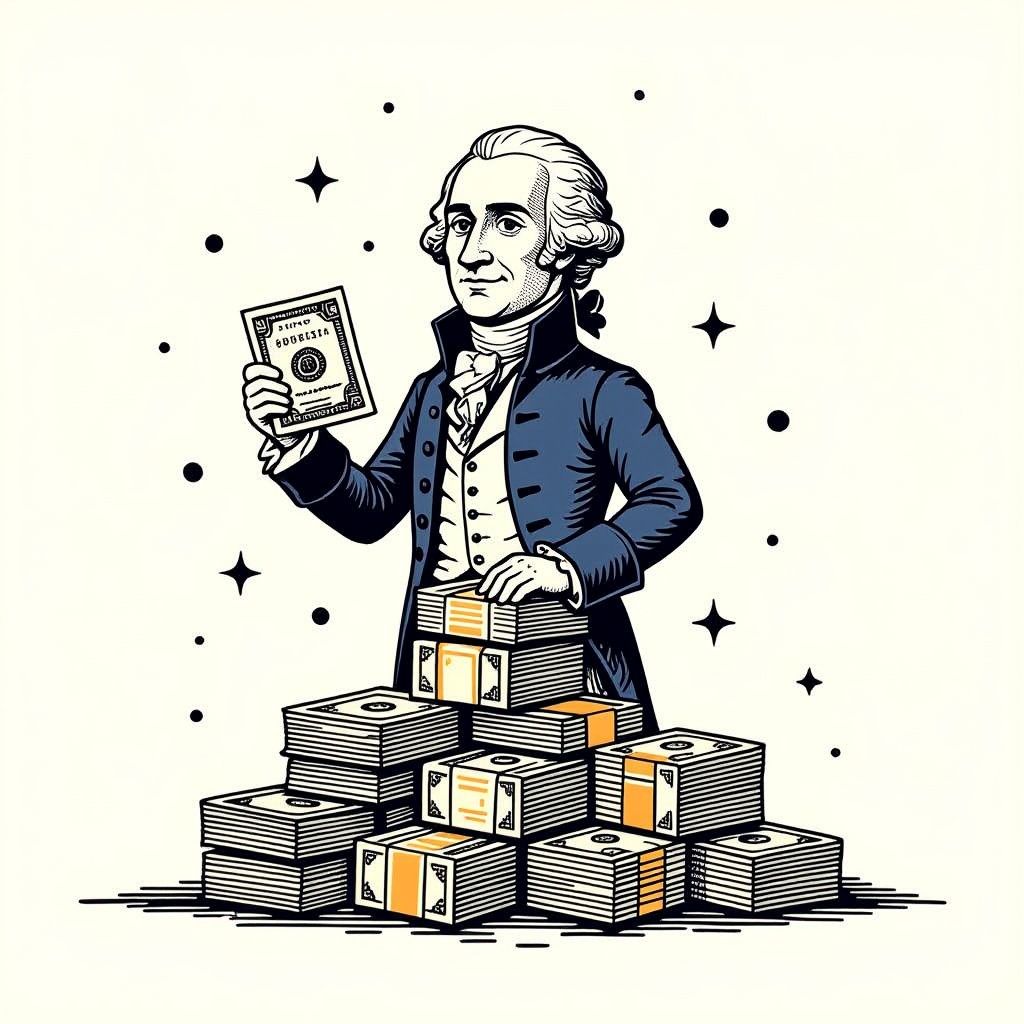
On July 4, 2026, as the United States observed the 250th anniversary of the Declaration of Independence, a historical retrospective cast light on the roots of the nation’s financial architecture [1][3]. In 1790, the country’s first Treasury Secretary, Alexander Hamilton, faced a chaotic financial landscape left in the wake of the Revolutionary War [1][4]. Rather than viewing these outstanding war liabilities as an insurmountable burden, Hamilton consolidated the state and federal debts into a single, unified national debt [1]. This consolidation, which amounted to a national debt of $71 million in 1790, laid the groundwork for U.S. creditworthiness [2][4]. By establishing a reliable system to service this debt, Hamilton transformed a potential liability into a powerful financial tool that eventually funded major national expansions, such as the 1803 Louisiana Purchase [1][4].
The Institutional Pillars of Early American Finance
Hamilton’s insights were forged during his military service in the Revolutionary War, where he observed that British forces held a significant advantage because their military campaigns were far better financed than those of the American revolutionaries [4]. To remedy this structural weakness, Hamilton advised on the development of a national currency, securities markets, and a central bank [4]. In 1791, he established the Bank of the United States in Philadelphia with $10 million in capital, structured with 20% government ownership and 80% private investment [4]. This institution functioned as a vital fiscal agent and a lender of last resort, famously stabilizing bond prices during the nation’s first financial panic in 1792 [4]. Although the bank’s charter expired in 1811 and its successor was later dismantled by President Andrew Jackson in the 1830s, Hamilton’s centralized model set the template for the modern American financial system [4].
The Modern Sovereign Debt Dilemma
Fast forward to July 2026, and the fiscal landscape of the United States has changed dramatically, raising deep concerns about long-term sustainability [1]. The national debt has ballooned from that initial 1790 figure of $71 million to an unprecedented $39 trillion [1][2]. To put this in perspective, the percentage increase of the nominal national debt from its founding era to the present day is a staggering 54.929 million% [2]. Today, publicly held debt is equivalent to 100% of the U.S. gross domestic product (GDP) [1]. More concerningly, the annual federal interest payments required to service this debt have reached $1 trillion, a sum that now exceeds the entire national defense budget [1]. This massive interest burden has intensified debates among policymakers regarding fiscal profligacy, systemic revenue shortages exacerbated by past tax cuts, and the overall stability of the U.S. dollar, which still serves as the primary global reserve currency [1].
The Solvency Threshold and Future Risks
The structural risks associated with this debt trajectory were highlighted in a study released on June 2, 2026, by the Penn Wharton Budget Model (PWBM) [1]. The PWBM analysis established that the sustainable federal debt threshold stands at 210% of GDP, warning that exceeding this outer bound makes a default on U.S. Treasury debt or entitlement transfers nearly certain [1]. While the Congressional Budget Office projects that the debt-to-GDP ratio will rise to 175% by 2056, PWBM warns that the critical 210% limit could be reached in 19 to 25 years [1]. Furthermore, under historical healthcare cost growth rates, PWBM experts estimate there is a 25% probability of hitting this debt maximum within the next 14 years [1]. These warnings have amplified public anxieties, with critics on the eve of the nation’s 250th anniversary arguing that decades of deregulation, corporate tax cuts, and government bailouts have distorted Hamilton’s original vision, shifting the U.S. from a public-interest republic into a system where corporate profit motives supersede public welfare [3].