Rising Impeachment Polls Introduce New Market Uncertainty
Washington, Sunday, 26 April 2026.
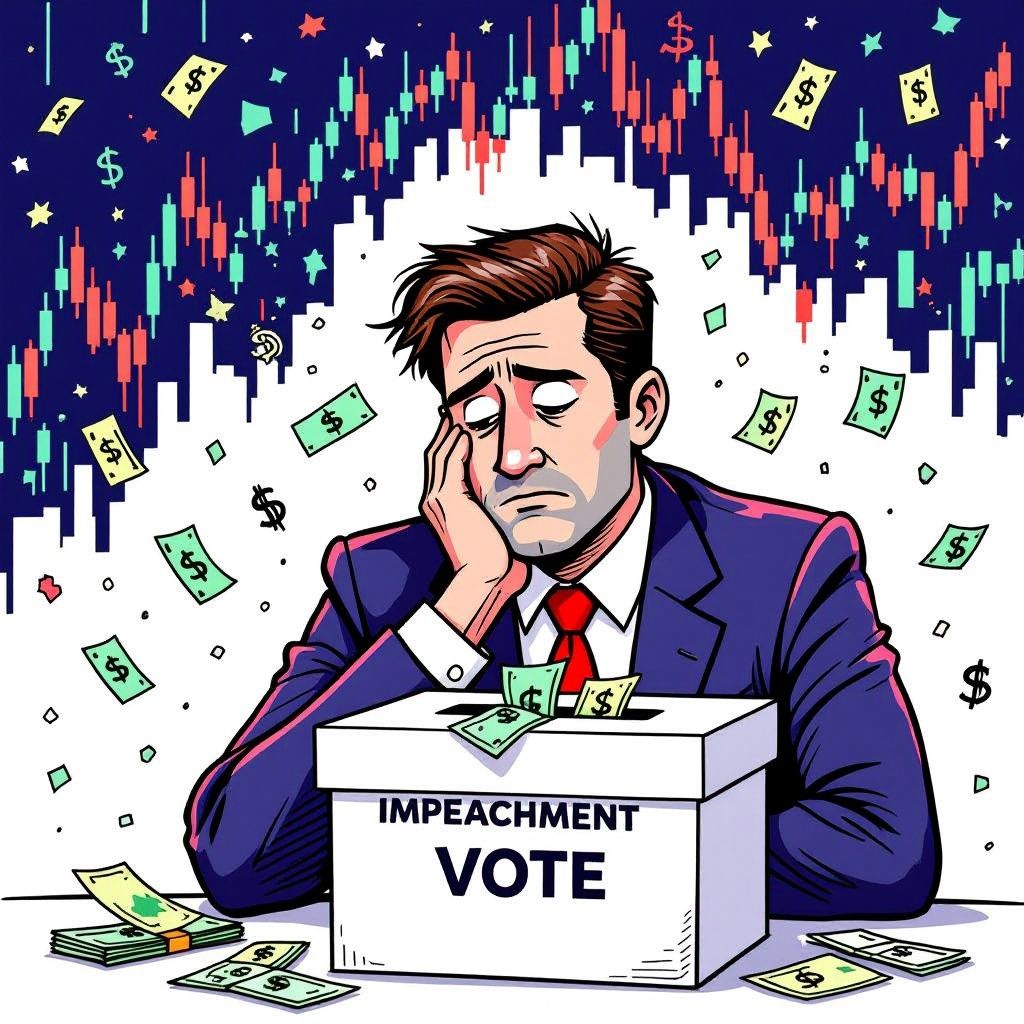
April 2026 polling shows 55% of voters—including 21% of Republicans—now favor impeachment, threatening to stall legislative agendas and inject fresh volatility into financial markets.
A Shifting Political Landscape
In late April 2026, the political calculus in Washington underwent a measurable shift. A Strength in Numbers/Verasight poll conducted on April 22, 2026, revealed that 55 percent of respondents support the impeachment of President Donald Trump, while 37 percent remain opposed [1]. This yields a net support margin of 18 percentage points. According to pollster G. Elliot Morris, this +18 net verdict places the President’s public standing in the same vicinity as Richard Nixon’s during the apex of the Watergate scandal in August 1974 [1]. These figures corroborate a separate survey conducted earlier in the month, between April 10 and April 14, 2026, which similarly found 55 percent of adults favoring impeachment efforts against 37 percent in opposition [2].
Geopolitical Catalysts and Legislative Gridlock
The origins of this political instability can be traced to significant policy decisions that have rattled both voters and global markets. Chief among these are the ongoing tariff war initiated in 2025 and the military conflict with Iran that the administration launched on February 28, 2026 [1][3]. The Iran conflict, in particular, has catalyzed opposition, prompting several House Democrats to demand the President’s removal via the 25th Amendment [1]. This follows an earlier period of severe legislative friction in December 2025, when numerous House Democrats voted to impeach Trump after he accused Democratic lawmakers of “seditious behavior” punishable by death [2].
Market Sentiment Versus Constitutional Mechanisms
The escalating political drama has triggered a surge of speculative trading in prediction markets. As of April 24, 2026, Polymarket assigned a 65 percent probability to Trump being impeached before the end of his term [2]. Similarly, Kalshi’s prediction markets, updated on April 25, 2026, priced in a 67 percent chance of impeachment before January 1, 2028 [2]. This speculative frenzy has even fueled viral, albeit exaggerated, online claims suggesting a 99.9 percent probability of imminent political removal [5]. However, financial analysts and political experts caution that these markets merely measure aggregated public sentiment and speculative betting, rather than verified institutional realities [5].
Navigating the Economic Fallout
Despite the low probability of a successful removal from office, the persistent threat of impeachment proceedings casts a long shadow over the U.S. economy. For business leaders, a fractured administration navigating historically low approval ratings [2] and internal party dissent [1][3] is significantly less likely to execute cohesive economic policies or deregulation efforts. As control of Congress hangs in the balance ahead of the November 2026 midterms [3], investors must price in the reality that Washington’s focus will remain consumed by political survival rather than fiscal stability.