Tesla and Waymo Warn Congress: Pass Self-Driving Laws or Risk Losing Global Lead to China
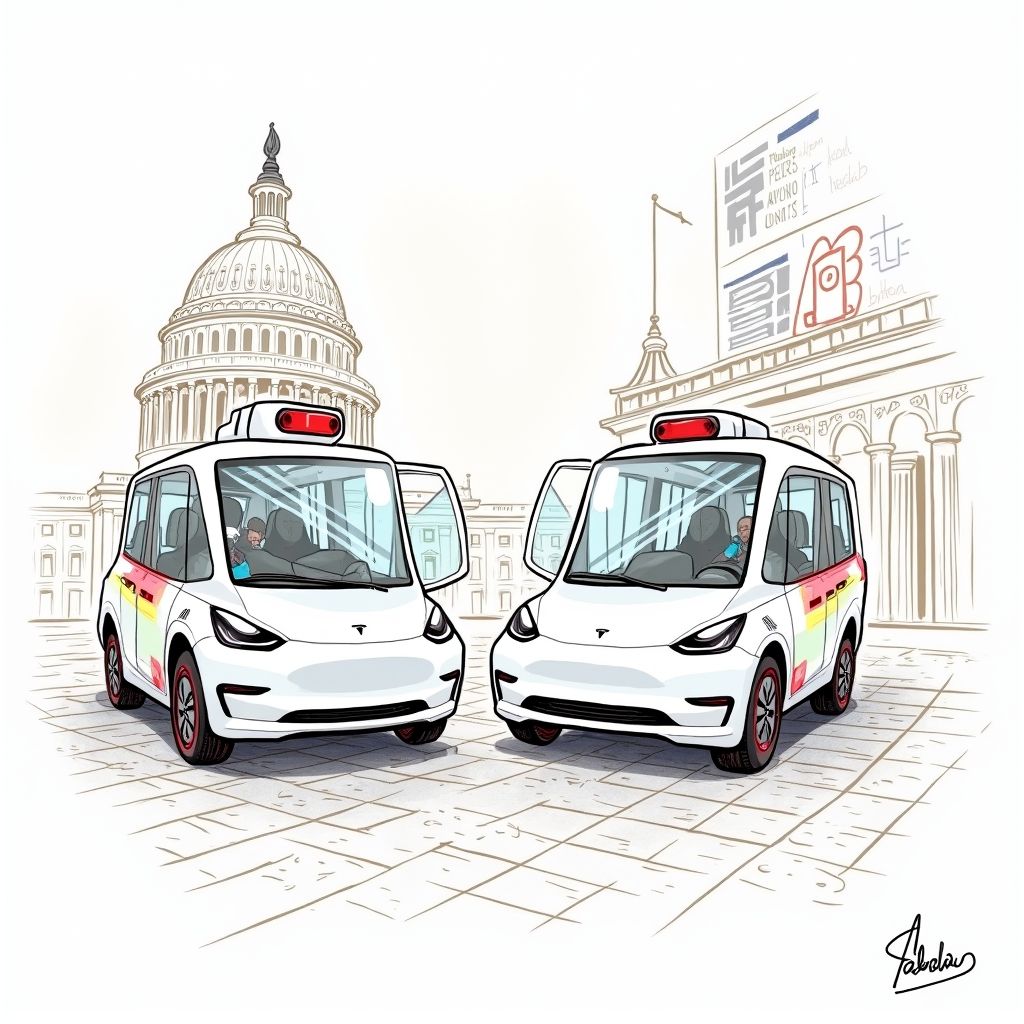
Washington D.C., Wednesday, 4 February 2026.
Executives testify today that delaying federal regulations risks handing the trillion-dollar autonomous vehicle industry to China, which is rapidly scaling technology and setting global standards with heavy state support.
A Rare Corporate Alliance in Washington
In a display of unity driven by geopolitical urgency, executives from fierce rivals Tesla and Waymo are appearing together today, February 4, 2026, before the Senate Commerce Committee [1][3]. The objective is clear: persuade Congress to dismantle the patchwork of state-level regulations that they argue is hampering American innovation. Leading the legislative charge are Committee Chair Senator Ted Cruz (R-Texas) and Senator Gary Peters (D), who emphasize that the current regulatory deadlock is effectively handing the advantage to Chinese competitors [1]. Senator Cruz has framed the issue starkly, warning that failing to modernize these regulations will not stop innovation but merely push it abroad to China, which is already deploying autonomous transportation at scale [1]. This bipartisan push comes as the industry seeks a federal framework to replace the confusing mix of local laws currently governing the deployment of autonomous vehicles (AVs) [3][5].
The Chinese Competitive Threat
The testimony provided by industry leaders today underscores the rapid advancements made by Chinese firms such as Baidu and BYD [2]. Lars Moravy, Tesla’s Vice President of Vehicle Engineering, stated in his written testimony that if the U.S. fails to lead, China will dictate the technology and standards for the 21st-century transportation market [1][2]. This sentiment is echoed by Mauricio Peña, Waymo’s Chief Safety Officer, who describes the situation as a “global race” for a trillion-dollar industry [2]. The competitive pressure is not merely theoretical; Chinese entities are already scaling operations with significant state support, and companies like BYD are reportedly outselling Tesla while offering similar driver-assistance technologies [2][5]. Furthermore, global players like WeRide and Pony.ai are expanding their footprints in Europe and the Middle East, securing permits and partnerships that threaten to encircle the American market [7].
Safety Incidents Complicate the Narrative
While the economic arguments are compelling, the push for deregulation faces significant headwinds due to recent safety incidents involving AV technology. Federal regulators, including the National Highway Traffic Safety Administration (NHTSA) and the National Transportation Safety Board (NTSB), are currently investigating Waymo following a series of troubling events [5][7]. Specifically, regulators are examining a January 27, 2026, incident in Santa Monica, California, where a Waymo vehicle struck a student, as well as reports from late 2025 involving vehicles illegally passing stopped school buses in Austin, Texas [3][5]. Justin Kintz, Waymo’s head of global public policy, defended the technology’s response during the Santa Monica event, noting that the vehicle identified the pedestrian and executed a hard brake, reducing its speed from 7.6 meters per second to under 2.7 meters per second before impact—a deceleration of approximately 64.474% [3][5].
Sources
- www.reuters.com
- sherwood.news
- www.foxbusiness.com
- www.lexology.com
- www.indexbox.io
- sherwood.news
- avmarketstrategist.substack.com
- www.aol.com