Drone Strike Sets Russian Cargo Ship Ablaze Near NATO Waters
Helsinki, Saturday, 21 November 2026.
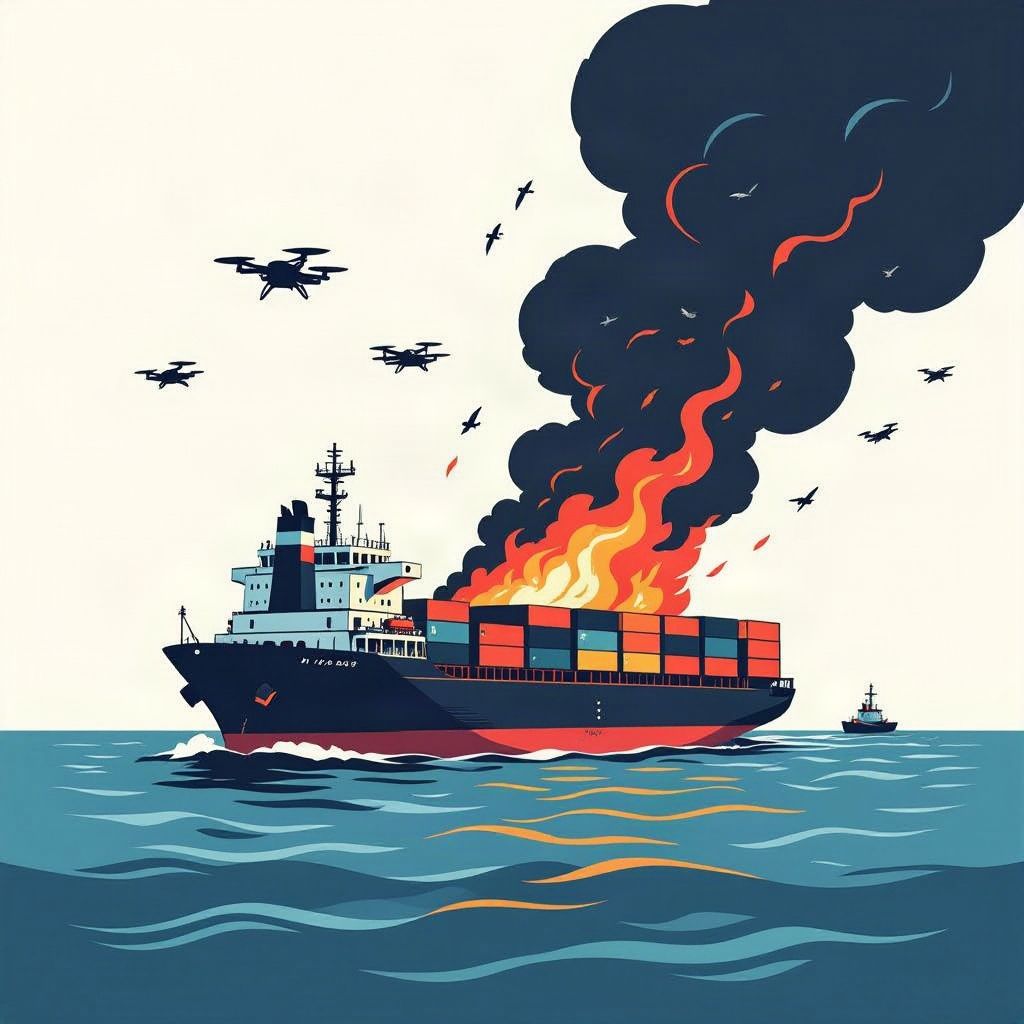
A sanctioned Russian ship caught fire after a drone attack in the Gulf of Finland and drifted into Finnish waters on Saturday, triggering airspace closures and regional security alerts.
Drone Strike Triggers Regional Maritime Crisis
On Saturday, 21 November 2026, a Russian-flagged dry cargo vessel identified as the Sparta II was struck by two drones approximately three nautical miles from Russia’s maritime border in the Gulf of Finland, resulting in a fire that forced the ship to drift into Finnish territorial waters [1][2][3]. Finnish authorities confirmed the attack occurred in international waters west of Gogland Island at approximately 09:35 local time, with the vessel later drifting north into Finnish jurisdiction [2][4]. The incident unfolded as the Sparta II, en route from Saint Petersburg to Kaliningrad, was operating in a critical international shipping lane 11 nautical miles north of Estonia’s Vaindloo Island [3][5].
Escalation in the Baltic: Security Protocols Triggered
The attack prompted immediate responses from regional authorities, with Finland’s Defence Forces detecting the drone strike and imposing temporary sea and air traffic restrictions in the eastern Gulf of Finland as a precautionary measure [2][4]. Finnish Defence Minister Antti Hakkanen stated that the restrictions were imposed to mitigate risks associated with stray drones, though no confirmed threat was identified [2]. Hours after the incident, Finnish authorities reported a suspected Russian helicopter violation of Finnish airspace, penetrating up to 4.1 kilometres into Finnish territory—a development that Finnish Defence Minister Hakkanen linked to possible rescue or surveillance operations following the damage sustained by the cargo ship [2][4]. Meanwhile, NATO was formally notified of the strike, underscoring the geopolitical gravity of the event [2].
The Sparta II: A Ship with a Sanctions-Bound History
The Sparta II is a 121.7-metre, 18.7-metre-wide vessel capable of carrying 7,260 tonnes of cargo, including ro-ro equipment, containers, and military materiel [6]. Launched in 2000, the ship operates at a speed of 15.9 knots (29 kilometres per hour) and has a crew of 16 [6]. Crucially, the vessel is listed under U.S. sanctions and is affiliated with Russia’s Oboronlogistika, a state-controlled entity responsible for transporting military equipment and personnel, including to occupied Crimea [7][8]. Ukrainian military intelligence has previously classified the Sparta II as a vessel involved in arms smuggling, with documented shipments of S-300 air defence systems from Syria to Russia in 2022 [8][9]. The ship was also noted for its role in transporting weapons to Syria during the same period [6].
A Flashpoint in the Baltic: Broader Implications for Trade and Security
The Gulf of Finland, a strategic maritime corridor connecting Saint Petersburg to international waters, has become a flashpoint in the broader conflict between Russia and Ukraine [2][5]. The Baltic Sea, already a theatre of hybrid warfare, has seen increased tensions since Russia’s 2022 invasion of Ukraine, with Western nations accusing Moscow of destabilising regional trade routes [2][5]. Finland’s Prime Minister Petteri Orpo framed the incident as evidence that the war is ‘spilling over’ into the Nordic region, while emphasizing Ukraine’s right to defend itself against aggression [4][5]. The Sparta II’s drift into Finnish waters, combined with the imposition of airspace and maritime restrictions, highlights the precarious balance between maintaining trade security and managing escalating geopolitical risks in one of the world’s busiest shipping lanes [2][3].
Environmental and Operational Fallout
Despite the fire aboard the Sparta II, authorities have reported no immediate environmental hazards or threats to other vessels in the area [2][3]. Finnish Border Guard Commander Ilja Iljin noted that while the cargo’s contents remain unconfirmed, there is a possibility of military materiel aboard, which could complicate environmental assessments [2]. The Finnish Border Guard is leading rescue and oil-spill preparation operations, coordinating with Estonian authorities who monitored the incident from its onset [3][5]. Sweden also contributed to regional security by scrambling fighter jets to protect Finnish and NATO airspace in response to the evolving situation [4].
Sources
- www.bloomberg.com
- www.france24.com
- news.err.ee
- yle.fi
- news.err.ee
- www.iltalehti.fi
- www.verkkouutiset.fi
- www.mtvuutiset.fi
- www.is.fi