New Analysis Projects $5.5 Trillion Deficit Spike From Recent Legislative Package
Washington D.C., Tuesday, 27 January 2026.
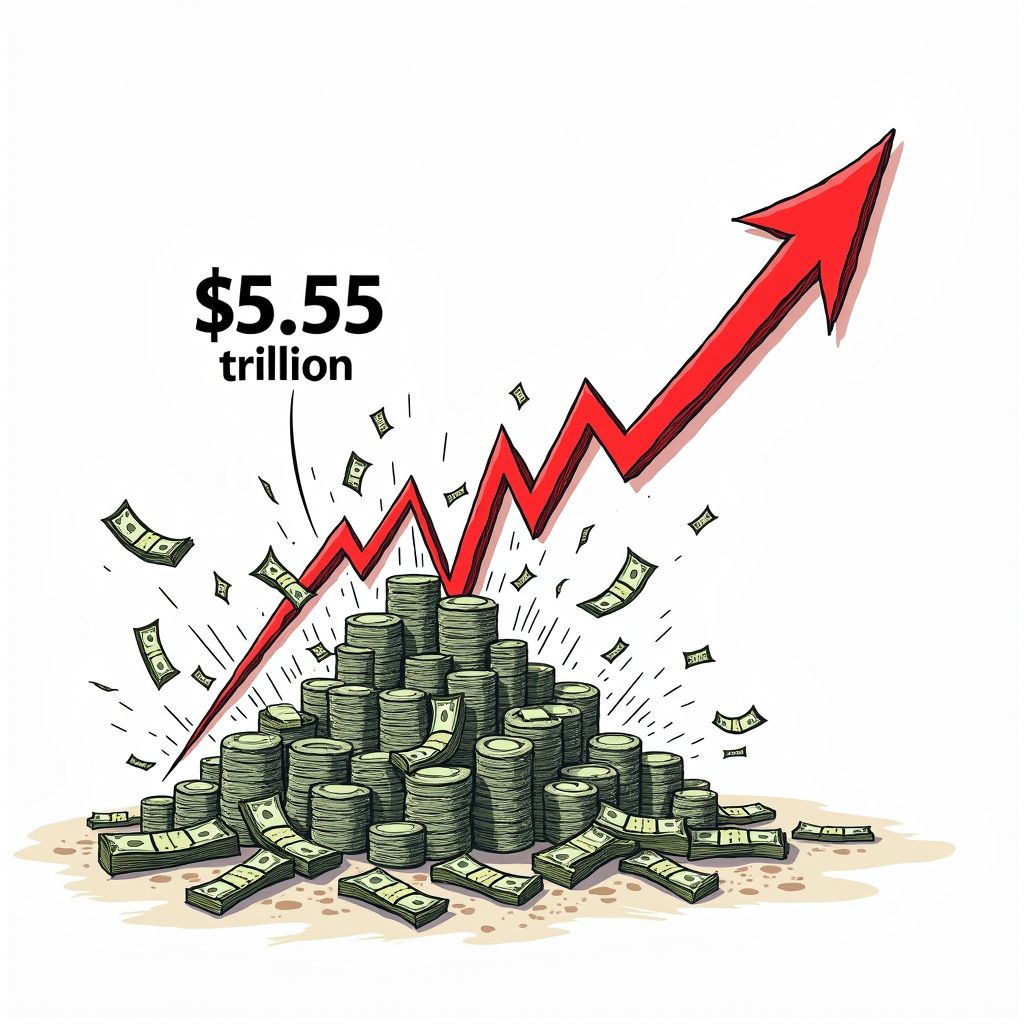
Projections indicate the ‘One Big Beautiful Bill’ could add $5.5 trillion to the deficit, challenging the administration’s strategy to resolve the debt crisis through economic growth alone.
The Growth Gamble vs. Fiscal Reality
As the 2026 tax season officially opened yesterday, January 26 [2], the economic landscape is being redefined by a contentious debate regarding the long-term fiscal impact of the ‘One Big Beautiful Bill’ (OBBB). While President Trump, speaking at the World Economic Forum on January 21, 2026, doubled down on a strategy of ‘growing out’ of debt through deregulation and AI advancements like the $500 billion Stargate data center project [1], new data suggests a more precarious financial future. An alternative scenario analysis by the Committee for a Responsible Federal Budget (CRFB) projects that the OBBB could swell the federal deficit by $5.5 trillion over the next decade if its provisions do not sunset [1].
Analyzing the Debt Trajectory
The administration’s economic doctrine relies heavily on the assumption that these policies will supercharge productivity and GDP, allowing the U.S. to pay down its obligations [1]. However, the arithmetic underpinning this growth strategy faces scrutiny. The CRFB’s model, which adjusts Congressional Budget Office (CBO) forecasts to account for the OBBB’s specific policy changes, predicts that by 2035, the federal debt could double to $59 trillion, representing 134% of GDP [1]. Under this scenario, the government would face a massive annual shortfall, with spending reaching $10.9 trillion against receipts of only $7.4 trillion [1]. This is compounded by current deficit trends; the CBO reported a federal deficit of $439 billion in just the first two months of the 2026 fiscal year [6].
Structural Deficits and Revenue Reductions
The widening fiscal gap is driven primarily by the bill’s aggressive tax incentives and simultaneous reductions in revenue enforcement. The legislation, enacted on July 4, 2025 [5], permanently increased the estate tax lifetime exemption to $15 million per individual as of January 1, 2026 [5], and introduced 100% immediate expensing for business investments in plants, equipment, and software [1][2]. Additionally, the bill raised the State and Local Tax (SALT) deduction cap to $40,000 through 2029 [2]. While these measures are designed to stimulate capital investment, they concurrently reduce the federal revenue baseline. Exacerbating this issue is a reduction in oversight; a fiscal year 2026 appropriations bill currently before Congress proposes slashing the IRS enforcement budget to roughly $4.999 billion [7]. The CBO estimates that a proposed rescission of $11.66 billion in IRS funding will paradoxically lower revenues by $38.6 billion through 2035 due to decreased audit capabilities [7].
Downstream Economic Effects
Beyond the immediate federal revenue loss, the cost of servicing this accumulation of debt is projected to soar, with interest expenses alone expected to exceed $2.5 trillion by 2035 under the CRFB scenario [1]. The fiscal strain is also shifting to the state level due to structural changes in funding. The OBBB’s alteration of the Supplemental Nutrition Assistance Program (SNAP) places new liabilities on states with high error rates. For instance, owing to a 9% error rate in 2024, Ohio could face a payment obligation of $318 million in 2026, threatening the viability of food assistance for 180,000 residents [4]. Ultimately, while the U.S. has not consistently achieved the 3% real GDP growth rate required to make the administration’s math work since the 1990s [1], the current fiscal trajectory suggests that without such unprecedented growth, the deficit will continue to expand aggressively.
Sources
- fortune.com
- www.nahb.org
- www.historicfinancialnews.com
- ohiocapitaljournal.com
- www.gma-cpa.com
- www.historicfinancialnews.com
- tax.thomsonreuters.com