Swiss Railway Solar Breakthrough: A Game-Changer for Global Clean Energy?
Bern, Tuesday, 23 June 2026.
Switzerland’s removable solar panels, installed between railway tracks, have generated over 16,000 kWh—enough to power 3-4 households annually—while proving safe under 11,000 passing trains. This world-first innovation could unlock 1 billion kWh yearly from Switzerland’s rail network alone, sparking global interest from France, Italy, and South Korea. Could this be the scalable solution to turn transport infrastructure into clean energy powerhouses?
The Swiss Innovation: Removable Solar Panels Between Railway Tracks
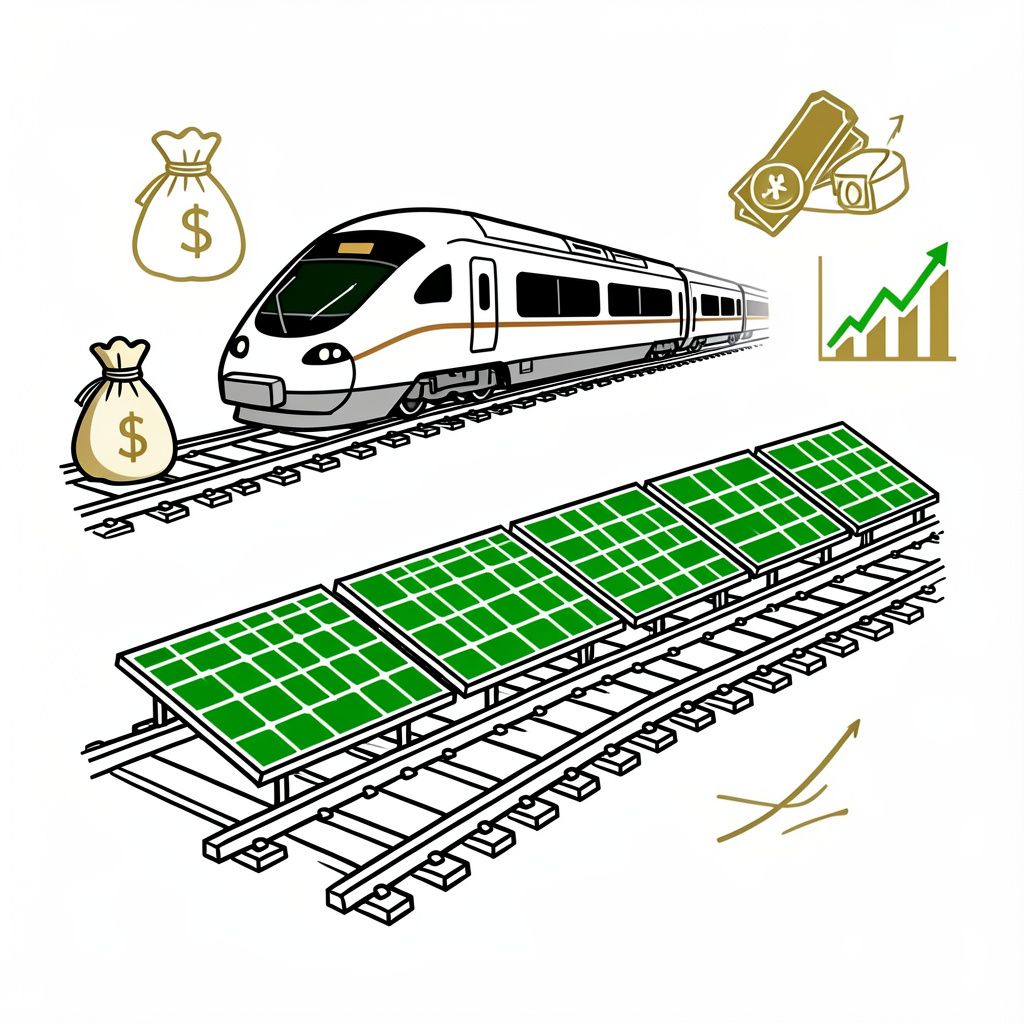
On 24 April 2025, Switzerland inaugurated the world’s first removable solar power plant installed between railway tracks in Buttes, canton Neuchâtel. The 100-metre stretch of solar panels, placed directly on railway sleepers, has since generated over 16,000 kWh of electricity—enough to power 3-4 Swiss households for an entire year [1]. This output was achieved despite a one-month operational shutdown due to snow and integration works, demonstrating the system’s resilience in real-world conditions [1]. The panels are designed to be fully removable, allowing railway maintenance crews to detach 6-metre modules (each containing three panels) from the tracks and disconnect them from the grid in approximately 10 minutes [1]. This feature addresses a critical challenge in railway infrastructure: the need for frequent maintenance without disrupting energy generation.
Safety and Stability Under Heavy Railway Traffic
The Swiss pilot project has already withstood the passage of more than 11,000 trains, with speeds reaching up to 90 km/h [1]. Joseph Scuderi, founder of Sun-Ways—the Swiss start-up behind the technology—confirmed that the installation has proven “perfectly stable and safe during their passage” [1]. This safety record is particularly significant given that railway tracks experience constant mechanical stress, vibration, and exposure to the elements. The airflow generated by passing trains has an added benefit: it helps keep the solar panels clean, reducing maintenance costs and improving efficiency [1]. TransN, the public transport operator for canton Neuchâtel, has reported no conflicts with infrastructure, maintenance routines, or train traffic, and no glare issues have been observed by staff [1].
Scaling Up: Switzerland’s Rail Network as a Clean Energy Powerhouse
Switzerland’s railway network spans 5,320 km, excluding tunnels and poorly sunlit sections [1]. Sun-Ways estimates that if the entire viable network were equipped with its removable solar panels, it could generate up to 1 billion kWh of electricity annually—approximately 2% of Switzerland’s total electricity consumption [1]. To put this into perspective, 1 billion kWh is enough to power roughly 300,000 Swiss households for a year, based on the country’s average household consumption of 303030.303 kWh per year [GPT][1]. This potential output aligns with Switzerland’s broader energy strategy, which aims to phase out nuclear power and increase reliance on renewables. The scalability of the technology is further underscored by its modular design, which allows for incremental deployment without requiring large-scale infrastructure overhauls.
Global Interest: France, Italy, and South Korea Move Toward Adoption
The success of Switzerland’s pilot project has attracted international attention, with several countries exploring similar deployments. In France, the national railway company SNCF signed a technical cooperation agreement with Sun-Ways in February 2026, aiming to cover 20% of its energy consumption with photovoltaics by 2030 [1]. Joseph Scuderi revealed that Sun-Ways is also in discussions with Italian authorities to organise a pilot project by the end of 2026 [1]. Meanwhile, South Korea has taken a more decisive step: its Korea Railway Solar Power Generation Project was approved in September 2025, with a two-year pilot phase underway at Osong station in Chungcheongbuk-do province [1]. If successful, this could pave the way for nationwide expansion, leveraging South Korea’s extensive high-speed rail network.
Railway-Integrated Solar: A Global Trend in Renewable Energy
Switzerland’s innovation is part of a broader global shift toward integrating solar power into existing infrastructure, a concept known as rail/road-integrated photovoltaics (RIPV). Unlike traditional solar farms, which require large tracts of land, RIPV systems utilise underutilised spaces such as railway tracks, highway dividers, and noise barriers [5]. The Netherlands has already demonstrated the viability of this approach with a solar noise barrier on the A50 motorway, which generates enough electricity to power 40-60 households annually [5]. Italy has deployed photovoltaic guardrails along highways, while Lithuania has installed solar panels on railway noise barriers, producing approximately 14 MWh per year [5]. These examples highlight the versatility of RIPV systems, which can be adapted to diverse geographical and infrastructural contexts.
India’s Ambitious Plans: From Metro Viaducts to National Highways
India, with its vast railway network of 99,000 km and over 140,000 km of national highways, is emerging as a key player in the RIPV space [5]. The country has set an ambitious target for Indian Railways to achieve net-zero carbon emissions by 2030, with a planned renewable energy capacity of approximately 30 GW [5]. To meet this goal, India is piloting several innovative projects. The Delhi Metro has installed a 50 kWp vertical solar plant using bifacial panels on the Okhla Vihar viaduct, marking India’s first foray into space-efficient solar installations [5]. Bifacial panels, which generate electricity from both their front and rear surfaces, are particularly suited to vertical or space-constrained installations [5]. Additionally, “solar-on-track” pilots are underway for Namo Bharat (India’s Regional Rapid Transit System) and Banaras Locomotive Works, while solar panels are planned for the Delhi-Dehradun Expressway [5]. The National Highways Authority of India (NHAI) has also partnered with the Solar Energy Corporation of India to deploy solar installations along national highways, further expanding the scope of RIPV in the country [5].
Challenges and Future Outlook
Despite its promise, the widespread adoption of railway-integrated solar power faces several challenges. Durability is a key concern, as solar panels installed on or near railway tracks must withstand constant vibration, mechanical stress, and exposure to harsh weather conditions [alert! ‘Long-term durability data for railway-integrated solar panels is limited, as the Swiss pilot is the first of its kind’]. Additionally, the efficiency of solar panels can be affected by factors such as dust accumulation, shading from trains, and the angle of installation [GPT]. In Switzerland, the panels are installed flat between the tracks, which may not be optimal for solar irradiance but is necessary to avoid interference with train operations [1]. Another challenge is the integration of generated electricity into the grid, particularly in regions with outdated or unstable power infrastructure [alert! ‘Grid integration challenges vary by country and are not yet fully addressed in pilot projects’].
A Scalable Model for the Future?
The success of Switzerland’s removable solar panels has positioned railway-integrated photovoltaics as a scalable solution for countries seeking to decarbonise their transport sectors while boosting renewable energy capacity. Joseph Scuderi’s assertion that the project has “achieved its objectives, both in terms of railway safety and electricity production,” underscores the technology’s potential [1]. As France, Italy, South Korea, and India move forward with their own pilots, the coming years will be critical in determining whether this innovation can be replicated at scale. If successful, railway-integrated solar power could transform transport networks from energy consumers into clean energy generators, accelerating the global transition to renewables. With land constraints and climate goals driving innovation, Switzerland’s breakthrough may well be the first chapter in a new era of sustainable infrastructure.