Foreign Steel in the New White House Ballroom Sparks Economic Policy Debate
Washington, Thursday, 9 April 2026.
A $37 million European steel donation for a new White House ballroom contradicts domestic policies, sparking backlash after the donor received favorable tariff adjustments days later.
The Anatomy of a $400 Million Project
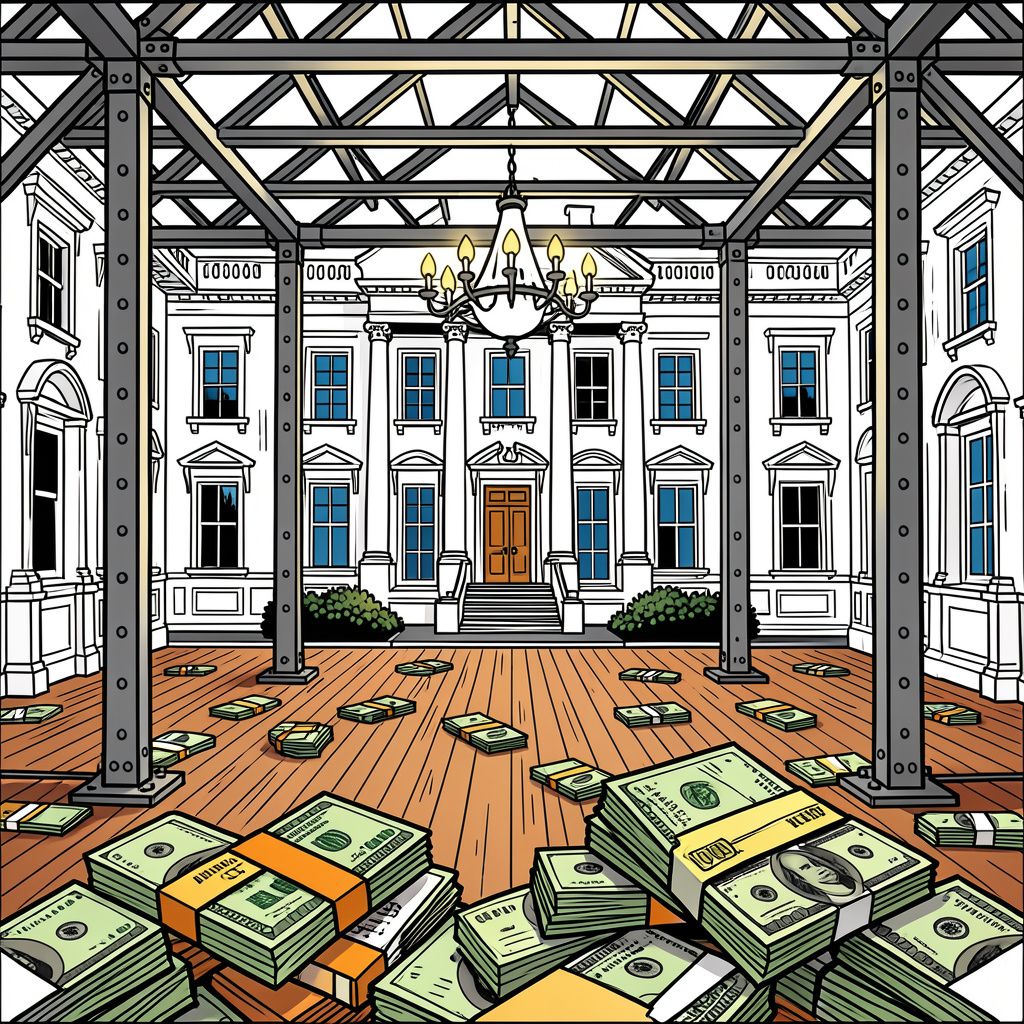
On April 8, 2026, reports surfaced revealing that the steel used in the construction of President Donald Trump’s new White House ballroom was produced in Europe [1][2]. The materials were donated by ArcelorMittal, a Luxembourg-based corporation recognized as the world’s second-largest steelmaker [1][2]. The massive 8,361-square-meter ballroom, which is located in the recently demolished 123-year-old East Wing, has seen its estimated costs double from an initial $200 million to $400 million [1][2]. This represents a staggering cost increase of 100 percent [1][2]. The president reportedly plans to name the completed structure after himself [alert! ‘It is currently unclear if the official naming process has been formalized or approved by relevant historical committees’] [1].
Domestic Mandates vs. Executive Preferences
The use of foreign materials for a high-profile executive project stands in stark contrast to the administration’s vocal “America First” economic platform, which heavily promotes domestic manufacturing [2]. Within the Executive Office of the President, the Office of Management and Budget’s Made in America Office is specifically tasked with establishing standards and managing compliance with domestic content preferences [3]. Despite these institutional mandates, Trump defended the quality of the foreign materials, stating he wanted “great steel as opposed to garbage steel” and asserting that the donor simply wanted to ensure the project utilized high-quality inputs [2].
Tariff Adjustments and Timing Scrutiny
The financial and regulatory timeline surrounding the steel donation has drawn intense scrutiny from trade analysts and political opponents alike [GPT]. In October 2025, President Trump first publicly hinted at a $37 million steel donation for the ballroom project [1][2]. According to the president’s own recounting of the exchange, a contractor informed him of the $37 million value, to which Trump replied, “This is a nice donation, right?” [1]. However, just two days after this October announcement, the White House altered its tariff policies in a move that potentially benefited ArcelorMittal by cutting tariffs in half on automotive steel exports originating from the company’s Canadian plant [1][2].
A Complex Trade Posture
Adding to the complexity of the administration’s trade posture, President Trump implemented further adjustments to existing steel import tariffs just last week, on April 1, 2026 [1]. The juxtaposition of these tariff adjustments against the acceptance of a massive European steel donation raises significant questions about the objective application of protectionist trade measures [GPT]. Critics highlight the irony of a president who has historically championed the revitalization of the domestic steel industry—and who received public thanks in 2020 from ArcelorMittal’s chairman, Lakshmi Mittal, for having “saved the steel industry in the United States”—now relying on European imports for a signature White House addition [1][2].
Political Fallout and Administration Response
The White House has vigorously defended the ballroom project against the growing backlash [1][2]. White House spokesperson Davis Ingle dismissed the criticism entirely, emphasizing that the president is “making the White House beautiful and giving it the glory it deserves at no cost to the taxpayer” [1][2]. Ingle further stated that “everyone should celebrate” the donation, adding that only individuals suffering from a “severe case of Trump Derangement Syndrome” would find fault with the arrangement [1][2]. Neither the White House nor ArcelorMittal immediately responded to further requests for comment regarding the specific logistics of the European steel supply chain [1].
Contrasting Regulatory Environments
The controversy over the steel procurement highlights a broader tension in how the current administration enforces federal contracting and procurement standards [GPT]. For instance, while domestic material preferences appear to have been bypassed for the ballroom, the administration has simultaneously been imposing strict new compliance rules on federal contractors in other areas [GPT]. On March 26, 2026, President Trump signed Executive Order 14398, which mandates that by April 25, 2026, all federal contracts must include strict clauses prohibiting “racially discriminatory DEI activities” [4]. This aggressive enforcement of ideological compliance on federal contractors, juxtaposed with the apparent flexibility granted to a foreign steel conglomerate donating to a presidential vanity project, is likely to fuel ongoing debates about the consistency and true priorities of the administration’s economic and regulatory policies [GPT].