American Leadership in Artificial Intelligence Depends on Taiwan's Computer Chip Industry
Washington, Saturday, 19 September 2026.
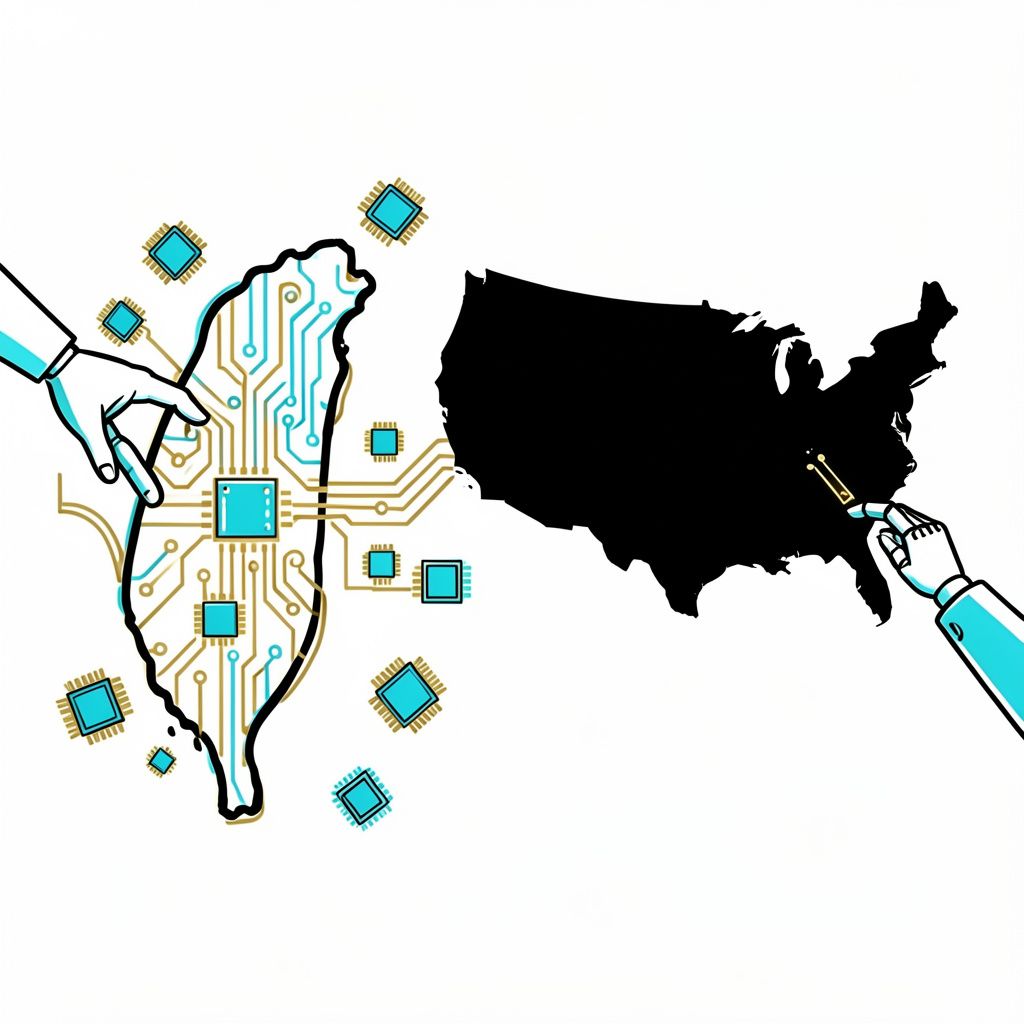
As superpower competition intensifies, American leadership in artificial intelligence relies heavily on Taiwan’s chip supply chain, making the island’s stability a vital economic priority for Washington.
Strategic Dependence on Taiwan’s Semiconductor Ecosystem
As the United States and China intensify their competition for global dominance in artificial intelligence, a new analysis from the Council on Foreign Relations underscores Washington’s heavy reliance on Taiwan’s semiconductor supply chain ecosystem [1]. The study highlights that American leadership in AI technologies remains critically dependent on stability in the Taiwan Strait, urging policymakers to leverage this economic reality to reinforce cross-strait deterrence and protect vital business interests [1][2]. This dependence is not merely theoretical; key dependencies include Nvidia’s “Vera Rubin” platform, which relies on 150 Taiwan-based partners, and AMD’s “Helios” system, which utilizes partners such as Advanced Semiconductor Engineering and Wiwynn [1].
Furthermore, OpenAI’s “Jalapeño” chip is manufactured by TSMC, illustrating the depth of integration between U.S. innovation and Taiwanese production [1]. While President Trump aims for the U.S. to account for 50% of global chip manufacturing by 2029 via TSMC’s Arizona expansion, physical constraints like labor and water shortages threaten the feasibility of this transition before the U.S.-China AI competition reaches a critical stage [1]. Policymakers are encouraged to frame Taiwan’s security as an economic necessity for American businesses and jobs to gain political support, rather than relying solely on arguments regarding democracy or regional stability [1].
Diplomatic Engagements and AI Safety Dialogues
In May 2026, U.S. President Donald J. Trump and Chinese President Xi Jinping held bilateral talks in Beijing, during which they reached an agreement regarding the importance of AI safety measures [1]. President Xi Jinping is scheduled to visit Washington for a reciprocal state visit in September 2026, where AI and the Taiwan Strait issue are expected to be key agenda items [1][3]. Ahead of this summit, the U.S. and China are expected to hold their first official bilateral dialogue on AI in September 2026 as a follow-up to the May 2026 agreement [1].
Treasury Secretary Scott Bessent, leading the U.S. side, stated the U.S. “remains the leader in AI” and is “open to discussions on avoiding shared risks and avoiding bifurcation of our two systems” [3]. However, the two governments approach the problem from different perspectives; in the U.S., the debate focuses on catastrophe models slipping beyond human control, whereas in China, the primary risk is viewed as AI that could “systematically affect the political-security environment” [3]. This divergence suggests that while both sides say they want “guardrails,” a durable AI dialogue remains a tall order because Washington and Beijing do not mean the same thing by “AI safety” [3].
Concentration Risks in Global Chip Production
Taiwan controls over 90% of global advanced-process chip production, making it the focal point of U.S.-China geopolitical competition [4]. The semiconductor supply chain exhibits extreme concentration, with TSMC holding over 90% of worldwide advanced-process capacity for chips 7 nanometers and below [4]. This leaves only 10 percent of advanced production capacity outside the island’s control, highlighting the fragility of the global supply network [4]. The U.S. is investing $52.7 billion through the CHIPS and Science Act to restore domestic semiconductor manufacturing, while the EU aims for 20% of global production capacity via the European Chips Act [4].
Despite these efforts, semiconductor manufacturing requires massive capital investment and a construction timeline of 3 to 5 years, creating high barriers to entry that function as national-level capabilities [4]. Chinese regulators are currently restricting local firms, including Huawei, Alibaba, and ByteDance, from utilizing overseas foundries like TSMC, suggesting a strategic move toward domestic AI self-sufficiency [1]. This concentration means that any conflict in the Taiwan Strait would threaten the future of the American AI industry [1].
Long-Term Strategic Outlook and Workforce Challenges
The semiconductor industry faces a talent crisis, with the Semiconductor Industry Association projecting a shortfall of over 1 million technical workers by 2030 [4]. Taiwan faces structural risks including technology diffusion, talent scarcity, and the geopolitical “bullseye effect” of being caught between U.S., China, and EU interests [4]. Taiwan’s digital minister, Lin Yi-jing, recently highlighted AI cybersecurity concerns during a visit to the U.S., noting that some authoritarian states are using AI to push their narratives on history [5].
To mitigate these risks, the administration is urged to initiate tabletop exercises with Taiwan to simulate disruptions in chip production and create contingency plans [1]. Experts suggest that Taiwan must shift from a defensive “silicon shield” strategy to an “irreplaceable ecosystem” strategy, integrating advanced packaging and IP licensing [4]. Ultimately, the AI race is adding a new dimension to America’s dependence on Taiwan’s chip industry, one Washington should use to its advantage [1].