Global Retail Shifts as Robotic Coffee Kiosks Reach 60 Countries
New York, Thursday, 28 May 2026.
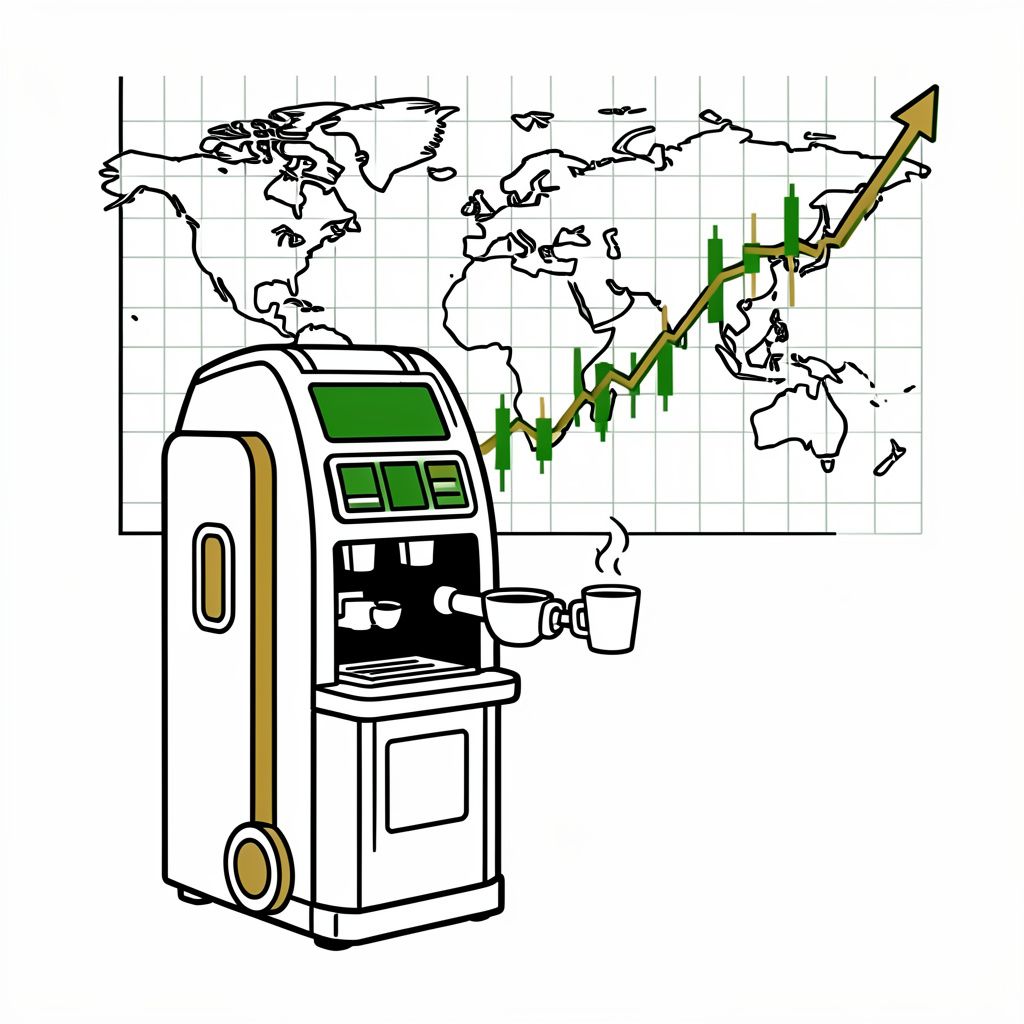
In May 2026, AI-driven robotic coffee kiosks expanded across 60 international markets, signaling a major economic shift toward autonomous retail in a sector projected to reach $45 billion.
The Economics of Autonomous Retail Expansion
As of late May 2026, the unattended retail sector is transitioning rapidly from early-stage experimentation into broad commercial implementation [1]. Industry analysts project that the global smart vending market will surpass $45 billion by 2027, driven heavily by automation, contactless payment infrastructure, and a pressing economic need for lower-labor retail formats [1]. A prime example of this scaling is Shenzhen-based Anno Robot, which has successfully deployed its six-axis robotic arm coffee and beverage systems across more than 60 countries and regions spanning North America, Europe, Asia, the Middle East, and Oceania [1]. These global deployments are increasingly facilitated by modular hardware architectures that standardize maintenance and allow for flexible kiosk relocation based on fluctuating consumer demand and seasonal traffic [1].
Upstream Processing and Global Coffee Demand
This downstream retail expansion is intrinsically linked to upstream processing capacity and global commodity demand [GPT]. In the 2023/24 period, global coffee consumption rose by 2.2% to reach 177 million bags, a surge bolstered by global economic growth exceeding 3% [2]. To support the preservation of aroma, flavor, and shelf life required for automated dispensing, the coffee freeze-drying lines market is experiencing parallel industrial growth [2]. Valued at $1.34 billion in 2025, this specialized food processing equipment market is projected to reach $1.45 billion in 2026—representing a growth rate of 8.209%—and is forecast to hit $2.04 billion by 2030 at a compound annual growth rate of 8.9% [2].
Securing and Sustaining the Unattended Storefront
While the economic incentives for autonomous retail are clear, operators face substantial challenges regarding inventory shrinkage and physical security [GPT]. In 2024, retailers in the United States lost an estimated $45 billion to shoplifting, a staggering figure that has driven intense industry demand for AI-driven security technologies to replace traditional guarding models [3]. In response, property management organizations are increasingly adopting autonomous security systems [3]. On May 27, 2026, Artificial Intelligence Technology Solutions, Inc. announced that a retail property management organization converted a pilot program into a permanent deployment of its ROSA security devices and SARA agentic AI platform [3]. The pilot, initially slated for 30 days, was extended to nearly three months to refine after-hours security operations, such as identifying unauthorized individuals and deploying automated voice deterrence [3].
Expanding into Essential Goods and Transit Hubs
Simultaneously, companies are pushing the boundaries of unattended retail into essential goods and high-traffic transit environments. On May 26, 2026, GrocerIQ Holdings, Inc. announced an initial rollout for AI-driven neighborhood grocery stores in Los Angeles [4]. The pilot phase targets more than five small-format locations, utilizing Vision AI, edge computing, and sensor-driven systems to provide intelligent inventory forecasting and real-time operational monitoring [4]. Transit hubs are also proving to be highly lucrative proving grounds for these technologies [GPT]. On May 25, 2026, VenHub Global, Inc. secured a two-year extension of its partnership with LA Metro to continue operating a 24/7 autonomous Smart Store at the LAX/Metro Transit Center [5]. Institutional investors have recognized this potential; in the first quarter of 2026, 16 institutional investors added VenHub shares to their portfolios, including Alyeska Investment Group, L.P., which acquired 7,700,000 shares for $4,752,440, representing an average price of 0.617 dollars per share [5].
The Data Deficit in AI Commerce
Despite the physical proliferation of autonomous kiosks, connecting consumers to these locations via AI assistants remains a significant technological hurdle [GPT]. Current AI models suffer from severe spatial processing failures, frequently hallucinating or missing physical storefronts entirely [6]. According to SOCi’s 2026 Local Visibility Index, AI assistants currently recommend a mere 1.2% of all local business locations [6]. Furthermore, a Voygr report indicates that 20% of the points of interest recommended by leading large language models do not actually exist, while Netcraft researchers found that these models return broken or illegitimate URLs for major brands 34% of the time [6].
Future Outlook for Automated Convenience
To resolve this disconnect and secure foundational location data for AI commerce, the industry is shifting toward deterministic data architectures [6]. Collaborative initiatives like the Overture Maps Foundation are building open, interoperable map data [6]. Earlier in 2026, BrightQuery joined Overture as a General Member, contributing a government-sourced entity graph encompassing 324 million organizations and 512 million locations across 222 countries [6]. For business leaders, the convergence of accurate geospatial data, robust physical security, and regulatory compliance—such as the ISO 9001:2015, CE, and FCC certifications held by operators like Anno Robot—presents a compelling blueprint for the future of retail [1][6]. With high-traffic events on the horizon, such as the eight FIFA World Cup games scheduled in Los Angeles beginning in June 2026, the unattended retail sector is poised to fundamentally reshape consumer convenience on a global scale [5].
Sources
- www.einpresswire.com
- www.einpresswire.com
- radsecurity.com
- www.eqs-news.com
- www.quiverquant.com
- www.retailtouchpoints.com