Why Military Robots Struggle Where Driverless Cars Succeed
Washington, Monday, 16 November 2026.
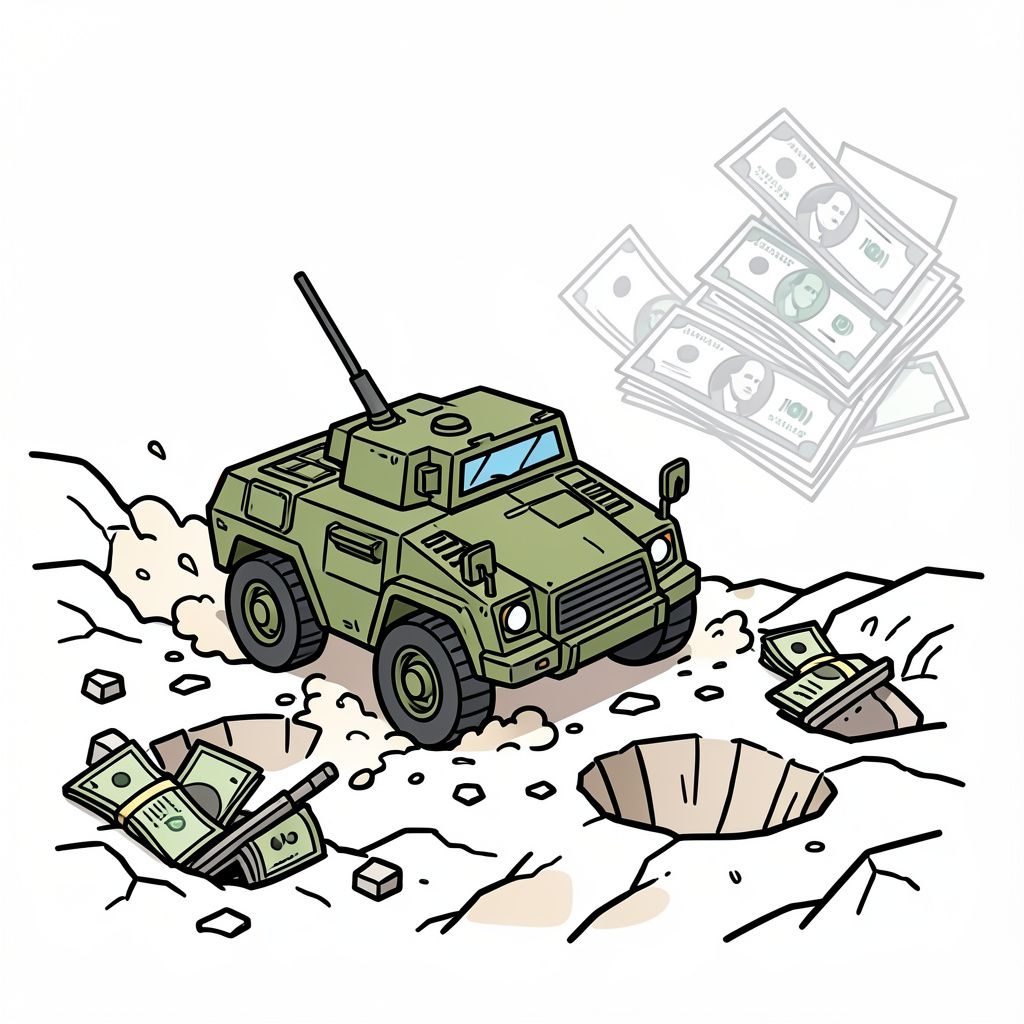
Unlike city streets, chaotic battlefields lack predictable roads, lane markings, and clear rules. This forces defense contractors to rebuild navigation algorithms from scratch, sharply escalating development costs and project timelines.
The Unpredictable Terrain of Modern Battlefields
The fundamental challenge facing autonomous military robots stems from the stark contrast between battlefield conditions and the controlled environments for which civilian autonomous systems are designed. While self-driving cars navigate well-mapped urban roads with clear signage and predictable traffic patterns, military robots must operate in environments where roads may not exist, terrain is constantly shifting due to combat activity, and threats emerge from any direction without warning [1]. As David Roberts, CEO of ARX Robotics’ British arm, explains: ‘Roads are structured… They’ve got rules. Roads are wide enough for cars to drive down. They have markings to tell a vehicle what to do and when to do it’ [1]. This structural predictability is entirely absent on battlefields, where even basic navigation requires entirely new approaches to sensor interpretation and path planning. The Ukrainian conflict has become a proving ground for these limitations, with Ukrainian defense innovators developing autonomous systems under the Brave1 initiative that must navigate communication disruptions while maintaining operational capability [1].
Algorithmic Blind Spots: From Potholes to Combatants
The technical hurdles facing military robotics development extend beyond mere navigation to fundamental questions of environmental perception. Mike McGinty, CEO of Digital Concepts Engineering (DCE), highlights the core problem: ‘True autonomy is an extremely hard problem on cross-country ground. If you see a line on the ground, is it a hole, a log, a burn mark, a shadow, a crocodile, a person?’ [1]. This ambiguity in sensor interpretation creates cascading challenges for autonomous systems that must make split-second decisions about movement, engagement, and evasion. The comparison to self-driving cars reveals the depth of this challenge - where autonomous vehicles might misidentify a plastic bag on a highway, military robots must distinguish between actual combatants and civilians, between safe terrain and minefields, or between friendly forces and adversaries [1]. DCE’s X-series ground robots, procured by the British Army, represent one approach to this problem by using the Marionette kit for remote control, which maintains human oversight in critical decision-making [1].
Ethical and Operational Constraints in Autonomous Warfare
The development timeline for truly autonomous military robots faces additional constraints beyond technical hurdles. While companies like Foundation Robotics have pivoted aggressively toward military applications - including securing Eric Trump’s backing and pursuing Pentagon contracts [4] - experts question whether their technical capabilities match their ambitions. The San Francisco Standard reported on November 15, 2026, that Foundation’s military ambitions ‘may be easier to sell than to deliver,’ citing concerns about misleading claims and unproven technology [4]. This scrutiny extends to broader ethical questions about building ‘potentially autonomous killing machines’ without clear international regulatory frameworks [4]. The U.S. Department of Defense has taken a more measured approach through programs like DARPA’s RACER initiative, which has spent five years developing autonomous navigation systems that can operate without GPS - a critical vulnerability in contested environments [5]. However, even these advanced systems maintain human operator control for final decision-making, as demonstrated in recent Fort Knox trials where robots mapped terrain and detected targets but required human authorization for any action [5].
Real-World Deployments and Their Limitations
Recent real-world deployments underscore both the potential and limitations of current autonomous military systems. In Haiti, footage released by El Salvador’s President Bukele on November 13, 2026, showed quadruped robots patrolling a stadium with mounted firearms, but no confirmed instances of autonomous operation or lethal engagement [6]. The manufacturer, weapon configuration, and control architecture remain undisclosed, highlighting the opacity surrounding these systems [6]. Similarly, while ARX Robotics’ GEREON systems have seen deployment in Ukraine and procurement by the UK, their capabilities appear limited to supervised autonomy rather than fully independent operation [1]. Ukrainian military innovators acknowledge these systems remain ‘in the early stages of development,’ with Oleksandr Yabchanka of the Da Vinci Wolves Battalion noting that ‘The future of both aerial drones and unmanned ground systems lies in the development of autonomy’ [1]. The contrast with commercial autonomous vehicle development is stark: while companies like Tesla and Waymo have spent over a decade refining their systems, military applications must achieve similar reliability in environments where failure costs lives rather than fender-benders.
The Path Forward: Incremental Progress Amidst Fundamental Challenges
Despite these formidable obstacles, defense contractors and research agencies continue to make incremental progress toward more capable autonomous systems. ARX Robotics predicts that battlefield management systems capable of direct vehicle routing may emerge within one to two years (by November 2027-2028), suggesting that near-term advancements may come from improved human-machine teaming rather than true autonomy [1]. DARPA’s RACER program demonstrates that core navigation challenges can be addressed through sensor fusion and terrain mapping, though these systems still require human oversight for mission-critical decisions [5]. The British Army’s procurement of DCE’s X-series robots indicates that even limited autonomous capabilities provide value in reducing risk to personnel [1]. However, the fundamental challenge remains: building systems that can operate reliably in environments where the rules of engagement change by the minute and where the penalty for misidentification is catastrophic. As McGinty observes, ‘The truth is it’s still extremely difficult, but developing autonomous uncrewed ground vehicles for war is a much more daunting task’ [1].
Sources
- www.businessinsider.com
- www.facebook.com
- www.facebook.com
- www.instagram.com
- voennoedelo.com
- www.gadgetreview.com