Poland Breaches EU Debt Limit for the First Time—What It Means for Investors and the Economy
Warsaw, Sunday, 14 June 2026.
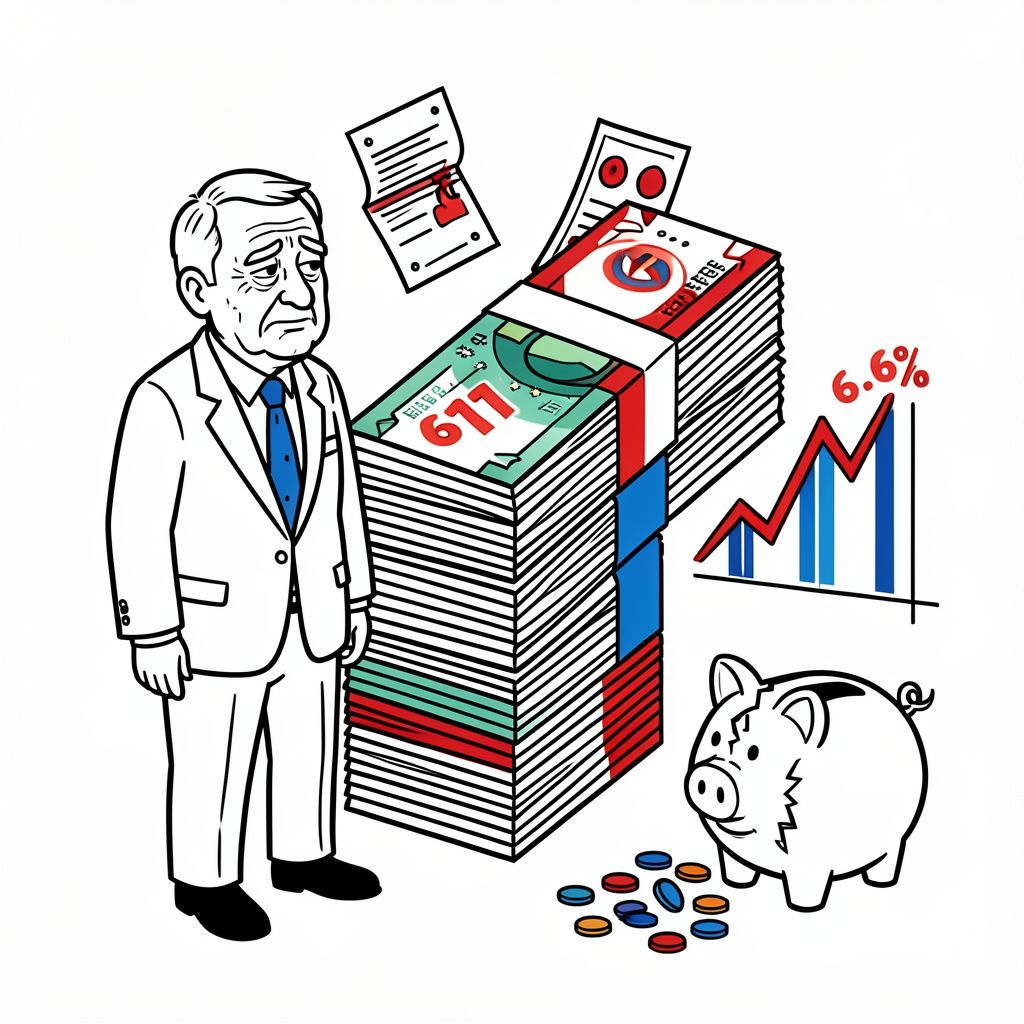
Poland’s public debt has surged past the EU’s 60% of GDP threshold for the first time, hitting 61.6% in Q1 2026—a historic milestone with far-reaching consequences. This breach, driven by a record 7.3% budget deficit in 2025, could trigger stricter EU scrutiny, higher borrowing costs, and pressure for austerity measures. With debt servicing alone costing €25.6 billion in Q1, Poland’s fiscal trajectory risks undermining investor confidence and economic growth. The gap between EU and national debt calculations has also widened to €102.5 billion, complicating policy responses. As Poland navigates post-pandemic recovery and geopolitical tensions, this debt surge raises urgent questions about its long-term financial stability.
The Debt Milestone: Poland Crosses EU’s 60% Threshold
Poland’s public debt reached 61.6% of GDP in Q1 2026 under EU accounting rules, breaching the 60% threshold set by the Maastricht Treaty for the first time in history [2]. This milestone, confirmed by the Ministry of Finance on 4 June 2026, represents a sharp increase from 59.7% in Q4 2025 [2]. The debt surge is quantified at 2.44 trillion zloty (approximately €570 billion), reflecting a quarterly increase of 109 billion zloty (€25.6 billion) [2]. The breach comes despite Poland’s 2024 commitment to reduce its budget deficit below the EU’s 3% limit by 2027 [1]. The gap between EU and national debt methodologies has widened to 436.1 billion zloty (€102.5 billion), equivalent to 11% of GDP, compared to a pre-pandemic gap of approximately 50 billion zloty [2].
Deficit Dynamics: A Fiscal Challenge in Numbers
Poland’s budget deficit hit 7.3% of GDP in 2025, the second-highest in the EU and significantly above the government’s 5.5% target for that year [2]. This represents a rapid acceleration from 3.4% in 2022, 5.2% in 2023, and 6.4% in 2024 [5]. The 2025 deficit amounted to 289 billion zloty (€67.3 billion), underscoring the scale of fiscal imbalance [1]. Interest payments on public debt alone cost 81.7 billion zloty (approximately 2.1% of GDP) over the past 12 months [2]. Economists warn that the deficit trajectory risks structural fiscal imbalance if consolidation measures are delayed [6]. The European Commission launched an excessive deficit procedure against Poland on 26 July 2024, alongside six other EU member states, following the country’s failure to meet the 3% deficit limit [1].
Defence Spending and Economic Growth: A Delicate Balance
Poland’s fiscal challenges are compounded by its record defence budget, projected at 4.7% of GDP in 2025—the highest in NATO [1]. Finance Minister Andrzej Domański acknowledged that delivering high defence spending while implementing fiscal consolidation would be a ‘significant challenge’ [1]. Despite fiscal pressures, Poland’s economy remains one of the fastest-growing in the EU, with the finance ministry projecting strong growth dynamics in 2025 [1]. However, economists caution that prolonged fiscal imbalances could undermine long-term growth prospects [6]. The government’s 2026 budget, signed by President Karol Nawrocki on 19 January 2026, maintains a deficit equivalent to nearly one-third of total spending for the second consecutive year, reflecting the difficulty of reconciling growth ambitions with fiscal responsibility [5].
Policy Responses and Future Projections: Navigating Uncertainty
Poland’s finance ministry projects public debt to reach 75% of GDP by 2029 under current fiscal policies [6]. To address the debt surge, the government has introduced a new bank levy and is exploring tax reforms, though political tensions have hindered progress [5]. The European Commission is expected to assess Poland’s fiscal plan within six weeks of submission, after which it will draft recommendations on the country’s spending path [1]. Economists from the Fundacja Przyjazny Kraj and Institute for Responsible Finance warn that without timely consolidation, Poland risks a prolonged period of fiscal instability [6]. The widening gap between EU and national debt methodologies—now at 11% of GDP—further complicates policy responses, as it limits the government’s flexibility in debt management [2].
Investor Implications: Assessing Risks and Opportunities
For global investors, Poland’s fiscal trajectory presents both risks and opportunities. The breach of EU debt limits could lead to credit rating downgrades, increasing borrowing costs for both the government and corporate sectors [5]. However, Poland’s strong economic growth and strategic geopolitical position may continue to attract foreign direct investment, particularly in defence, energy, and infrastructure [1]. The government’s plan to build a second nuclear power plant, announced on 12 June 2026, signals long-term investment opportunities in the energy sector [6]. Analysts recommend monitoring Poland’s compliance with EU fiscal recommendations, as successful implementation of consolidation measures could restore market confidence and stabilize debt dynamics [2].
Sources
- notesfrompoland.com
- notesfrompoland.com
- next.gazeta.pl
- www.instagram.com
- www.gospodarkamorska.pl
- w8w.pl