Gold Prices Hang in the Balance as Fed Signals Shift
New York, Tuesday, 23 June 2026.
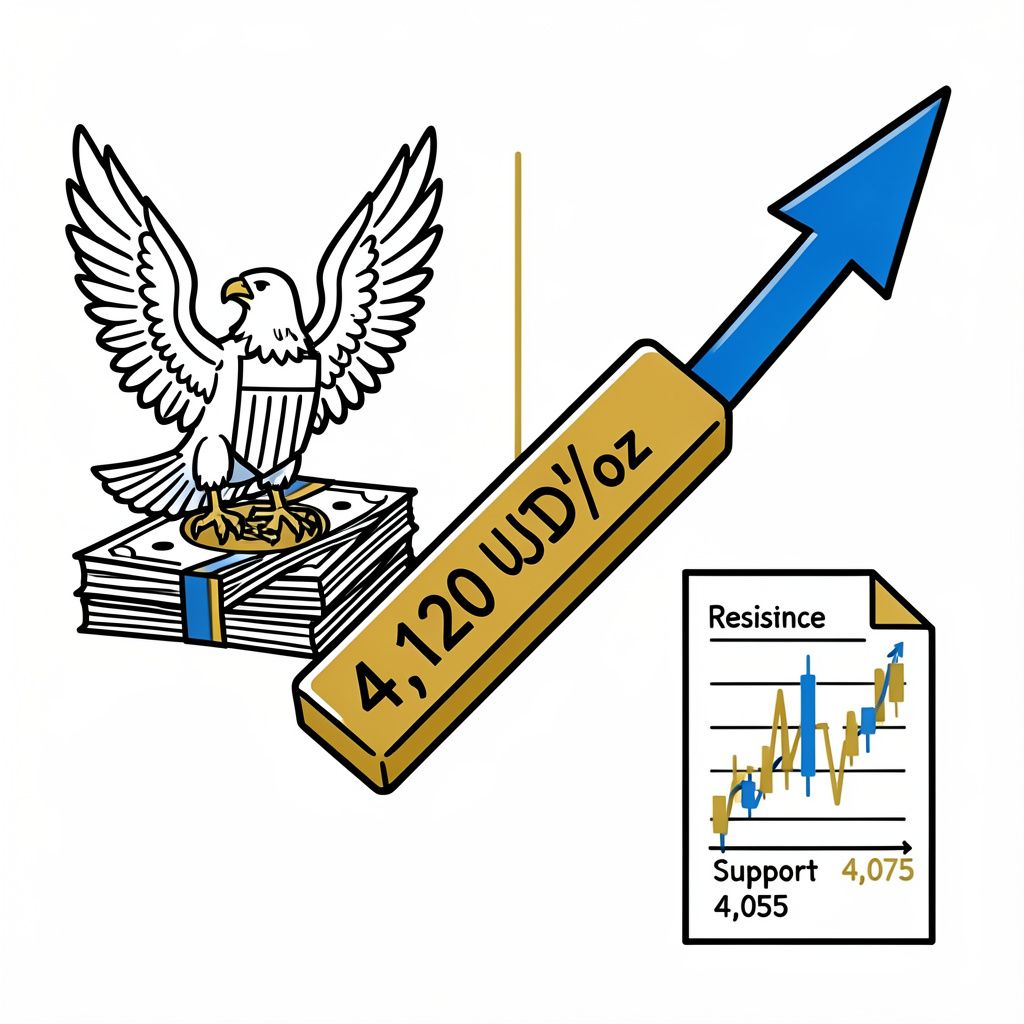
Gold prices are caught between easing Federal Reserve policy and stubborn inflation, swinging near 4,120 USD/oz. The metal’s next move hinges on Thursday’s PCE inflation data—could it break resistance at 4,175 or fall to 4,050?
The Fed’s Policy Pivot and Gold’s Delicate Balance
Gold markets entered a period of heightened volatility following the Federal Reserve’s June 18, 2026 meeting, where policymakers signaled a more restrictive monetary stance while acknowledging persistent inflation concerns [1]. The spot price of gold (XAU/USD) retreated to approximately 4,120 USD/oz by June 23, 2026, after peaking at 4,350 USD/oz in the immediate aftermath of the Fed’s announcement [1]. This 5.287% pullback reflects market repricing rather than a fundamental shift in gold’s demand profile, according to technical analysts [1]. The Federal Open Market Committee (FOMC) maintained its benchmark interest rate at 5.25-5.50%, but revised its dot plot to indicate fewer rate cuts in 2026 than previously anticipated, reinforcing a ‘higher-for-longer’ policy trajectory [1].
Inflation Data: The Catalyst for Gold’s Next Move
The upcoming Personal Consumption Expenditures (PCE) price index release on June 26, 2026, has emerged as the critical catalyst that could determine gold’s short-term trajectory [1]. Core PCE, the Fed’s preferred inflation gauge, is expected to show a year-over-year increase of 2.7% for May 2026, following April’s 2.8% reading [alert! ‘Market expectations based on Bloomberg consensus; official data pending’] [1]. A softer-than-expected print could reignite gold’s rally toward the 4,175-4,200 USD/oz resistance zone, while stronger inflation data might push prices toward the 4,075-4,050 USD/oz support level [1]. The transmission mechanism is well-established: inflation data influences Treasury yields, which in turn affect real yields and the U.S. dollar, creating a ripple effect on gold prices [1].
Technical Indicators and Market Sentiment
Technical analysis reveals a market in compression, with gold prices consolidating near key support levels. The Renko chart structure shows reduced momentum, with the Exponential Commodity Relative Oscillator (ECRO) and stochastic indicators both signaling caution [1]. Current support levels are clustered at 4,125-4,100 USD/oz, with structural support at 4,075-4,050 USD/oz [1]. Resistance zones stand at 4,175, 4,200, and 4,225 USD/oz, with acceptance above 4,175 potentially reopening the path to 4,200-4,225 USD/oz [1]. Market participants are closely monitoring the U.S. Dollar Index (DXY), which has fluctuated between 105.3 and 106.1 during the past week, as dollar strength remains inversely correlated with gold prices [1].
The Growth-Inflation Conundrum
The final U.S. GDP growth figures for Q1 2026, scheduled for release on June 25, 2026, will provide additional context for the Fed’s policy path [1]. The Atlanta Fed’s GDPNow model currently estimates Q2 2026 growth at 2.1%, down from 1.6% in Q1 2026 [5]. This potential reacceleration of economic activity complicates the Fed’s dual mandate, as policymakers must balance inflation concerns against growth considerations. Gold’s performance in this environment will likely depend on whether markets perceive the Fed as prioritizing inflation control over economic growth—a scenario that could either support or undermine the metal’s appeal as a non-yielding asset [1].
Looking Ahead: Key Levels and Scenarios
Market analysts have outlined two primary scenarios for gold’s near-term performance. In the upside case, softer inflation data coupled with weaker-than-expected GDP growth could push gold above 4,175 USD/oz, potentially targeting the 4,200-4,225 USD/oz range [1]. This scenario would likely be accompanied by a pullback in Treasury yields and a softer U.S. dollar. Conversely, stronger inflation or growth data could trigger a test of the 4,100-4,075 USD/oz support zone, with a break below 4,050 USD/oz potentially opening the door to further downside [1]. The CME FedWatch Tool currently shows a 62% probability of a rate cut by the September 2026 FOMC meeting, down from 78% a month earlier, reflecting shifting market expectations [6].
Sources
- www.investing.com
- www.gold.org
- www.reuters.com
- www.blackrock.com
- www.atlantafed.org
- www.cmegroup.com