Why Rising Living Essentials Squeeze American Household Budgets
Washington, Tuesday, 3 November 2026.
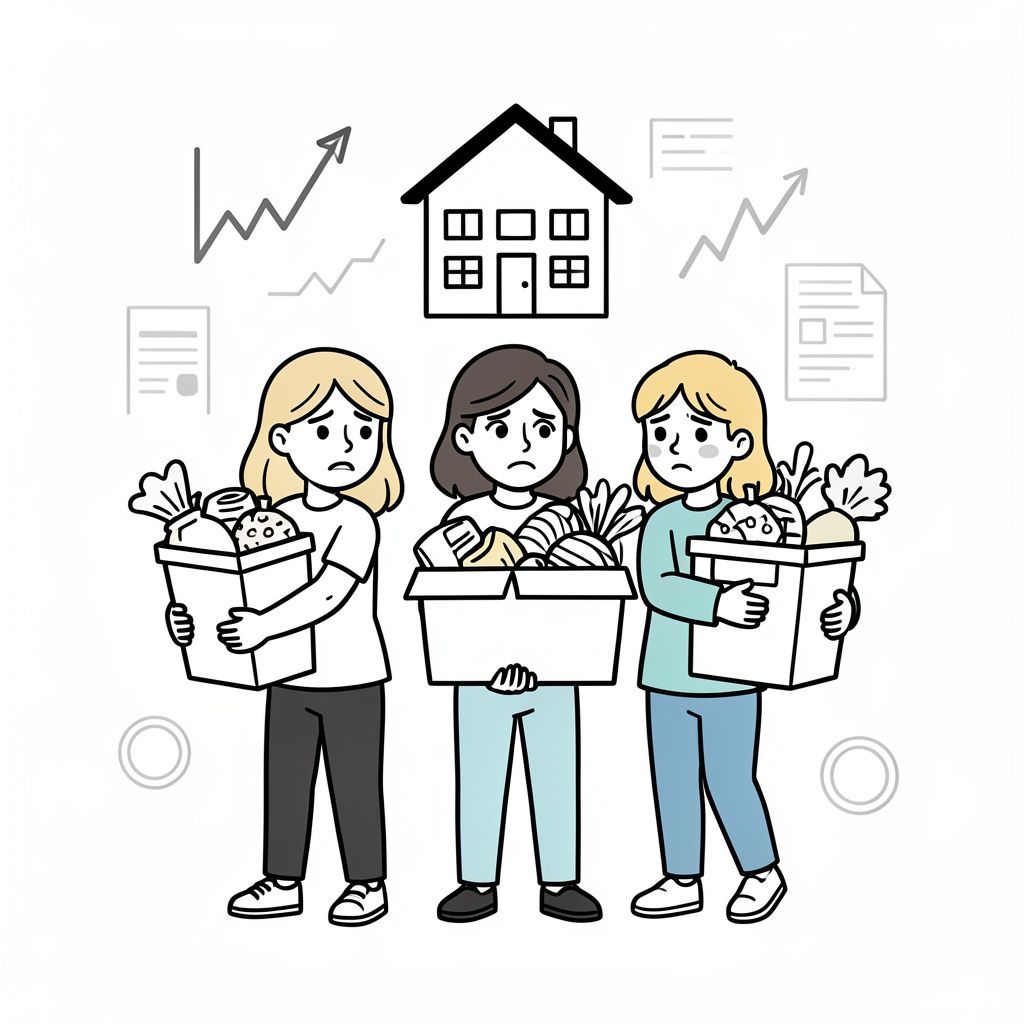
American families now allocate nearly half their spending exclusively to basic food and shelter—a 15-year high that severely limits discretionary buying power and drives consumer sentiment toward historic lows.
The 50% Threshold: A 15-Year High in Essential Spending
As of late 2026, American households are dedicating nearly half of their total budgets to food and housing alone—a level not observed since 2011 [1]. This surge reflects a 3.1-percentage-point increase from 2025, when shelter and food costs absorbed 46.9% of average consumer expenditures according to the U.S. Bureau of Labor Statistics [1]. The acceleration has outpaced broader inflation, which rose only 2.6% in 2025, underscoring how essential living expenses have become the primary driver of household financial strain [1].
Shelter and Food: The Dual Engines of Budget Pressure
Housing costs have climbed 5.8% year-over-year to an average of $27,790 in 2025, driven by an 8% increase in shelter costs, a 10.8% jump in rented dwellings, and a 7.3% rise in owned dwellings [1]. Food expenditures rose 4.6% to $10,633, with meat, poultry, fish, and eggs surging 11.7% [1]. The combined effect is a $1,988 increase in annual spending on these two categories compared to 2024, according to Bloomberg analysis [5].
Disposable Income Erosion and Its Economic Ripple Effects
Average pre-tax income climbed 6.4% to $110,847 in 2025, but average spending rose faster at 4.3%, reaching $81,905 [1]. For households earning under $60,000, the burden is even starker: the lowest income quintile earns $18,125 but spends $37,935 annually, exceeding pre-tax income by 109% [1]. This imbalance has eroded discretionary spending power, with durable goods purchasing conditions plummeting 18% in October 2026 due to higher interest rates and affordability concerns [1].
Consumer Sentiment at Historic Lows Amid Financial Stress
The University of Michigan’s October 2026 consumer sentiment index stood at 48.0, down from 53.6 in October 2025 and marking the second-lowest reading in survey history [1]. The Current Conditions subindex fell to 46.7 in October 2026 from 50.9 the prior month, with Joanne Hsu, director of the Surveys of Consumers, attributing the decline to durable goods affordability concerns [1]. Sentiment is now 10% below 2025 levels and 15% below February 2026, prior to the Iran conflict [1]. The Urban Institute’s October 2026 tracker further revealed that 49% of American families lack the resources to cover essential expenses securely [1].
Macroeconomic Implications: Growth Without Relief
Despite headline GDP growth of 3.4% in Q3 2026—driven by consumer spending, business investment, and government outlays—the underlying data reveals a K-shaped recovery [7][9]. While overall consumer spending rose 0.5% in September 2026, inflation-adjusted purchases were unchanged, with prices increasing 0.5% over the same period [8]. The personal saving rate dropped to 3.8% from 4.0% in August, with total savings at $911.1 billion [8]. Real Personal Consumption Expenditures (PCE) data from the U.S. Bureau of Economic Analysis shows continued reliance on services (69% of spending increases) rather than goods, reflecting constrained purchasing power [2].
The Path Ahead: Policy and Market Headwinds
The convergence of high essential spending, low sentiment, and eroding savings portends challenges for non-essential retail and services in Q4 2026 [1][5]. With 44% of U.S. adults reporting financial hardship in medical care, transportation, housing, or food between July and August 2025, the burden extends beyond immediate necessities [6]. Renters now pay approximately $710 more per month for housing than in 2017, while families with two young children face $6,600 in extra annual childcare costs compared to a decade prior [1]. These structural pressures suggest that without intervention, the squeeze on household budgets will persist, further dampening economic dynamism [GPT].
Sources
- fortune.com
- fred.stlouisfed.org
- www.facebook.com
- www.bloomberg.com
- www.facebook.com
- www.ibtimes.com
- www.facebook.com
- www.facebook.com
- www.instagram.com