Global Trade Tour Secures Seventeen Billion Dollars in New Commercial Deals
Washington, Saturday, 21 November 2026.
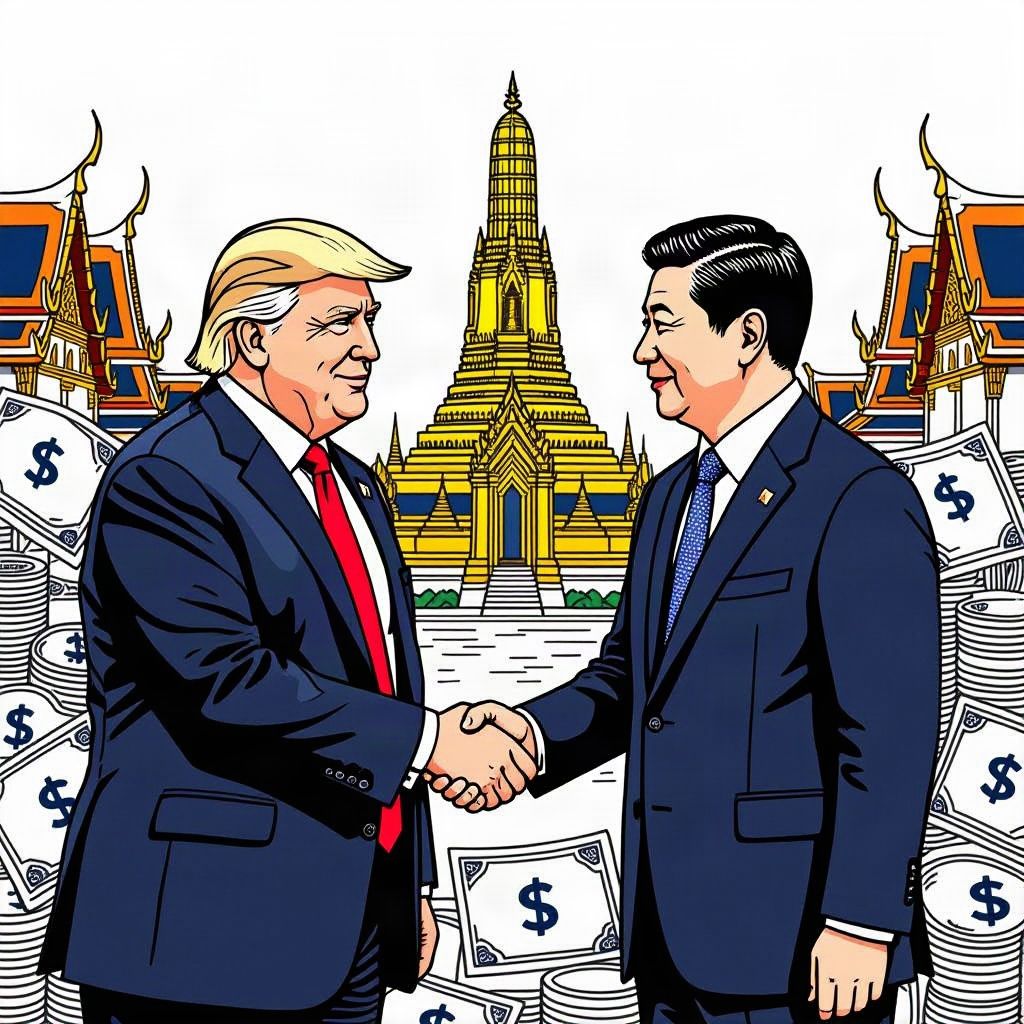
President Trump finalized $17 billion in international agreements, including a tariff-slashing trade pact with Thailand, while a key summit with China concluded without new agricultural commitments.
A Four-Day Asia-Pacific Blitz Secures $17 Billion in New Deals
On November 19, 2026, President Donald J. Trump concluded a four-day diplomatic tour of the Philippines and China, culminating in the announcement of more than $17 billion in new economic and trade commitments aimed at bolstering U.S. industrial capacity and energy security [1]. The White House framed these agreements as core achievements of its domestic economic agenda, emphasizing their role in redirecting capital toward domestic infrastructure and energy projects [1]. The commitments span multiple sectors, including energy infrastructure, agricultural trade, and industrial development, and were finalized during high-level meetings with heads of state from Southeast Asia and East Asia [1]. While the administration described the outcome as transformative, market participants are now scrutinizing the details for enforceability, particularly regarding corporate timelines and regulatory implementation over the coming quarters [1].
Thailand Deal Cuts Tariffs on 99% of U.S. Exports, Pledges $2.6 Billion in New Agricultural Purchases
A landmark trade agreement signed with Thailand eliminates tariffs on 99% of U.S. exports and secures a Thai commitment to purchase an additional $2.6 billion in U.S. agricultural products annually [1][2]. This deal, announced during President Trump’s visit to Manila, marks a significant expansion of U.S. agricultural market access in Southeast Asia and is expected to support farm income and export volumes [2][7]. The accord also aligns with broader U.S. efforts to diversify export markets amid ongoing trade tensions with major partners, including China [3]. While the full scope of the agreement remains under review, trade analysts anticipate immediate benefits for U.S. exporters of processed foods, machinery, and technology [2][GPT].
Alaska LNG Pipeline Gains Asian Financing as U.S. Expands Energy Infrastructure
As part of the diplomatic engagements, the Trump administration announced approval of a liquefied natural gas (LNG) pipeline project in Alaska, with funding commitments secured from South Korea and Taiwan [1]. The project, identified as a key component of U.S. energy security strategy, aims to enhance LNG export capacity and reduce reliance on Middle Eastern and Russian energy supplies [1]. While the financial scale of the Asian investments has not been publicly disclosed, the pipeline’s approval signals a strategic pivot toward Asia-Pacific energy markets and complements broader U.S. efforts to position Alaska as a critical LNG hub [1][GPT]. Energy analysts highlight the geopolitical significance of this development, particularly in light of ongoing supply chain disruptions and regional energy demands [GPT].
China Summit Ends Without Agricultural Breakthrough, Soybean Commitments Remain on Track
The November 19 summit between President Trump and Chinese President Xi Jinping in Shenzhen concluded without new agricultural trade agreements, leaving U.S. soybean growers facing continued uncertainty ahead of the 2027 marketing year [3]. Despite the lack of new commitments, China remains on track to fulfill its existing 2026 soybean purchasing obligations, with commitments totaling 15.95 million metric tons as of October 29, 2026—an increase of 67.75 or approximately 6,767% year-over-year [3]. Weekly USDA data from November 12, 2026, shows China accounting for 37.6% of U.S. soybean exports, with net sales of 581,000 metric tons and shipments of 692,000 metric tons [3]. Analysts caution that the absence of a comprehensive deal could leave the market vulnerable to shifts in Chinese purchasing patterns or retaliatory tariff adjustments [3]. A truce between Washington and Beijing, originally scheduled to expire on January 10, 2027, is now expected to be a focal point of discussions at the upcoming G20 summit in Miami in December 2026 [3].
Quad Leaders Advance Economic Security Initiatives Amid Regional Tensions
On the sidelines of his Asia-Pacific tour, President Trump participated in a Quad Leaders Summit with the presidents of India, Japan, and Australia, where the group announced the establishment of the first-ever Quad Bureau Leaders’ Forum to enhance economic security cooperation [2]. The initiative includes the launch of a Quad Strategic Infrastructure (SI) Accelerator and new plans for maritime security and surveillance operations across the Indo-Pacific [2]. These measures reflect a coordinated response to regional challenges, including China’s growing influence and the proliferation of transnational cybercrime targeting U.S. and allied interests [2][6]. While the Quad’s economic security framework remains in early stages, analysts view the forum as a critical step toward harmonizing trade policies and countering non-tariff barriers in key markets [2][GPT].
Growth Projections and Policy Signals Spark Market Speculation
During a post-tour press conference, President Trump suggested that lowering U.S. interest rates could propel economic growth to a range of 14–15%, citing India’s current low-rate environment and 7% growth rate as a benchmark [2]. While the President did not outline specific policy mechanisms, the comments fueled market speculation about potential shifts in Federal Reserve policy or fiscal stimulus measures [2]. Analysts note that such growth projections would represent a significant acceleration from the U.S. economy’s 2026 growth rate of approximately 2.5%, as estimated by the OECD for the third quarter [2][GPT]. However, the feasibility of such a surge remains contingent on broader macroeconomic conditions, including inflation trends, labor market dynamics, and global trade stability [GPT].
Immediate Market Reactions and Long-Term Implications
Financial markets reacted cautiously to the announcement of new trade deals, with futures and sector-specific indices showing muted gains in energy and industrial equities [alert! ‘specific market data not provided in sources’]. Investors are particularly focused on the enforceability of the Thai trade pact and the timeline for regulatory approvals on the Alaska LNG project [1][2]. In the agricultural sector, soybean futures remained relatively stable, reflecting the absence of new Chinese commitments but also the market’s confidence in existing purchase orders [3]. Over the next six months, market participants will closely monitor implementation milestones, including the ratification of trade agreements, the disbursement of committed funds, and the resolution of outstanding disputes in the U.S.-China trade relationship [1][3]. While the $17 billion in commitments represents a notable short-term boost, the long-term impact will depend on sustained policy coordination and global economic conditions [GPT].
Sources
- www.whitehouse.gov
- tickernews.co
- www.agrolatam.com
- www.youtube.com
- www.facebook.com
- www.facebook.com
- x.com
- www.facebook.com