Eurasia Group Report Flags Canada as Top Casualty of US Political Turmoil in 2026
New York, Sunday, 11 January 2026.
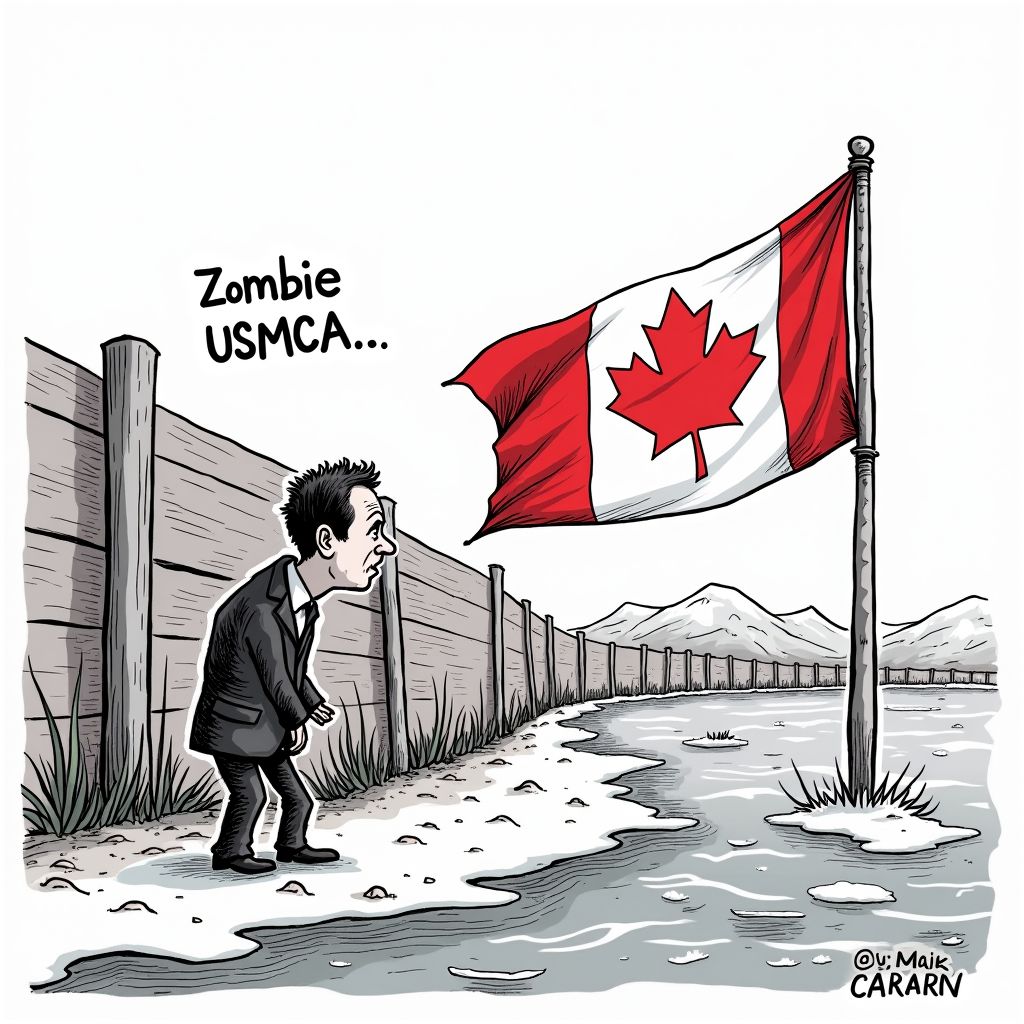
The Eurasia Group’s 2026 risk assessment delivers a sobering verdict: no country is more vulnerable to the United States’ deepening political instability than Canada. The report argues that the era of reliable cross-border partnership is effectively over, replaced by a volatile landscape where Canada’s economic dependency becomes its greatest weakness. Analysts highlight the emergence of a “Zombie USMCA”—a trade deal neither fully functional nor formally dead—as a primary threat to supply chains during its critical review year. Compounding this economic precarity are heightened geopolitical risks, including potential Russian hybrid aggression in the Arctic and the diplomatic tightrope of Prime Minister Mark Carney’s upcoming pivot to Beijing. For investors, the stability of the North American trading bloc appears to be a historic artifact rather than a current reality.
The “Zombie USMCA” and Trade Paralysis
At the heart of Canada’s vulnerability lies the deteriorating state of the United States-Mexico-Canada Agreement (USMCA), which the Eurasia Group has ominously dubbed a “Zombie USMCA.” [1][5] As the agreement heads for its scheduled review in 2026, analysts predict it will stagger forward in a state of suspended animation—neither fully functional nor officially terminated. [6] This uncertainty is expected to chill investment and disrupt supply chains, as the pact is kept on “life support” merely to preserve tariff exemptions for compliant goods. [1] However, the report indicates that President Donald Trump intends to utilize sectoral tariffs as leverage to fracture the diplomatic alignment between Ottawa and Mexico City, effectively isolating Canada. [1] This strategy follows a breakdown in trade talks after the Ontario government, led by Premier Doug Ford, released an anti-tariff advertisement in the U.S., prompting Washington to cease negotiations. [1]
Sovereignty Under Siege
Beyond economics, the political risk assessment points to a fundamental threat to Canadian sovereignty. Former foreign affairs minister Lloyd Axworthy, citing the report, observed that the current U.S. administration operates under the belief that they are the “masters of the Western Hemisphere.” [6] This sentiment has manifested in extreme rhetoric, with reports surfacing of threats by President Trump to reduce Canada to the status of a U.S. state. [3] The Eurasia Group identifies a potential “political revolution” within the U.S., driven by efforts to dismantle checks on executive power, as a primary driver of this instability. [1][6] This internal American turmoil is predicted to reshape Canada’s engagement with the world, forcing Prime Minister Mark Carney’s government into a perpetual defensive posture to protect national independence. [1]
The Arctic Front and Global Headwinds
The geopolitical pressure on Canada is further compounded by escalating tensions in the Arctic. As melting ice reveals new shipping routes and mineral deposits, the region has become a flashpoint for competition between major powers. [6] Axworthy warns that the U.S. administration aims to establish a “chokehold” on the Arctic—Canada’s “backyard”—threatening Ottawa’s control over its northern territories. [6] Simultaneously, the Eurasia Group warns of Russian “hybrid attacks” on Canadian Forces, creating a scenario where Canada could be drawn into a broader NATO-Russia crisis in 2026. [1][4] These security threats arise at a moment when Canada’s traditional European allies—the U.K., France, and Germany—are facing their own crises of paralysis and destabilization, leaving Ottawa with fewer reliable partners on the global stage. [1][4]
A High-Stakes Pivot to Beijing
Faced with “powerful headwinds” in diversifying trade away from the U.S., Prime Minister Carney is preparing for a significant diplomatic gamble. [3] He is scheduled to meet with President Xi Jinping in Beijing next week, marking the first official visit to China by a Canadian prime minister in over eight years. [1] This pivot is fraught with complexity; bilateral relations have been strained since the 2018 arrest of a Chinese telecom executive and subsequent retaliatory measures, including China’s tariffs on Canadian agricultural products like canola and peas. [4] Furthermore, Canada recently imposed a 100% tariff on Chinese electric vehicles, aligning with U.S. interests—a stance that may complicate these new diplomatic overtures. [4] Notably, the Eurasia Group’s insights into the Carney administration may be particularly acute given the close ties between the firm and the government; the Prime Minister’s wife, Diana Fox Carney, is affiliated with the group, and key political figures like Gerald Butts and Evan Solomon have past links to the consultancy. [4]