Global Fuel Prices Surge as Ukrainian Drone Strikes Disrupt Russian Refineries
Washington, Thursday, 22 October 2026.
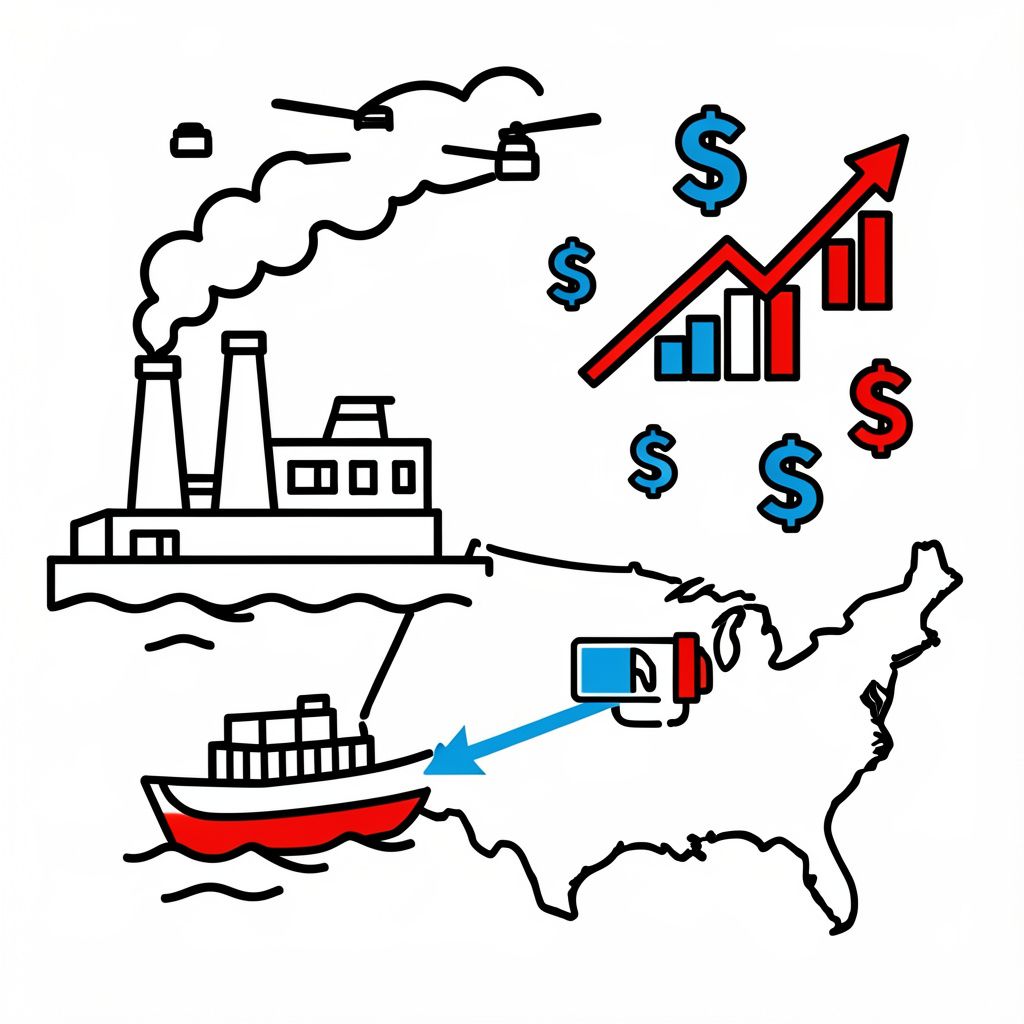
Ukrainian drone strikes crippled over half of Russia’s refining capacity, forcing an unprecedented emergency deal for Moscow to ship diesel directly to the United States ahead of midterm elections.
Drone Campaign Disrupts Global Diesel Supply
A coordinated campaign of Ukrainian drone strikes has severely damaged Russian energy infrastructure, triggering a global supply crunch just weeks before the United States midterm elections. On 2026-10-18, Ukraine launched over 1,000 drones against Russian oil infrastructure, marking one of the year’s largest attacks and hitting a St. Petersburg export terminal [1][7][8]. These strikes have crippled over half of Russia’s refining capacity, forcing an unprecedented emergency deal for Moscow to ship diesel directly to the United States [1][3]. The resulting supply bottleneck highlights the vulnerability of global energy markets to asymmetric warfare and its immediate spillovers into macroeconomic stability [1][6].
Export Declines and Market Volatility
Data indicates a severe contraction in Russian diesel exports, dropping from 608,000 barrels per day (bpd) in September 2025 to 141,000 bpd in September 2026, a decline of more than 75% [1]. This reduction contributes to a global diesel supply constraint of approximately 1 million bpd, exacerbated by a 540,000 bpd drop in Middle Eastern exports through the Strait of Hormuz following Iran’s military actions in late February 2026 [1]. As of 2026-10-20, national average diesel costs in the US reached $1.67 per liter ($6.32 per gallon), representing a 75% increase year-over-year [1]. Prices had previously peaked at $1.73 per liter ($6.53 per gallon) in late September 2026, causing significant economic strain on farmers and truckers [6].
The Trump-Putin Diesel Agreement
In response to soaring prices, President Donald Trump announced a deal on 2026-10-09 for Russia to supply diesel to the U.S. market, aiming to relieve fuel prices ahead of the vote [3][4]. Under the agreement, Russia committed to supplying 300,000 metric tons in October 2026 and 500,000 metric tons in November 2026 [4][6]. Russia lifted its ban on diesel exports on 2026-10-09, and Moscow confirmed it would send its first tanker of diesel fuel to the United States on 2026-10-22 [2][3]. The vessel is carrying 40,000 tonnes of fuel to an undisclosed U.S. port, with Russian Deputy Prime Minister Alexander Novak stating additional shipments would follow [2][5].
Consumption Context and Economic Impact
Daily diesel consumption in the US amounts to 554,000 tonnes, according to S&P Global Energy data cited by CBS [3]. The initial shipment of 40,000 tonnes represents a fraction of daily demand, calculated as 7.22 percent of daily consumption [3]. Experts, including S&P Global and Goldman Sachs, indicate the deal will not significantly lower U.S. diesel prices, estimating it would reduce wholesale costs by only $1–$2 per barrel [4]. The International Energy Agency projects diesel supply constraints will persist well into 2027, with prices remaining elevated due to the difficulty of replacing complex refining equipment [1][4].
Political Ramifications and Expert Analysis
The supply crisis has become a major political flashpoint, with President Trump publicly criticizing Kyiv as surging energy costs weigh heavily on Republican prospects just weeks before the 2026 midterm elections [1][6]. On 2026-10-19, the Trump administration announced an $8 billion, one-time payment relief package for American farmers to address temporary market disruptions [6]. However, experts warn there are no silver bullets to solve the underlying problem without a durable peace deal [6]. Douglas Holtz-Eakin of the American Action Forum noted the administration looks panicky because they cannot move the price of diesel in the next 14 days before the vote [6].
Sources
- www.cnbc.com
- www.aljazeera.com
- www.pravda.com.ua
- www.americanprogress.org
- www.facebook.com
- www.cnn.com
- www.cnbc.com
- x.com