Why America’s Giant Warehouses Are Becoming Fire Traps
Linthicum Heights, Thursday, 18 June 2026.
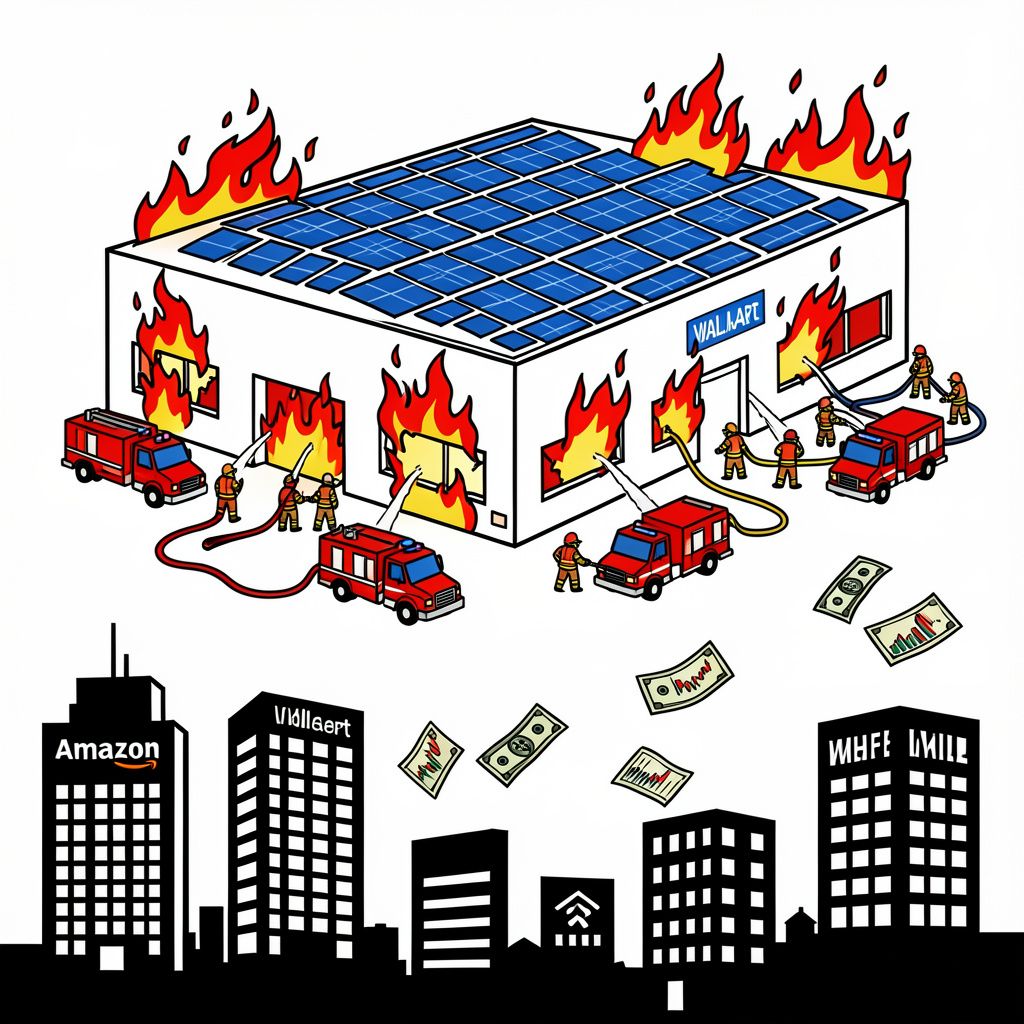
A surge in catastrophic fires at U.S. mega-warehouses—some exceeding 1 million square meters—has exposed critical flaws in fire safety standards. With roofs often fully covered in solar panels and sprinklers designed only for interior fires, these blazes are overwhelming emergency responders, disrupting supply chains, and costing companies like Amazon and Walmart millions. Experts warn the problem could soon trigger federal oversight, reshaping risk management for 2027 and beyond.
The Scale of the Problem: Mega-Warehouses as Modern Fire Hazards
Since April 2026, at least three catastrophic fires have engulfed U.S. mega-warehouses, each exceeding 1 million square meters (10.76 million square feet) in size. The most recent incidents occurred in Los Angeles (1400 block of South Los Palos Street, June 17), Tracy, California, and Heights, Maryland (April 7), with arson suspected in the Maryland blaze [1][3]. These facilities, often housing cold food storage or e-commerce fulfillment operations, represent a new class of industrial infrastructure that has outpaced existing fire protection standards. The National Fire Sprinkler Association (NFSA) has described these structures as ‘reminiscent of structural conflagrations of the late 19th and early 20th centuries,’ highlighting how modern logistics demands have created unprecedented fire risks [1].
Design Flaws: Why Current Fire Protection Systems Are Failing
The core issue lies in the fundamental mismatch between modern warehouse design and legacy fire protection systems. Current NFPA-compliant sprinkler systems are engineered to contain fires at their point of origin within a building’s interior, but recent mega-warehouse fires have exposed critical limitations. In the Tracy, California incident, the facility lacked roof sprinklers entirely, allowing a fire that likely originated outside the protected interior to spread unchecked [1]. NFSA President Shane Ray emphasized this systemic flaw: ‘Fire sprinklers are not like firefighters, they can’t think, they can’t change their pattern, they can’t move through a building, and they are designed to handle a fire when and where it starts’ [1]. This static protection approach becomes particularly problematic in facilities where nearly the entire roof surface is covered with photovoltaic (PV) panels—a common feature in modern warehouses seeking energy efficiency [1].
The Solar Panel Paradox: Energy Efficiency vs. Fire Safety
The rapid adoption of rooftop solar installations on mega-warehouses has created an unexpected fire hazard. While PV panels offer significant energy savings and sustainability benefits, their widespread deployment across entire roof surfaces has introduced new vulnerabilities. The NFSA has specifically identified this configuration as problematic, stating that ‘modern day fires in these complex facilities that are mega-warehouses of unlimited size, and in this case with photovoltaic panels on nearly the entire roof, are beyond the fire and life safety standards of today’ [1]. The Los Angeles warehouse fire on June 17, which reportedly involved a cold food storage facility, demonstrated how flames spreading across a PV-covered roof can overwhelm traditional fire suppression systems [3]. This design trend has effectively created a paradox where energy-efficient buildings may be more susceptible to catastrophic fires.
Economic and Operational Fallout: Beyond the Flames
The consequences of these mega-warehouse fires extend far beyond immediate property damage. The NFSA has identified a cascading series of risks including public safety threats, firefighter endangerment, job losses, supply chain disruptions, environmental harm, and substantial taxpayer costs [1]. For major retailers like Amazon (AMZN) and Walmart (WMT), which rely on these facilities for just-in-time inventory management, the disruptions have already resulted in multi-million-dollar losses [GPT]. The insurance industry is taking notice, with reports indicating that carriers are reevaluating premiums and coverage terms for mega-warehouses [GPT]. This financial pressure could significantly impact site selection, operational costs, and corporate risk management strategies as companies plan for 2027 and beyond.
The Regulatory Reckoning: Is Federal Oversight Inevitable?
The recent spate of mega-warehouse fires has intensified calls for federal intervention in industrial fire safety standards. Current regulations vary significantly by state and municipality, creating a patchwork of requirements that often lag behind the rapid evolution of warehouse design and usage. Industry analysts suggest that the scale and frequency of these incidents could accelerate the push for federal oversight, similar to existing regulations governing high-rise construction or hazardous materials storage [1]. The NFSA has positioned itself at the center of this debate, advocating for updated standards while emphasizing the shared responsibility of building owners and tenants to design and maintain facilities that prevent catastrophic fires [1]. As emergency response resources in key logistics hubs like Southern California, New Jersey, and Texas become increasingly strained, the pressure for comprehensive regulatory reform continues to mount.