Tesla Replaces Legacy EV Production With Robots and a $2 Billion AI Bet
Austin, Saturday, 31 January 2026.
Tesla marks a historic shift by sunsetting Model S and X production to prioritize Optimus robots and a $2 billion xAI investment, despite Wall Street’s concerns over declining revenue and unproven AI profitability.
A Definitive Pivot from Hardware to Intelligence
Following the release of its earnings report on Wednesday, January 28, 2026, Tesla (TSLA) has confirmed a fundamental transformation that redefines its identity from an automotive manufacturer to a technology firm centered on artificial intelligence and robotics [3][4]. This strategic realignment was punctuated by the announcement that the company will discontinue its legacy Model S and Model X electric vehicles, a move CEO Elon Musk described as an “honorable discharge” for the pioneering product lines [6]. Wall Street analysts have characterized this pivot away from automobiles as the most significant takeaway from the recent earnings call, though many retain skepticism regarding the immediate financial viability of this transition [1]. The shift comes as the company faces intensifying pressure to differentiate itself, with Musk asserting that in the future, less than 5%—and perhaps as low as 1%—of vehicle miles will be driven by humans [3].
The End of the Legacy Era
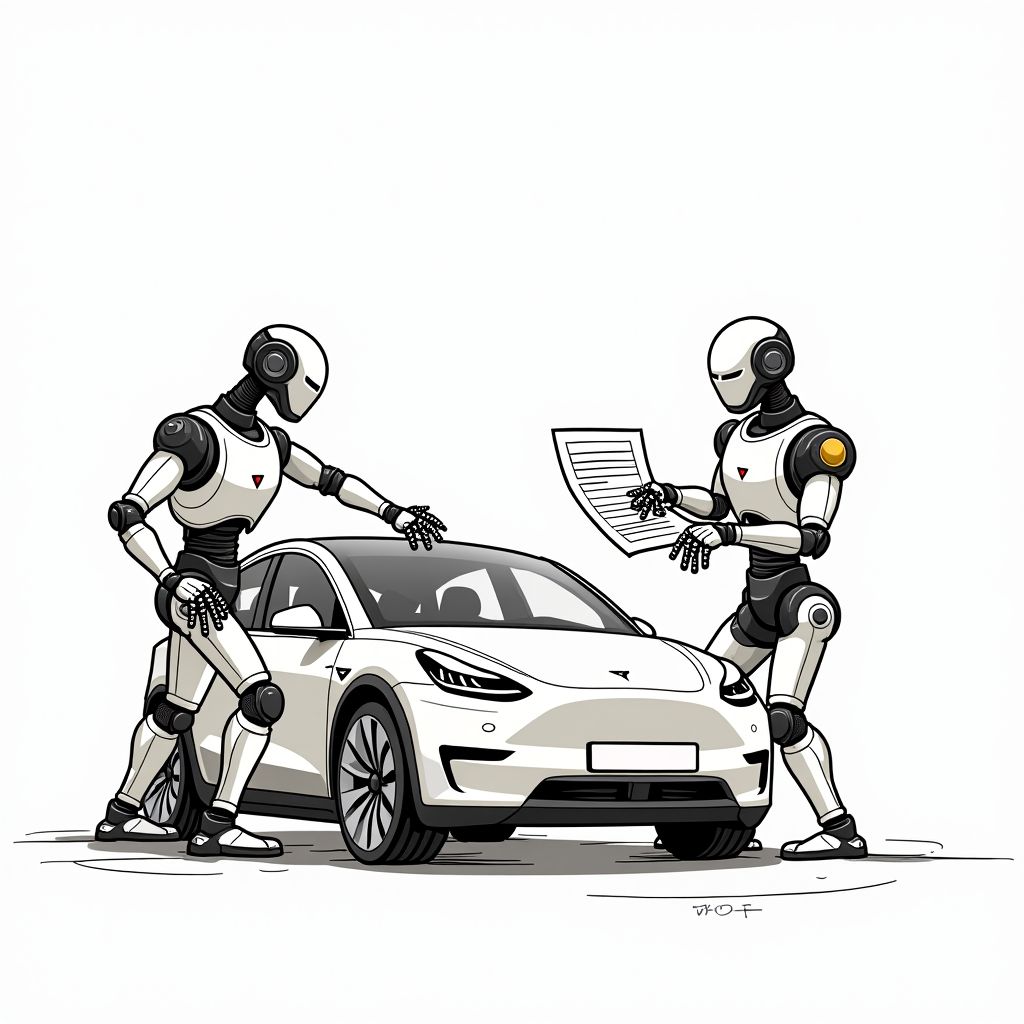
To facilitate this technological metamorphosis, Tesla plans to sunset production of the Model S and Model X in the second quarter of 2026 [4][6]. These models, which established Tesla’s dominance in the premium EV sector, saw their sales figures drop to less than one-third of the mass-market Model 3 and Model Y combined throughout 2025 [6]. The manufacturing capacity at the Fremont, California factory currently dedicated to these legacy vehicles will be converted to produce the Optimus humanoid robot [3][6]. This reallocation of industrial real estate signals Tesla’s aggressive commitment to its robotics division, with the company aiming for a production capacity of one million Optimus units annually at the Fremont facility [6]. The company intends to begin mass production of these third-generation robots by the end of 2026, targeting a price point of approximately $30,000 per unit [4][6].
Financial Headwinds and Capital Allocation
This ambitious pivot occurs against a backdrop of financial contraction. For the fiscal year 2025, Tesla reported its first-ever annual decline in revenue, accompanied by a significant erosion in profitability [3][7]. The company’s GAAP net income fell to $3.8 billion in 2025 from $7.1 billion in 2024, representing a steep year-over-year decline of -46.479% [6]. Despite beating Q4 estimates with $24.9 billion in revenue, the broader financial picture reflects the strain of a cooling EV market and the expiration of the $7,500 tax credit in September 2025 [3][4]. To fund its next generation of products, Tesla plans to increase capital expenditures to over $20 billion in 2026, directing these funds toward autonomous vehicles, AI compute infrastructure, and robot ecosystems [4][7]. CFO Vaibhav Taneja confirmed that this massive outlay is necessary to support new production lines and the computational power required for AI development [3].
Deepening Ties with xAI
A central pillar of this new strategy is a $2 billion investment in xAI, Elon Musk’s artificial intelligence startup, which was disclosed in the Q4 2025 Shareholder Deck [2]. This investment, executed on January 16, 2026, involves the acquisition of Series E Preferred Stock and is expected to close in the first quarter of 2026, pending regulatory approval [2]. The move is designed to integrate xAI’s large language model, Grok, into Tesla’s physical hardware, providing the “brains” for Tesla’s “bodies” [2]. However, this capital transfer has raised governance questions; in November 2025, Tesla shareholders rejected a nonbinding measure to authorize investment in xAI, with 1.06 billion votes in favor versus 916.3 million opposed, as abstentions effectively counted as votes against [5]. Musk has defended the transaction as a vital component of “Master Plan Part IV,” intended to accelerate the development of Full Self-Driving (FSD) capabilities and the Optimus robot [2][5].
Execution Risks and Future Timelines
The success of this pivot hinges on Tesla’s ability to adhere to aggressive production schedules, an area where the company has historically faced challenges. Tesla is preparing to begin manufacturing its dedicated robotaxi, the Cybercab, in April 2026 [3][6]. This two-seater vehicle, designed without a steering wheel or pedals, is critical to Musk’s vision of a future dominated by autonomous transport [7]. Furthermore, the company has updated timelines for its robotaxi business operations in Nevada, Florida, and Arizona, aiming to have services running in up to half of the U.S. by the end of 2026 [3][4]. As Tesla transitions from a hardware-centric automaker to a “physical AI company,” it faces the dual challenge of managing declining legacy revenue while proving the commercial viability of unproven technologies like the Optimus robot and autonomous networks [2][7].
Sources
- www.cnbc.com
- www.tesery.com
- www.businessinsider.com
- www.linkedin.com
- techcrunch.com
- newatlas.com
- www.satonic-autoparts.com