Supreme Court Halts Missouri's New Voting District Lines Ahead of Midterms
Washington, Wednesday, 9 September 2026.
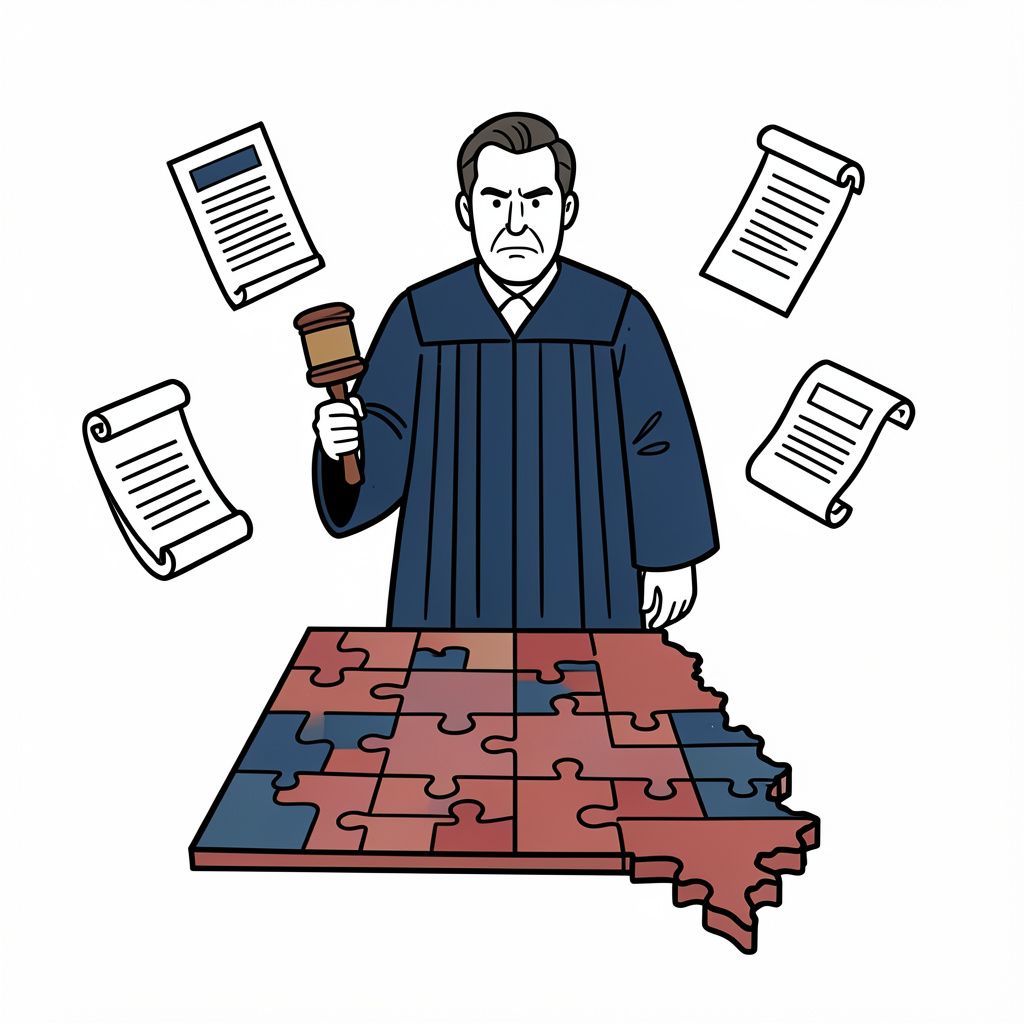
Justice Brett Kavanaugh denied Missouri’s emergency appeal, enforcing a state Supreme Court ruling that suspends a Republican-drawn map after voters gathered over 300,000 signatures to force a statewide referendum.
Supreme Court Denial and Legal Timeline
The United States Supreme Court has denied an emergency request by Missouri Republicans to reinstate a contested congressional map for the upcoming midterm elections, forcing the state to utilize previously established district boundaries [1][2]. Justice Brett Kavanaugh issued the denial on Monday, 2026-09-07, leaving the Missouri Supreme Court’s ruling in place and requiring the use of the 2022 congressional map for November’s election [1][8]. This decision provides regulatory certainty for political campaigns and business leaders tracking potential policy shifts in key legislative races, ending a week of legal uncertainty [1]. The ruling highlights ongoing legal battles over redistricting across the nation that could ultimately influence the balance of power in Washington and impact broader fiscal and regulatory policies [1][4].
State Court Rulings and Referendum Process
The legal dispute originated when the Missouri Supreme Court ruled unanimously on 2026-08-31 that the revised Republican-backed congressional map could not be used for the November 2026 general election because a voter-backed referendum suspended the law [1][6]. Organizers submitted over 300,000 signatures in December 2025 to force a statewide referendum on the map, which Missouri Secretary of State Denny Hoskins initially rejected on 2026-08-04 [6][8]. The state’s highest court declared the referendum petition legal, sufficient, and timely, affirming that under state law, the challenged redistricting map must be put on hold until the public vote occurs [4][6]. Consequently, Missouri officials must execute the general election using 2022 districts, despite having used the revised map for the primary election held in August 2026 [1][4].
Political Stakes and Redistricting Goals
The revised map, supported by Donald Trump and Missouri Republicans, aimed to shift the state’s congressional delegation balance from 6-2 to 7-1, specifically targeting Democratic Rep. Emanuel Cleaver’s Kansas City-area district [1][4]. This mid-decade redistricting plan, approved by Missouri Republicans in 2025, aimed to increase GOP electoral chances by carving up the Democratic-leaning 5th congressional district and shifting parts of it into neighboring Republican-held districts [2][4]. The potential gain for the Republican party represents a 1 seat increase in the state’s delegation, reflecting a broader national strategy to secure additional House seats outside the decennial census cycle [2][6]. Governor Mike Kehoe and Attorney General Catherine Hanaway supported the redrawn map, arguing it was necessary for timely elections, though opponents argued it was an extreme mid-decade gerrymander [4][8].
Conflicting Court Orders and Election Logistics
Complicating the situation, a separate federal court ruling contradicted the Supreme Court judgement, leaving the map status in limbo for several days [2]. On 2026-09-01, US District Judge Stephen Clark issued a conflicting ruling temporarily blocking the older map and ordering the use of the new Republican-backed map for the upcoming midterm elections [2][4]. However, Judge Clark’s order was set to remain in effect for only 14 days while courts considered the dispute, creating a window of uncertainty for election officials [2]. With first ballots for the 2026 election scheduled to be sent out on 2026-09-19, the Supreme Court’s denial on 2026-09-07 resolved the immediate conflict in favor of the 2022 boundaries [4][8].
Implications for November and Beyond
Missouri election officials now face the implementation of the 2022 congressional map for the 2026 General Election, with voting scheduled to begin within days of the 2026-09-07 ruling [1][8]. The referendum regarding the repeal of the 2025 Missouri First map will still appear on the November 2026 ballot, meaning voters will ultimately decide the map’s fate for future cycles [6][7]. If the November 2026 referendum passes, the 2022 congressional map will be utilized for the 2028 and 2030 election cycles, barring any new mid-decade redistricting efforts [7]. This outcome ensures that the immediate electoral framework remains stable while allowing the democratic process to determine long-term district boundaries through the pending referendum [6][8].
Sources
- www.foxnews.com
- www.aljazeera.com
- www.nbcnews.com
- www.scotusblog.com
- electionlawblog.org
- www.courthousenews.com