Tesla Advances Ten Billion Dollar Solar Factory in Texas
Houston, Monday, 9 November 2026.
Initial ground site preparation has commenced on Tesla’s massive project, which promises nearly 10,000 permanent jobs alongside a requested $115 million local school property tax incentive.
Groundbreaking Progress on a Mega-Project
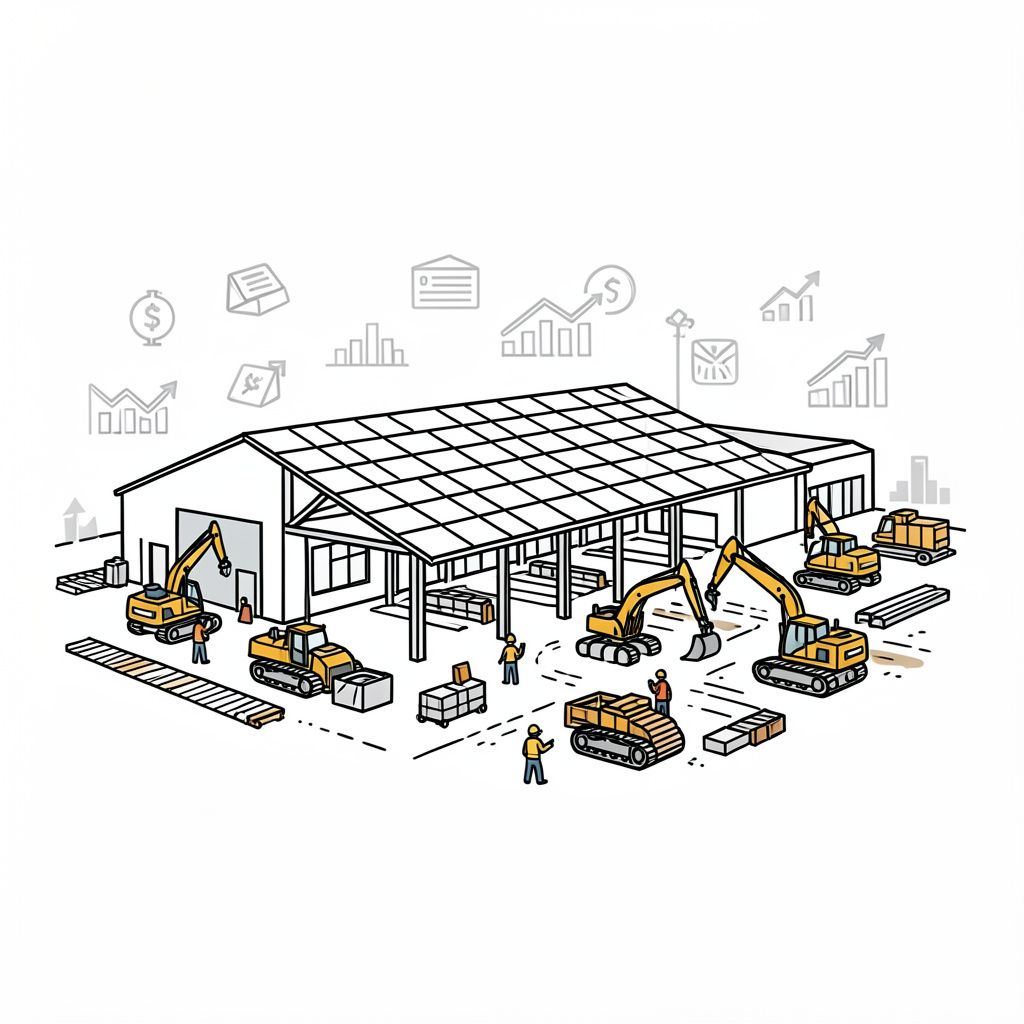
Tesla Inc. (NASDAQ: TSLA) has initiated preliminary earthworks at a 3,057-acre site in Fort Bend County, Texas, marking the first tangible step toward ‘Project Crystal Sun,’ a $10.1 billion solar-cell and panel manufacturing facility [GPT]. The site, located within the Lamar Consolidated Independent School District (Lamar CISD) near the intersection of FM 1994 and FM 762, is undergoing large-scale clearing and grading operations, as documented by local observers and verified through aerial footage [5][7]. These preparatory activities signal Tesla’s apparent commitment to moving forward with the project, despite the incentive package still requiring final state approval [alert! ‘Local board approval secured, but state-level review pending as of 9 November 2026’]. The scale of the operation is underscored by the removal of vegetation, establishment of equipment staging areas, and modifications to the former homestead site, all of which are consistent with early-phase industrial site development [5][7].
Economic and Industrial Significance
The proposed facility represents one of the most substantial industrial investments in Texas this decade, with a capital outlay of $10.1 billion—comprising $1.5 billion allocated to real property and $8.6 billion to manufacturing equipment and personal property [1][2][4]. Once operational, Tesla intends to produce photovoltaic solar cells and assembled solar modules, covering the entire solar value chain from silicon ingots to finished panels [3][6]. The project’s economic footprint extends beyond manufacturing, with Tesla’s application projecting the creation of 9,712 permanent jobs by 2033, alongside 1,147 temporary construction jobs during the build-out phase [2][3][4][6]. Annual payroll is anticipated to reach $1.3 billion, with average wages benchmarked at 110% of the county average—$134,148—reflecting the high-skill nature of roles in solar manufacturing [2][3][4]. This aligns with Fort Bend County’s long-term economic development strategy, which aims to transition from a bedroom community to a major employment hub, as articulated by local leaders [4].
Tax Incentives: A Critical Lever for Development
To offset the project’s significant capital costs, Tesla has pursued a 10-year school property tax incentive under Texas’ Jobs, Energy, Technology and Innovation (JETI) program, targeting an estimated $115.2 million in savings for Lamar CISD [1][2][4]. The proposed structure of the incentive is designed to balance immediate fiscal relief for the district with long-term economic benefits. During the construction phase, the property’s taxable value for school maintenance-and-operations taxes would be set to zero, while interest-and-sinking taxes—used to repay school bonds—would continue to apply at full value [1][2][4]. Post-construction, eligible property would be taxed at 50% of its taxable value for maintenance-and-operations purposes through 2038, with the incentive period running from 2029 to 2038 [1][2][4]. The Texas Comptroller’s office has estimated these savings at approximately $115.2 million over the decade, averaging $11.5 million annually or roughly $37,700 per acre of the 3,057-acre site [1][2]. On 8 November 2026, Lamar CISD trustees voted unanimously (7-0) to approve the local incentive terms, a critical milestone in securing the broader JETI agreement [1][2][4][5][7]. However, final approval remains contingent on state-level sign-off from the Texas Comptroller and the Governor’s office, with each entity having up to 30 days to decide following a favorable comptroller recommendation [2].
Timeline and Future Milestones
While Tesla has not officially confirmed a construction start date, local reporting and social media posts suggest that preliminary earthworks began in early November 2026, with commercial operations targeted for early 2029 [5][7][8][9]. This timeline would allow for approximately two years of construction, assuming no unforeseen delays. The project’s commercial launch in 2029 coincides with the anticipated commencement of the school tax incentive period, creating a synchronized financial framework for both Tesla and Lamar CISD [1][2][4]. However, several key details remain unconfirmed, including the total production capacity of the facility, the final headcount for permanent jobs, and the exact phasing of construction activities [alert! ‘Tesla has not publicly disclosed these details as of 9 November 2026’]. The site’s reinvestment zone designation, approved by Fort Bend County commissioners on 24 August 2026, provides additional local incentives but does not alter the state-level JETI approval process [3][4]. For stakeholders tracking Texas’ evolving clean-energy landscape, Project Crystal Sun stands as a bellwether for the state’s ability to attract high-value manufacturing projects amid intensifying global competition.