America’s Colleges Face a Demographic Tsunami—Here’s Why It’s Happening Now
New York, Saturday, 20 June 2026.
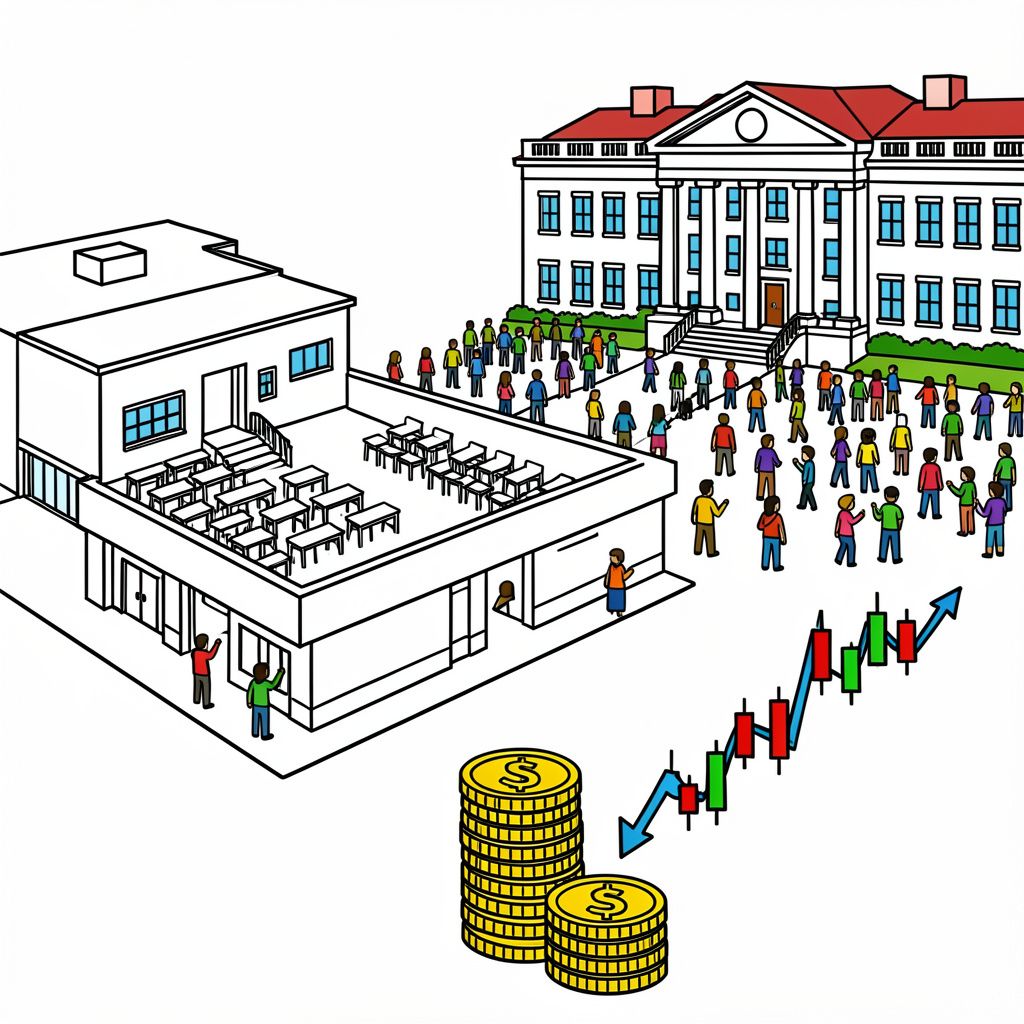
A 17% drop in U.S. births after the 2008 financial crisis has left universities scrambling as 576,000 fewer college-aged students enter the system. The result? Budget deficits, campus closures, and a fight for survival—with small private colleges hit hardest. Even flagship universities are slashing budgets, while elite schools remain untouched. The enrollment cliff isn’t coming—it’s here.
The Demographic Time Bomb: How the Great Recession Created Today’s Enrollment Crisis
The United States is experiencing a higher education crisis that was set in motion nearly two decades ago. Following the 2008 financial crisis, American households responded to economic uncertainty by delaying childbearing, resulting in a 17% drop in birth rates [1]. This demographic shift has now reached college campuses, with 576,000 fewer college-aged Americans projected between 2025 and 2029 [1]. The impact is immediate and severe: total U.S. post-secondary enrollment rose just 1% in fall 2025, down from 4% growth the previous year, while private four-year institutions saw a 1.6% decline [2]. The National Student Clearinghouse Research Center’s latest reports confirm this trend is accelerating, with preliminary fall 2026 enrollment data showing continued contraction across most institution types [3].
Budget Deficits and Campus Closures: The Financial Fallout
The enrollment decline is translating into concrete financial distress for universities nationwide. The University of Vermont announced a $12 million budget deficit for fiscal year 2027 after experiencing a 15% drop in freshman enrollment for 2026 [4]. Similarly, the University of Wyoming projects a $15 million shortfall for the same period, citing enrollment declines compounded by inflation and falling investment returns [4]. Even flagship institutions are not immune: the University of Oregon has already implemented $30 million in budget cuts and warned that deficits could reach $65 million if current trends persist [4]. The financial strain is most acute at small private colleges, where Hampshire College in Massachusetts will close its doors after the fall 2026 semester, becoming one of approximately 60 U.S. colleges that close annually [1][4].
A Tale of Two Higher Educations: Who Survives and Who Doesn’t
The enrollment crisis is creating a stark divide in American higher education. Elite institutions and large public university systems remain insulated due to strong demand and substantial endowments [1]. However, mid-tier private institutions and regional public universities are facing existential challenges. Syracuse University, which missed its 2026-27 undergraduate enrollment targets, represents this vulnerable middle tier [1]. University leadership describes the current environment as ‘widespread, unpredictable and the new normal,’ with Chancellor J. Michael Haynie warning that ‘the fall 2026 enrollment shortfall carries real financial consequences’ [1]. Sandy Baum, Senior Fellow at the Urban Institute, offers a blunt assessment: ‘Forget the elite institutions. If you’re enrolling 300 students, it’s going to be really tough to make it work, and some of them will have to go out of business’ [1].
Regional Economic Ripple Effects: Beyond Campus Borders
The enrollment crisis extends far beyond university balance sheets. In New England, where 32 four-year colleges have closed or merged in the past decade, the Federal Reserve Bank of Boston warns of significant regional economic consequences [1]. College towns face declining property values, reduced local spending, and brain drain as institutions close. The impact is particularly acute in rural areas, where colleges often serve as major employers. Nationally, the enrollment decline threatens to exacerbate existing labor shortages in critical fields. With fewer students pursuing higher education, industries already facing workforce gaps—including healthcare, education, and technology—may see their talent pipelines further constrained [GPT]. The Federal Reserve projects that annual college closures could double if enrollment drops by 15% between 2025 and 2029, potentially removing tens of thousands of seats from the higher education system [1].
The New Normal: Higher Education’s Uncertain Future
As universities confront this demographic reality, several trends are emerging. The traditional higher education business model—reliant on steady enrollment growth and tuition revenue—is being fundamentally challenged. University of Oregon President Karl Scholz observes, ‘These dynamics are not affecting just the University of Oregon: they represent a changing reality across higher education’ [1]. Some experts predict a wave of mergers and acquisitions, similar to what occurred in the healthcare sector during the 1990s [GPT]. Others foresee a bifurcated system where elite institutions thrive while smaller colleges struggle to survive. What is clear is that the enrollment cliff is not a temporary phenomenon but rather a structural shift. With birth rates remaining below replacement levels, higher education faces a prolonged period of contraction that will reshape institutions, communities, and the national economy for decades to come [1][4].