The $11 Billion Blind Spot: How Sudan's Conflict Gold Flows Untraced Into Global Markets
Dubai, Wednesday, 8 April 2026.
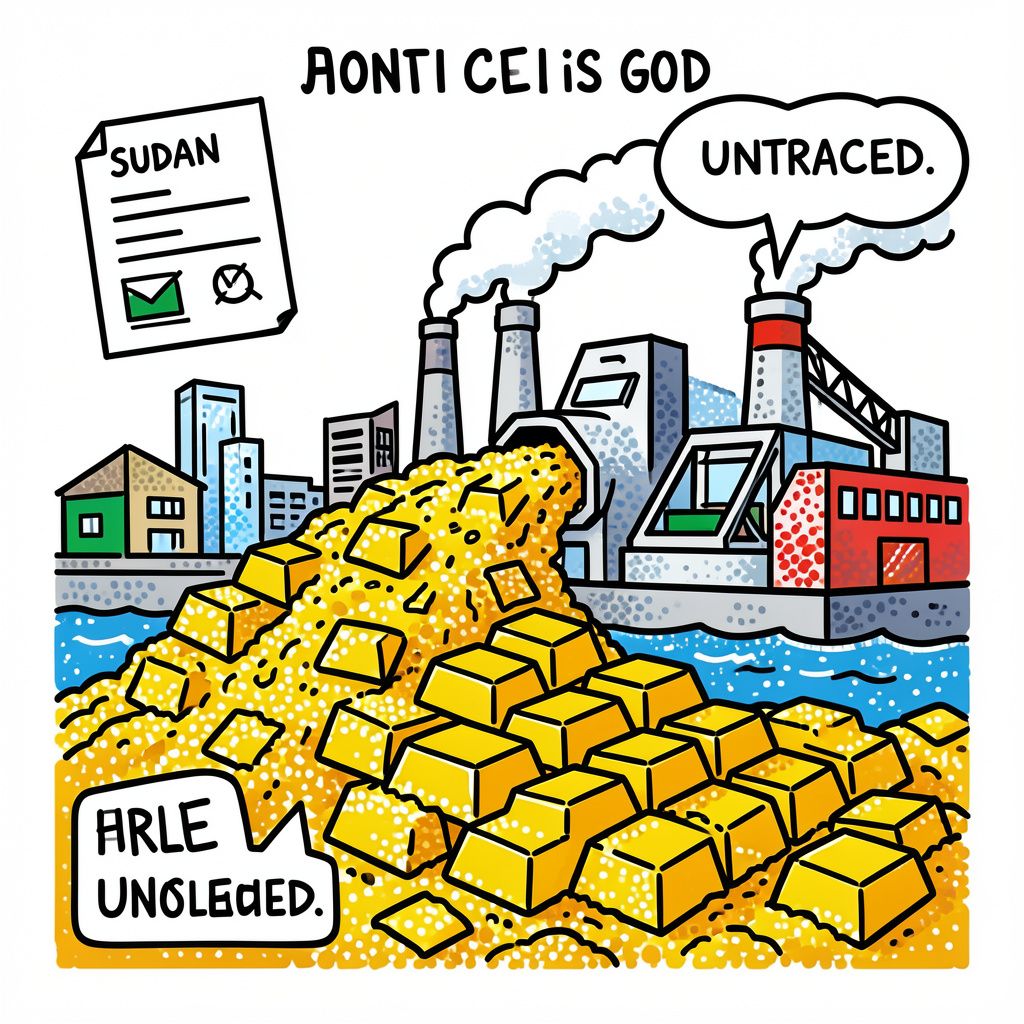
A staggering 70 tonnes of Sudanese conflict gold, worth $11 billion, flows annually through UAE refineries, bypassing origin verification to covertly fund ongoing paramilitary violence.
The Mechanics of the Conflict Gold Pipeline
On April 7, 2026, an independent investigation by Tinsel News brought into sharp focus the financial engine driving Sudan’s ongoing civil conflict [1]. Since 2023, the Rapid Support Forces (RSF) have maintained control over Sudan’s most lucrative mining territories, primarily located in North Darfur [1][4]. In 2025 alone, these regions produced approximately 70 tonnes of gold [1][4]. With gold prices reaching $5,100 per ounce in March 2026, this annual output is valued at roughly $11 billion [4]. Despite this massive wealth generation, the Sudanese civilian population receives zero percent of the returns [4]. Instead, the RSF utilizes a “conflict discount” to extract value directly at the source, forcing miners to accept prices significantly below global market rates [1][4].
Dubai’s Role and the Laundering Architecture
Once extracted and formed into rudimentary bars, the gold is transported to Dubai within mere days [1][4]. Dubai acts as a critical nexus in the global commodities market, processing approximately 40% of the world’s gold supply [1][4]. According to a March 2025 study by Chatham House, the United Arab Emirates (UAE) directly imported about 29 tonnes of gold from Sudan in 2024 [1][4]. However, this direct route is only part of the picture. Significant volumes of Sudanese gold are smuggled through neighboring transit countries, including Chad and the Central African Republic, where it is relabeled with falsified origin documentation before entering the international market [1][4].
Embargoes, Smuggling, and the War Economy
Geopolitical friction has inadvertently exacerbated this illicit trade. In August 2025, the UAE imposed an air and maritime embargo against Sudan, blocking vital routes to Port Sudan and barring vessels from using UAE ports for direct shipments [2][3]. An April 2026 report by the Sudan Transparency and Policy Tracker highlights that this embargo sent “shockwaves through the market,” as the UAE had previously been the destination for nearly all of Sudan’s official gold exports [2]. Consequently, formal trade channels have rapidly shrunk, forcing economic activity into shadowy, militarized networks [2].
A Broader Geopolitical Crisis
The implications of this unregulated pipeline extend far beyond Sudan’s borders, intersecting with broader geopolitical interests in the Sahel region [4]. The RSF’s gold network operates alongside other illicit flows, such as those controlled by the Africa Corps (formerly the Wagner Group), which provides military backing to mining operations in Mali, Burkina Faso, Niger, and the Central African Republic [4]. Since 2022, Russian-affiliated networks have been linked to over $2.5 billion in African gold exports [1][4]. With only 10% of Sudan’s land currently surveyed for minerals—and potential deposits of copper, zinc, silver, and rare earth elements waiting to be exploited—the risk of further resource-driven conflict remains exceptionally high [1][4].