White House Invokes Wartime Powers to Force Restart of California Oil Pipeline
Santa Barbara, Sunday, 5 April 2026.
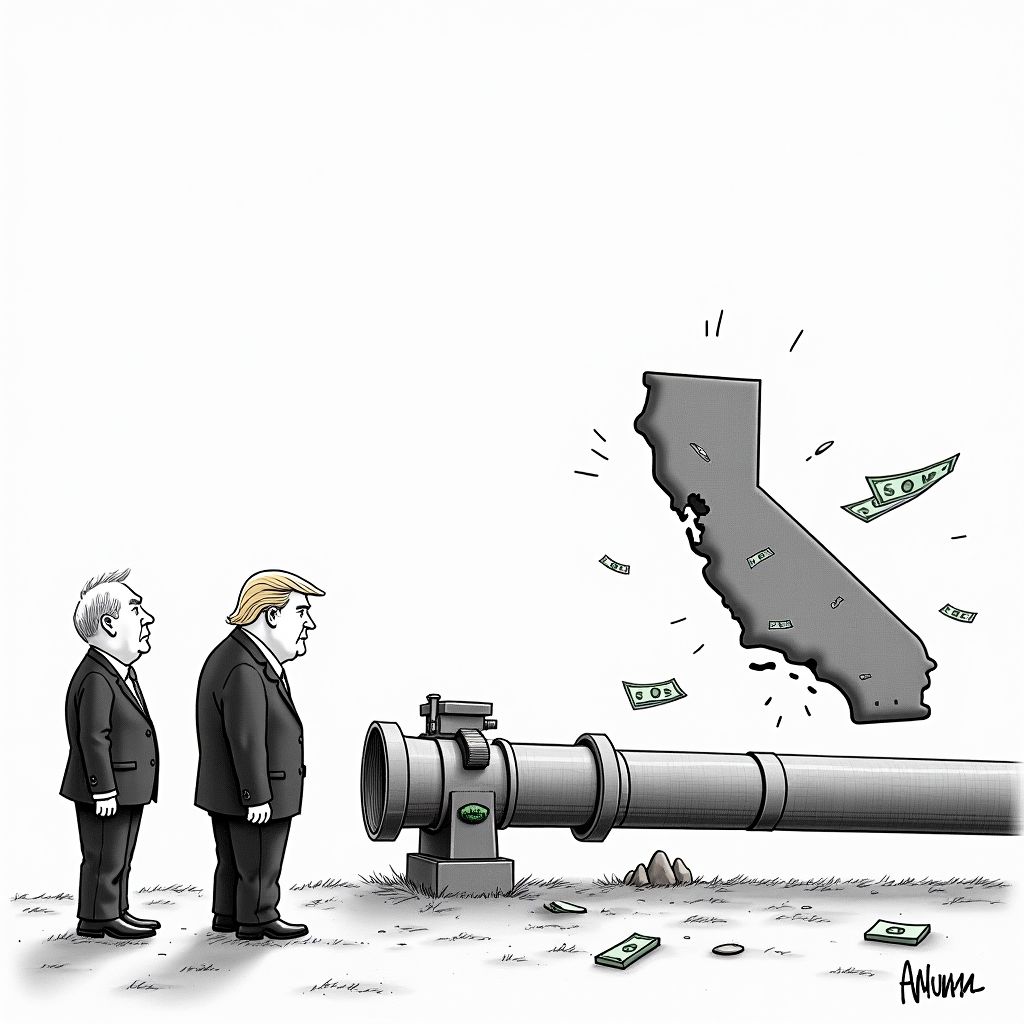
The Trump administration utilized the Defense Production Act to bypass California state laws, forcing the restart of a pipeline responsible for a catastrophic 378,500-liter oil spill in 2015.
A Geopolitical Pretext for Domestic Production
On March 13, 2026, U.S. Secretary of Energy Chris Wright, operating under the administration of Republican President Donald Trump [GPT], invoked the Defense Production Act of 1950 to mandate the immediate restart of the dormant Santa Ynez Unit in California [4][5]. The administration concurrently amended the “National Defense Resources Preparedness” executive order, citing supply disruption risks and the reliance of U.S. military forces on foreign oil as justification for federal intervention [4]. This aggressive policy maneuver followed military strikes in Iran during late February 2026, which disrupted shipping through the Strait of Hormuz—a vital global checkpoint handling approximately 20 million barrels of oil daily [5]. Secretary Wright argued that California’s restrictive energy policies had compromised national security, framing the unprecedented federal override as a necessary measure to ensure reliable energy for West Coast military installations [4][5].
Environmental Legacy and Legal Defiance
The 196-kilometer onshore pipeline—formerly known as Line 901 and now designated as Line 324—carries a deeply troubled environmental history that underpins the state’s resistance [2][5]. In May 2015, a compromised cathodic protection system and trapped moisture led to severe pipeline corrosion, causing a catastrophic structural failure [4]. The resulting Refugio Oil Spill released over 378,500 liters of crude, which contaminated 241 kilometers of the California coastline, forced widespread beach closures for two months, and killed over 550 seabirds [4][5]. Following the incident, the pipeline’s operational easement through Gaviota State Park expired in 2016 [4]. The California Department of Parks and Recreation recently demanded the removal of the pipeline segment crossing the park, prompting Sable Offshore to retaliate by filing a lawsuit against the state agency on March 13, 2026 [4].
Data Contradicts National Security Claims
While the Department of Energy justifies the pipeline’s forced restart on national security grounds, independent academic research challenges the underlying premise that California’s local production significantly impacts foreign oil reliance [4][5]. Dr. Paasha Mahdavi, a professor at the University of California, Santa Barbara, analyzed state import data following the pipeline’s initial shutdown in 2015 [5]. His research revealed that the closure did not trigger a surge in foreign oil dependence; rather, imported oil volumes actually decreased from 50.9 million cubic meters in 2014 to 50.2 million cubic meters in 2016 [5]. This represents a reduction of -1.375 percent in imports during the two years immediately following the pipeline’s failure [5]. Furthermore, local public opposition remains formidable, with 64.9% of Santa Barbara County residents supporting a total ban on new oil and gas operations [5].