Trump Claims Authority to Issue $2,000 Tariff Checks Without Congress
Washington D.C., Friday, 23 January 2026.
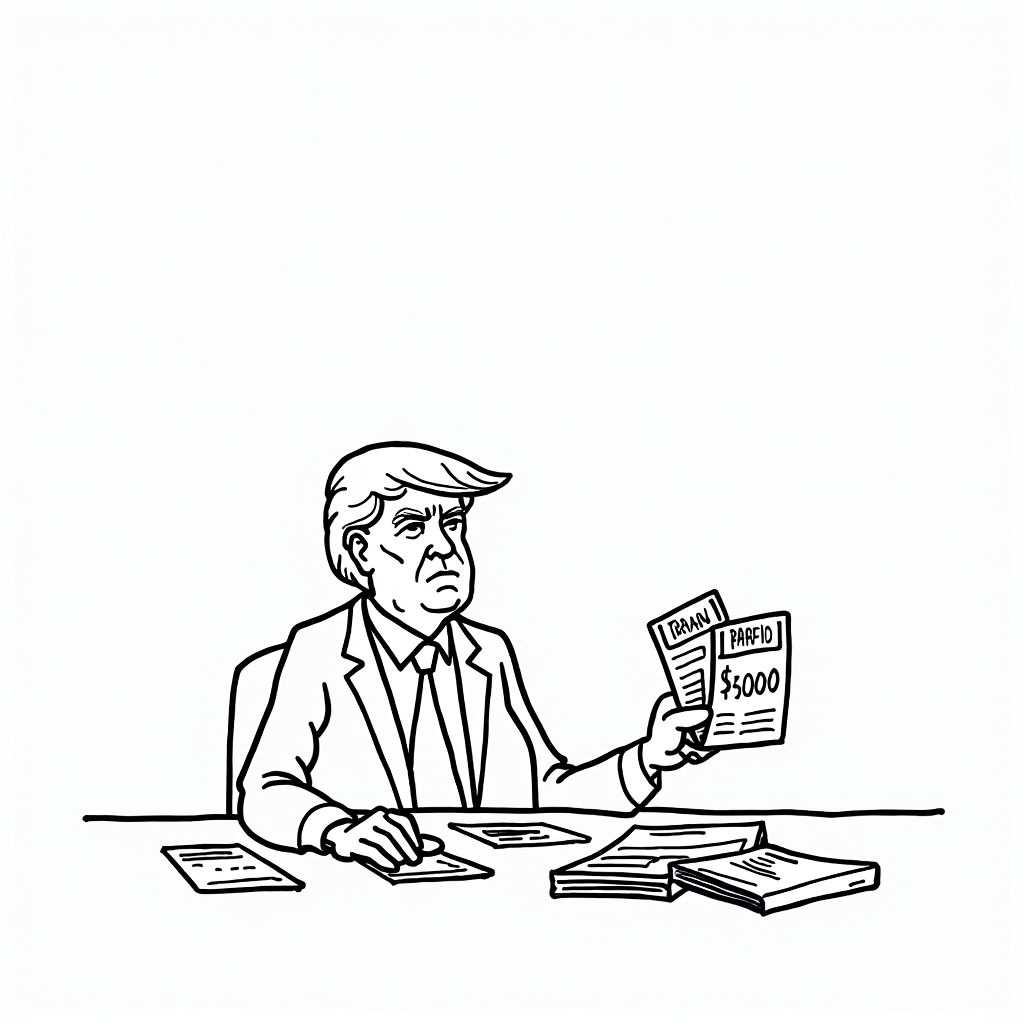
President Trump claims executive power to distribute $2,000 tariff checks without legislative approval, yet collected tariff revenue covers less than half of the program’s estimated $600 billion cost.
Executive Ambitions Versus Fiscal Reality
On Tuesday, January 20, 2026, President Donald Trump reignited the debate over executive spending power by suggesting he could unilaterally authorize $2,000 dividend checks for Americans without congressional approval [1][4]. While the President expressed confidence that his administration could bypass the legislative branch to distribute these funds, his own economic adviser, Kevin Hassett, publicly contradicted this stance earlier that same day, affirming that such payments remain contingent upon congressional authorization [1]. This friction within the executive branch highlights the complex legal and financial hurdles facing the proposal. The administration aims to fund these payments using revenue generated from aggressive trade tariffs, yet analysts estimate the program’s total cost could range from $300 billion to $600 billion [1][4]. This stands in stark contrast to the actual revenue collected; in the 2025 fiscal year, U.S. Customs and Border Protection reported collecting $216 billion in tariff revenue [4]. Even looking at the broader calendar year of 2025, total tariff collections amounted to $264 billion [8], leaving a funding gap of up to 336 billion against the higher cost estimates.
The Constitutional Power of the Purse
The proposal to bypass Congress challenges the traditional interpretation of the Appropriations Clause of the Constitution. Legal experts and economists, including researchers from the Cato Institute and the Tax Foundation, argue that the President lacks the unilateral authority to redistribute tariff revenue as direct payments to taxpayers [4]. Erica York of the Tax Foundation noted that the authority to spend tariff revenue resides with Congress, not the executive branch [4]. A precedent for congressional involvement was set recently; in December 2025, the administration distributed $1,776 “warrior dividend” checks to approximately 1.5 million military personnel [8]. Notably, this specific disbursement, totaling roughly $2.6 billion, was not an executive action but was funded through a $2.9 billion appropriation in the legislatively passed “One Big Beautiful Bill Act” [8]. Despite this, President Trump insisted on January 20 that he believes he can issue the broader public dividends without lawmakers, stating, “I don’t think we would have to go to Congress, but we’ll find out” [2].
Legal Jeopardy and Market Instability
Beyond the separation of powers, the financial viability of the dividend plan hangs on a pending Supreme Court decision regarding the legality of the administration’s tariff orders [6]. The Court heard arguments on the constitutionality of these tariffs on November 5, 2025, and a ruling is expected imminently [6]. The stakes are high; if the Supreme Court rules against the administration, the U.S. government could be forced to refund hundreds of billions of dollars collected from importers [6]. President Trump acknowledged this risk, admitting that an adverse ruling would create a financial “mess” involving potential repayments of “trillions of dollars” [6]. Meanwhile, the economic atmosphere remains tense. Following threats of new tariffs on European nations regarding Greenland, the Dow Jones Industrial Average fell nearly 900 points earlier this week, and Treasury yields surged on January 19, 2026 [7]. Experts warn that injecting hundreds of billions of dollars into the economy via these checks could further exacerbate inflation [1].
Scammers Exploit Policy Confusion
The uncertainty surrounding the dividend checks has created a fertile ground for fraud. On January 23, 2026, reports confirmed that a group calling itself “Major Gross Profit” has been circulating deceptive emails claiming that the “Trump’s $2,000 tariff dividend is live” and urging recipients to “act” immediately [2]. These emails, which began appearing around January 16, 2026, are false; no general public dividend program has been implemented or funded [2][5]. Idaho Attorney General Raúl Labrador has issued warnings that any message demanding a response to receive a payment is a scam [2]. Cybersecurity professionals caution that clicking links in these emails could install malware or harvest personal data [5]. While the President continues to advocate for the payments, targeting a rollout toward the end of 2026, the current lack of legislation means no funds are currently available for distribution to the general public [1][2].
Sources
- powib.com
- www.wral.com
- www.investopedia.com
- www.politifact.com
- www.delawareonline.com
- www.npr.org
- www.factcheck.org