House Oversight Committee Recommends Contempt Charges Against Bill and Hillary Clinton
Washington, Thursday, 22 January 2026.
In a rare bipartisan rebuke, nine Democrats joined Republicans to advance criminal contempt charges against the Clintons for defying subpoenas related to the Jeffrey Epstein investigation.
Bipartisan Support for Contempt Resolutions
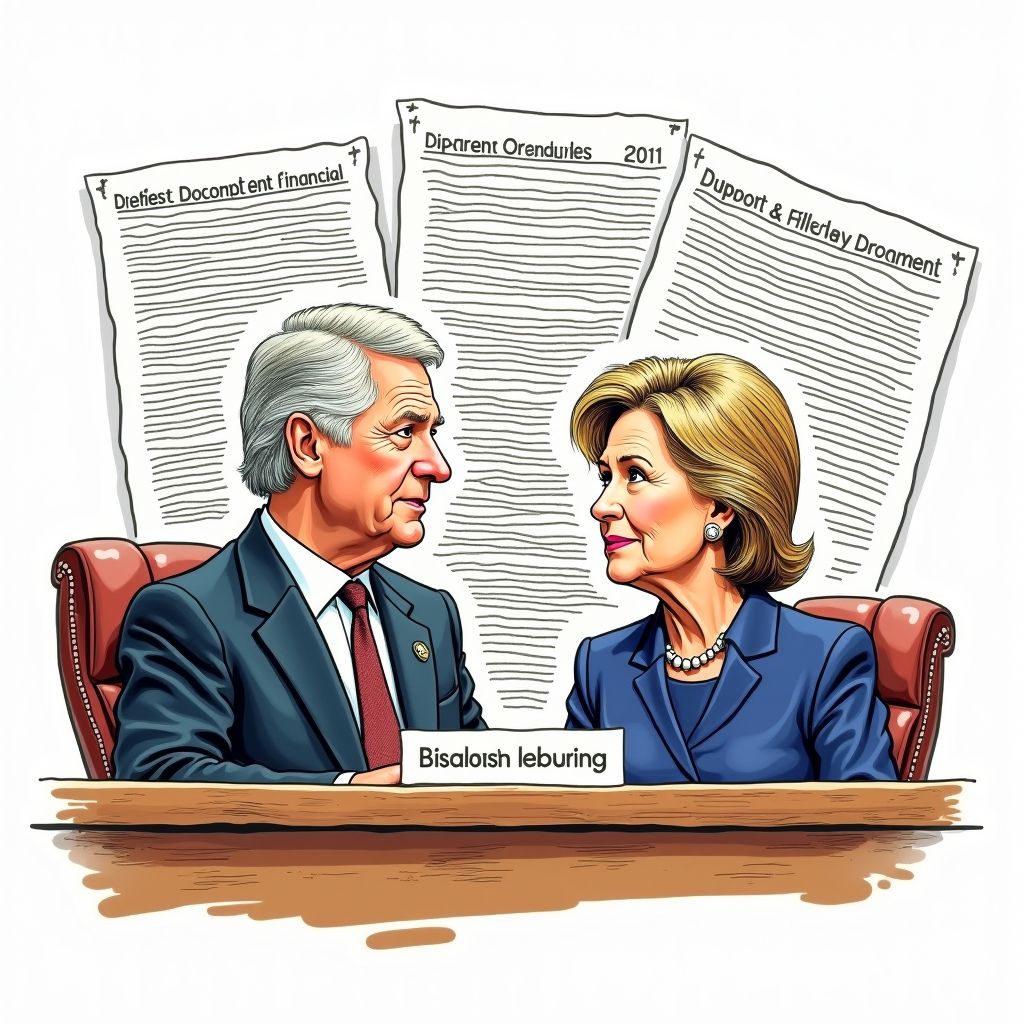
On Wednesday, January 21, the House Oversight Committee voted to recommend criminal contempt of Congress charges against former President Bill Clinton and former Secretary of State Hillary Clinton [1]. The vote regarding Bill Clinton passed 34-8, with nine Democrats breaking ranks to join Republicans in supporting the measure [4][5]. A separate vote to hold Hillary Clinton in contempt passed 28-15, with three Democrats—Representatives Summer Lee, Melanie Stansbury, and Rashida Tlaib—voting in favor [5][6]. The charges stem from the Clintons’ refusal to sit for deposed testimony regarding the committee’s investigation into the government’s handling of the Jeffrey Epstein case, specifically their alleged non-compliance with subpoenas issued in August 2025 [4][7]. While the Clintons have dismissed the subpoenas as invalid and provided sworn written declarations instead, Committee Chairman James Comer maintained that “subpoenas are not mere suggestions, they carry the force of law and require compliance” [2][3].
The Standoff Over Testimony Conditions
The conflict escalated after negotiations over the terms of the Clintons’ testimony collapsed earlier this week. Although the Clintons’ legal team offered an alternative arrangement—an informal interview with Bill Clinton in New York attended by Chairman Comer and Ranking Member Robert Garcia—Comer rejected the proposal on January 19 [3][7]. Comer insisted on a formal, transcribed deposition, arguing that the absence of an official transcript would be “insulting to the American people” and insufficient for a serious investigation [7]. In response, a spokesperson for the Clintons stated they had “offered to help” and accused Republicans of refusing to accept their cooperation [6]. The Clintons have consistently denied knowledge of Epstein’s criminal activities, with their lawyers asserting they have already provided the “limited information they possess” [5].
Democratic Divide and Political Implications
The vote exposed a significant rift within the Democratic minority, balancing loyalty to party elders against a progressive push for transparency. Representative Maxwell Frost, one of the Democrats who voted to hold Bill Clinton in contempt, emphasized that while he believed Republicans had failed to conduct a serious investigation, “we all want to hear from former President Bill Clinton” [4]. Conversely, the committee’s top Democrat, Representative Robert Garcia, opposed the resolutions, characterizing the Republican focus on the Clintons as an obsession with “political score-settling” rather than a genuine pursuit of justice [4]. This internal debate unfolds against a backdrop of broader transparency efforts; earlier in January, the Department of Justice released approximately 12,285 documents related to the Epstein probe, with another 2 million under review [5].
Next Steps and Potential Penalties
The resolutions now move to the full House of Representatives, where a floor vote is expected as soon as the first week of February [5]. If the House approves the citations, the matter will be referred to the Department of Justice for potential criminal prosecution [1]. A conviction for contempt of Congress can carry a penalty of up to a fine of $100,000 and imprisonment for up to one year [1][7]. While Chairman Comer expressed confidence that the measures would pass the House with Democratic support, the ultimate decision to prosecute lies with the Justice Department [1]. Additionally, the committee plans to continue its inquiry with a virtual interview of Ghislaine Maxwell scheduled for February [4].