Carney and Xi Strike Strategic Deal to Slash Tariffs and Restore Ties
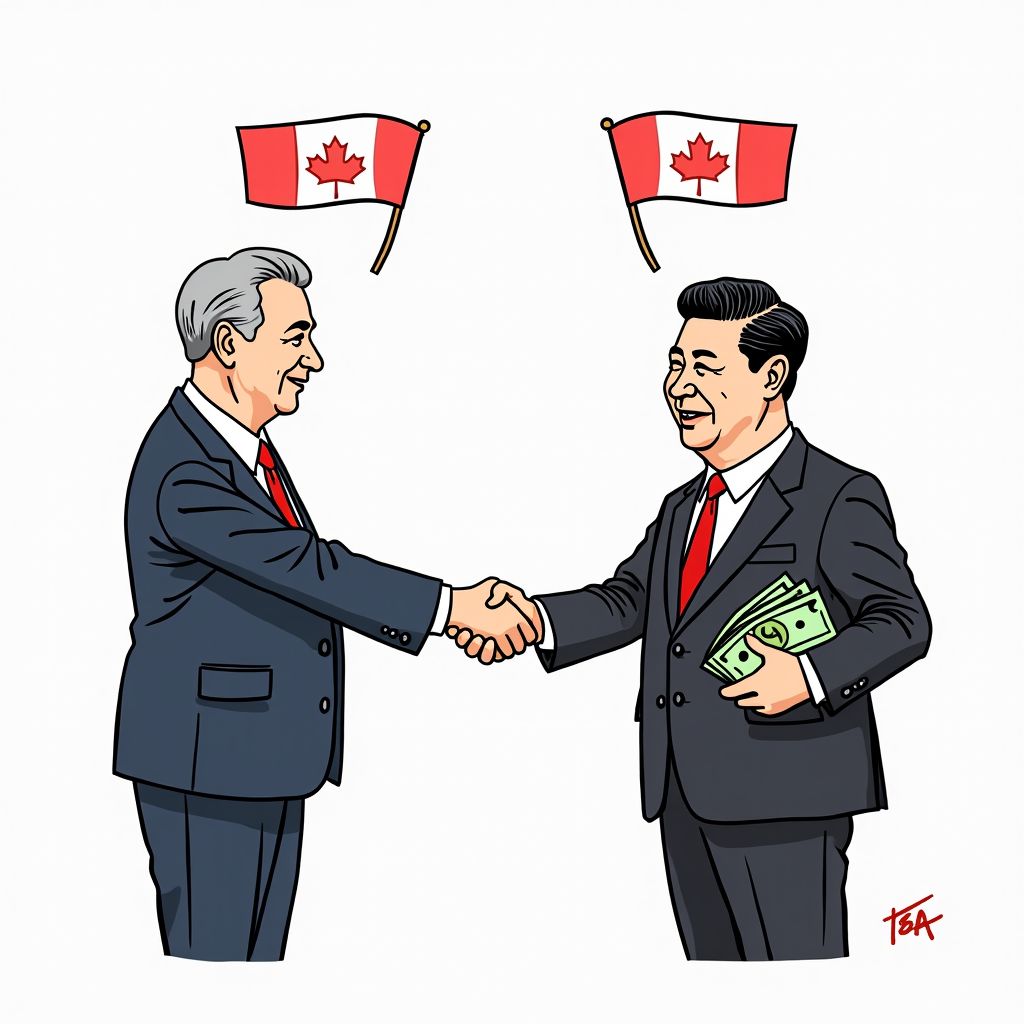
Beijing, Friday, 16 January 2026.
Canada pivots to Beijing, agreeing to import 49,000 Chinese electric vehicles at preferential rates in exchange for slashed canola tariffs and visa-free access, ending an eight-year diplomatic freeze.
A Strategic Hedge Against American Volatility
Following our recent coverage of the Eurasia Group’s warning that Canada stands as the primary casualty of deepening U.S. political instability, Prime Minister Mark Carney has moved swiftly to diversify the nation’s economic dependencies. On Friday, January 16, 2026, Carney and Chinese President Xi Jinping formalized a “new strategic partnership” in Beijing, effectively ending an eight-year diplomatic freeze [1][3]. The timing is critical; as analysts warn of a “Zombie USMCA” threatening North American supply chains, Ottawa has secured a definitive alternative, prioritizing trade certainty with the world’s second-largest economy over the unpredictability currently radiating from Washington [1][3]. Carney explicitly framed this pivot by characterizing China as a “more predictable partner” than the United States, a stark assessment that underscores the widening rift in traditional North American alliances [3][7].
The Quid Pro Quo: EVs for Agriculture
The centerpiece of this agreement is a calculated trade-off between Canadian agricultural access and Chinese automotive manufacturing. In a move that reverses the previous administration’s restrictive stance, Ottawa has agreed to admit a quota of 49,000 Chinese electric vehicles (EVs) into the Canadian market [1][3]. These vehicles will be subject to a preferential tariff rate of just 6.1%, a dramatic reduction from the prohibitive 100% duties imposed by the Trudeau government in 2024 [1][5]. This concession directly addresses Beijing’s grievances regarding market access and serves as the lever that unlocked reciprocal benefits for Canadian exporters [6][8].
Unlocking Billions for Canadian Farmers
In exchange for opening the door to Chinese EVs, Canada secured immediate and significant relief for its agricultural sector. China has committed to slashing tariffs on Canadian canola products—a critical export commodity—from current levels of approximately 84% down to roughly 15% [1][2]. This reduction is scheduled to take effect by March 1, 2026 [1][5]. Furthermore, the deal removes retaliatory “discrimination tariffs” on other key exports, including peas, lobsters, and crabs, for a period extending from March 1 through at least the end of 2026 [4][5]. Government estimates suggest these measures will unlock nearly $3 billion in export orders for Canadian farmers and fish harvesters, providing a vital lifeline to sectors that had been collateral damage in the Sino-Canadian trade disputes of 2024 and 2025 [5].
Diplomatic Normalization and Visa Reform
Beyond the ledger of tariffs and quotas, the Beijing summit yielded immediate diplomatic dividends aimed at restoring people-to-people ties. The agreement includes a normalization of visa processes, with China granting visa-free entry to Canadian visitors, a significant gesture intended to revive tourism and business travel [1]. This diplomatic thaw follows a period of intense friction, marking the first visit by a Canadian leader to China since 2017 [2][5]. The swift finalization of these terms—occurring just days after initial talks began on January 14—suggests a mutual urgency to stabilize economic relations. While the U.S. remains Canada’s dominant trading partner, absorbing 75% of its goods in 2024, Carney’s administration is clearly executing a strategy of “variable geometry,” engaging in multilateral pacts to insulate the Canadian economy from the shocks of American protectionism [1][6].
Sources
- www.channelnewsasia.com
- www.bbc.com
- www.bbc.com
- www.cbc.ca
- www.reuters.com
- www.cbc.ca
- nationalpost.com
- www.bnnbloomberg.ca