Measuring the Divide Between Stock Market Records and Everyday Economic Reality
Washington, Friday, 7 August 2026.
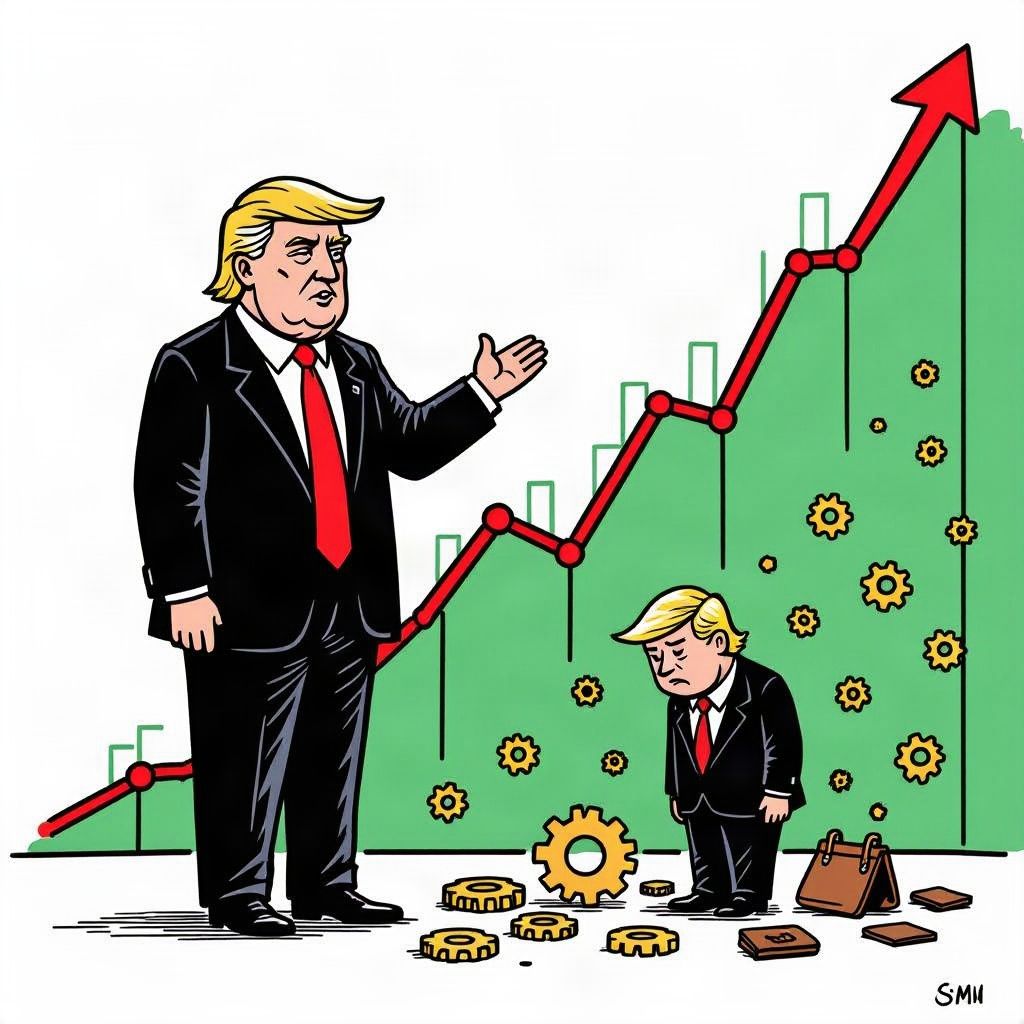
Despite record stock market highs and total employment, President Trump faces a 32% economic approval rating as job growth slows sharply and manufacturing loses 95,000 positions.
Political Rhetoric Meets Economic Data in Las Vegas
On August 5, 2026, President Donald Trump addressed a crowd at the Red Rock Casino Resort and Spa in Las Vegas, emphasizing record stock market highs and claiming unprecedented employment levels [1][4]. Despite these assertions, an AP-NORC poll conducted in late July 2026 reveals a stark contrast in public perception, with only 32% of U.S. adults approving of the President’s handling of the economy [6][8]. Furthermore, 69% of Americans characterize the economy as poor, citing the cost of groceries and gas as primary stressors [7]. This divergence sets a contentious tone ahead of the midterm elections scheduled for November 3, 2026, where control of Congress will be decided [1][6].
Employment Records Mask Slowing Growth Trends
While the President stated that more Americans are working than at any point in history, data confirms U.S. non-farm payrolls reached nearly 159 million in June 2026, continuing a long-term historical trend [4][7]. However, the rate of job creation has decelerated significantly during the second Trump term, averaging 92,000 jobs per month in 2026 compared to 329,000 per month during the Biden administration [8]. The difference in monthly job creation averages 237000 jobs, highlighting a substantial slowdown in labor market momentum [6]. Factors contributing to this reduction include high interest rates, immigration policy changes, and Baby Boomer retirements [7]. As of August 7, 2026, the July jobs report status remains pending, leaving analysts waiting for updated figures [alert! ‘July jobs report release status unconfirmed in source text’].
Manufacturing Activity Versus Factory Employment
President Trump claimed manufacturing is booming, supported by Institute for Supply Management data showing activity hitting its highest level since May 2022 [4][6]. Yet, the sector employs 95,000 fewer workers in June 2026 than in January 2025, with only 18,000 jobs added so far in 2026 [7][8]. Trade data further complicates the picture; U.S. goods exports peaked at $221.8 billion in April 2026 but declined to approximately $206.9 billion in June 2026 [1][6]. This represents a percentage change of -6.718 in export value over the two-month period [4]. Additionally, imports in June 2026 reached nearly $388 billion, maintaining a significant trade deficit despite export fluctuations [8].
Democratic Opposition and Investment Discrepancies
Democratic candidates, including Nevada gubernatorial candidate Aaron Ford, criticized the administration’s economic policies at a Reno event on August 6, 2026 [3]. Ford highlighted ongoing legal challenges against tariffs, claiming they cost Nevada families an average of $1,700 annually [3]. Regarding investment, while Trump claimed trillions in new capital inflows via Truth Social on August 4, 2026, the White House cites a $10.7 trillion figure that includes prior commitments [6][7]. In contrast, Bureau of Economic Analysis data shows total private investment operating at an annual pace of $5.7 trillion from April 2026 through July 2026 [8]. These discrepancies underscore the analytical challenges executives face in forecasting for the remainder of 2026 [1].
Sources
- www.dallasnews.com
- www.instagram.com
- www.kolotv.com
- www.wral.com
- www.yahoo.com
- www.darnews.com
- www.mysanantonio.com
- www.lowellsun.com