Massive National Debt Has Already Eroded Federal Reserve Independence
Washington D.C., Wednesday, 14 January 2026.
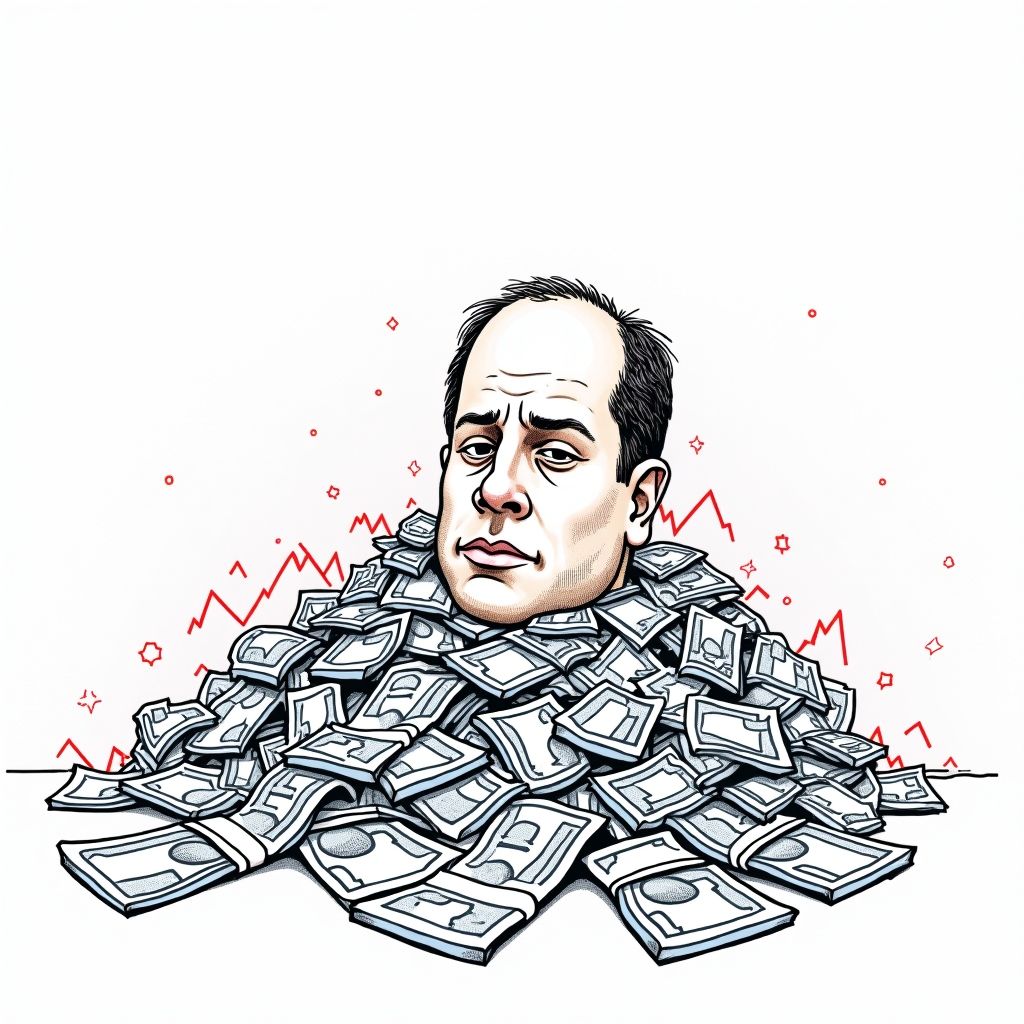
Economist Tyler Cowen argues the $38 trillion national debt has already nullified Federal Reserve independence, predicting years of 7% inflation may be necessary to erode the burden.
Market Calm Belies Institutional Erosion
The financial world remained surprisingly composed following the revelation on Sunday, January 11, 2026, that Federal Reserve Chair Jerome Powell is under criminal investigation by the Department of Justice regarding a $2.6 billion renovation of the central bank’s headquarters [1]. While such an announcement would historically trigger significant volatility in equities, the muted market reaction underscores a deeper structural shift identified by prominent economist Tyler Cowen. Cowen argues that the market’s indifference signals a tacit acceptance that the Federal Reserve’s independence has already been dismantled, not by political scandal, but by the overwhelming weight of the nation’s $38 trillion sovereign debt [1]. According to Cowen, the United States has entered a phase where fiscal constraints dictate monetary policy, rendering the specific leadership of the Fed less consequential than the macroeconomic mathematical realities facing the nation [1].
The Mechanics of Fiscal Dominance
This phenomenon, often referred to in economic circles as ‘fiscal dominance,’ suggests that when government debt reaches unsustainable levels, the central bank loses the luxury of setting interest rates solely to manage inflation or employment. Instead, its primary function shifts toward keeping the government solvent. Cowen posits that the accumulation of budget deals, tax cuts, and chronic deficits over recent decades has narrowed the Federal Reserve’s operational freedom to the point of obsolescence [1]. He describes this loss of autonomy as the “ugly little truth” behind the current news cycle: the markets effectively ignored the Trump-Powell friction because investors understand that the path of monetary policy is now predetermined by debt servicing requirements rather than the discretion of the Federal Reserve Chair [1].
The Inflationary Endgame
The economic implications of this debt burden are severe. Cowen forecasts that the United States may require a prolonged period of high inflation—specifically, half a decade of 7% inflation—to erode the real value of the debt relative to the size of the economy [1]. This view aligns with the ‘Big Cycle’ theory proposed by Ray Dalio, founder of Bridgewater Associates, who warns that nations burdened with massive debts inevitably face a trilemma of austerity, default, or inflation [1]. Both Cowen and Dalio agree that the U.S. political economy is structured to choose inflation over the alternatives. As Dalio notes, future generations are likely destined to service this debt in “devalued dollars,” effectively transferring the cost of current fiscal profligacy to the future through diminished purchasing power [1].
Structural Deficits and Productivity Hopes
The pressure on the Federal Reserve is compounded by entrenched structural spending that policymakers have shown little appetite to curb. For instance, the Social Security Fairness Act, passed during the Biden administration, expanded benefits for affluent retirees, adding to the fiscal load [2]. Furthermore, automatic cost-of-living adjustments continue to ratchet up outlays; in years where adjustments should mathematically be negative due to deflationary pressures, benefits remain flat, permanently increasing the real cost of the program [2]. While some optimism remains—Morgan Stanley recently noted a 4.9% annualized boost in productivity based on third-quarter GDP data—economists led by Michael Gapen caution that this rise may be merely cyclical rather than a structural solution to the debt crisis [1]. Ultimately, the consensus among these experts is that without a radical shift in fiscal discipline, the Federal Reserve will be forced to monetize the debt, validating the market’s grim acceptance of higher inflation as the inevitable path forward [1].