Laundry Fire Aboard USS Gerald R. Ford Highlights Risks of Extended Naval Deployments
Washington, Friday, 13 March 2026.
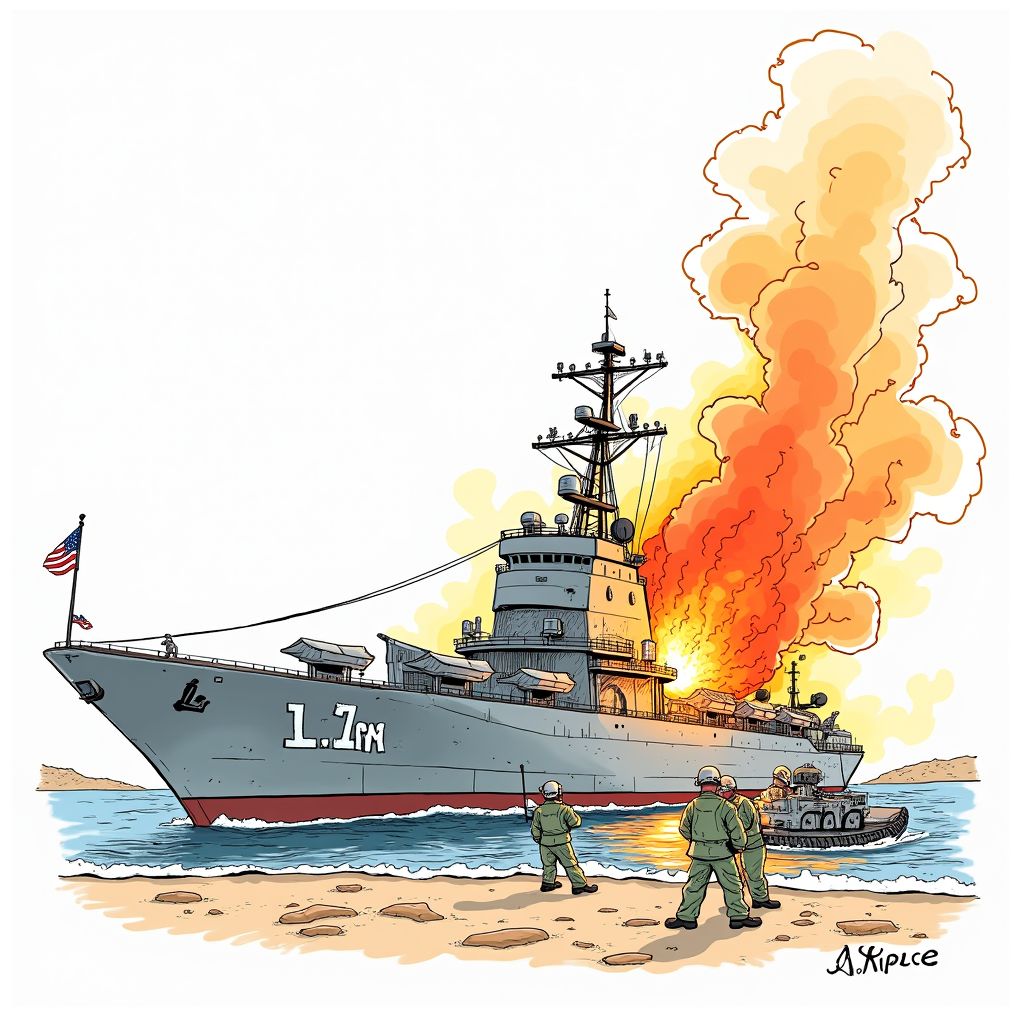
A non-combat laundry fire aboard the USS Gerald R. Ford injured two sailors. Despite the incident, the advanced aircraft carrier remains fully operational during its critical Red Sea deployment.
Operational Status and Incident Details
Following the outbreak of a non-combat-related fire on March 12, 2026, the crew of the USS Gerald R. Ford (CVN-78) swiftly contained the blaze within the ship’s main laundry spaces [1][2]. [alert! ‘Sources 3 and 6 state the fire occurred on March 6 and March 5 respectively, but official U.S. Central Command statements confirm March 12’] Operating in the northern Red Sea off the coast of Al Wajh, Saudi Arabia, the multi-billion dollar vessel avoided critical damage [1]. Statements from the U.S. Navy’s 5th Fleet confirmed that the nuclear propulsion plant remained entirely unaffected, ensuring the aircraft carrier retains its fully operational status [2][5].
The Strains of an Extended Deployment
The incident brings renewed attention to the physical and logistical strains of prolonged maritime deployments. The USS Gerald R. Ford departed Naval Station Norfolk, Virginia, on June 24, 2025 [3]. As of Monday, March 9, 2026, the carrier had been underway for 261 days [3]. By the time of the fire on Thursday, the deployment had stretched to 264 days. This extended operational tempo has not been without maintenance hurdles; since 2023, the carrier has logged 42 calls for assistance specifically related to plumbing issues, highlighting the inevitable wear and tear on shipboard infrastructure [3].
Operation Epic Fury and High-Stakes Deterrence
The operational demands on the Ford Carrier Strike Group are currently dictated by Operation Epic Fury, the ongoing U.S.-Israeli military campaign against Iran initiated under the Trump administration [1][4]. The carrier’s recent movements reflect a high-stakes strategic posture: after operating off the coast of Crete in late February, the USS Gerald R. Ford transited the Suez Canal on March 5 alongside the guided-missile destroyers USS Mahan (DDG-72), USS Bainbridge (DDG-96), and USS Winston S. Churchill (DDG-81) [1][4].
Balancing Asset Preservation and Strategic Mandates
For defense analysts and military planners, the laundry fire aboard the USS Gerald R. Ford is a critical data point in the broader calculus of naval readiness [GPT]. While the immediate crisis was expertly managed by the crew [1][2], it underscores the compounding risks of sustaining complex military assets in high-threat, forward-deployed environments [GPT]. As the U.S. Navy continues to project decisive power in the Red Sea, balancing the urgent demands of Operation Epic Fury with the imperative of asset preservation will remain a central challenge for naval leadership [GPT].
Sources
- news.usni.org
- www.cusnc.navy.mil
- www.navytimes.com
- www.washingtonpost.com
- www.instagram.com
- www.washingtonexaminer.com