U.S. Launches Rescue Mission for Missing Airman Following the Loss of Two Aircraft
Washington, Saturday, 4 April 2026.
As the U.S. searches for a missing airman after losing two aircraft, a rescue helicopter was struck by Iranian fire, signaling an escalation that threatens global energy markets.
Escalation in the Skies
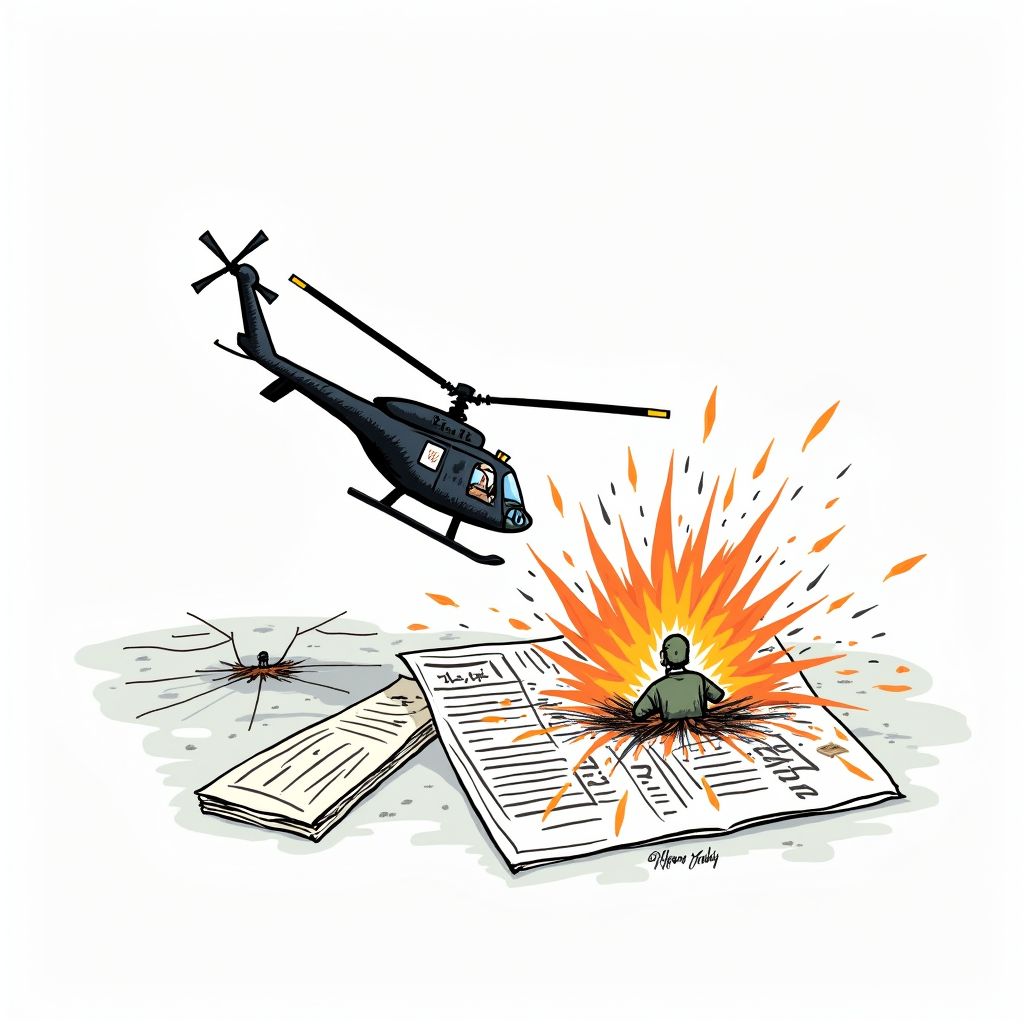
Following earlier reports analyzing unverified images of a destroyed US fighter jet in Iran, the situation has definitively escalated into a confirmed loss of American military assets [GPT]. On April 3, 2026, Iranian forces claimed responsibility for downing two United States warplanes: an F-15E Strike Eagle over the Kohgiluyeh and Boyer-Ahmad provinces, and an A-10 Warthog attack aircraft in the Persian Gulf, though U.S. officials maintain it remains unclear whether the A-10 was shot down or crashed due to other operational failures [alert! ‘Conflicting reports between Iranian state media and U.S. officials regarding the exact cause of the A-10 crash’] [1][2][4]. While two American crew members were successfully rescued, a third remains missing in action, triggering an intensive search and rescue operation [1][4]. The recovery mission, utilizing a C-130 Hercules flanked by Black Hawk helicopters, faced direct hostile engagement [4][5]. One of the U.S. Black Hawks was struck by Iranian fire during the search but managed to remain airborne [4]. Tehran asserts that a “new advanced defence system” was responsible for downing the aircraft [4].
Diplomatic Stalemates and Regional Spillovers
Diplomatic efforts to halt the hostilities have entirely stalled. On April 1 and 2, 2026, Iran formally rejected a 15-point, 48-hour ceasefire proposal offered by the Trump administration [3][4]. Iranian Foreign Minister Abbas Araghchi stated that Tehran is not planning negotiations to end the war under the current framework, insisting that any dialogue must guarantee a conclusive end to what he described as an “illegal war” [1][3]. Iranian President Masoud Pezeshkian further accused Washington of hypocrisy regarding diplomacy, pointing to previous threats by President Trump to bomb Iran “back to the Stone Ages” [4].
Economic Fallout and Supply Chain Disruptions
The geopolitical instability is sending shockwaves through global financial and energy markets. The Strait of Hormuz, a critical maritime chokepoint that was open prior to the conflict, is now heavily compromised [2]. President Trump recently addressed the disruption by suggesting that nations heavily reliant on the strait should secure their own transit, noting that while 80 to 85 percent of the crude oil passing through the Strait of Hormuz goes to Asia, only 2 percent is destined for the United States [2]. In response to the crisis, the United Kingdom organized a coalition of forty countries on April 2, 2026, to work toward reopening the strait, while nations like China and India are attempting to negotiate separate safe-passage deals directly with Iran [2].
Nuclear Infrastructure Under Fire
Adding to the volatile mix are repeated strikes near Iran’s nuclear facilities. On April 3, 2026, a fourth attack occurred near the Bushehr nuclear complex, killing a security guard and damaging a support building [1]. While the International Atomic Energy Agency (IAEA) reported no immediate increase in radiation levels following the strike, the proximity of the attacks to active reactors remains a profound concern [1]. Iranian Foreign Minister Araghchi issued a stark warning that any radioactive fallout from the Bushehr plant would not primarily affect Tehran, but would instead “end life” in neighboring regional capitals [1].