Iranian Missile Strike on Qatar Gas Facility Jolts Global Energy Markets
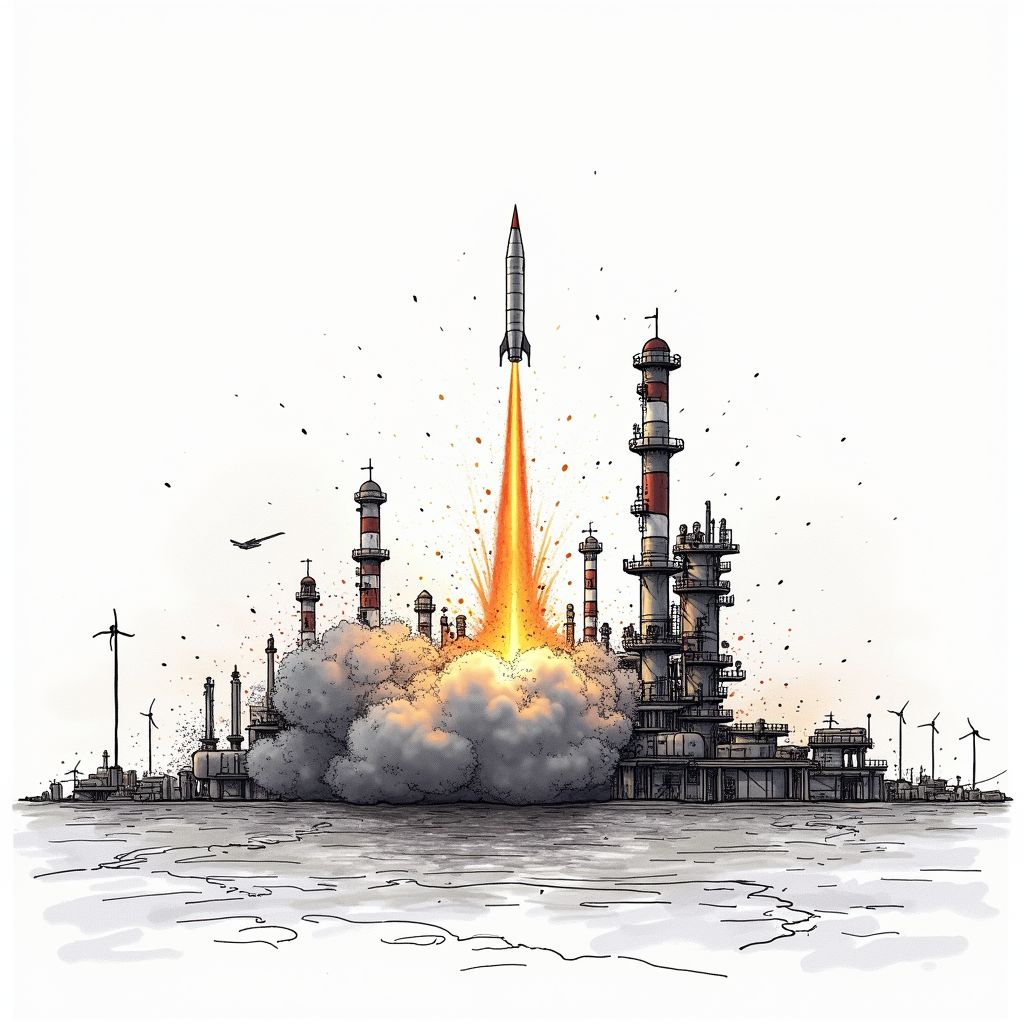
Ras Laffan, Wednesday, 18 March 2026.
Wednesday’s Iranian missile strike severely damaged Qatar’s Ras Laffan facility, halting production. This escalation instantly severs 20% of global liquefied natural gas supplies, triggering severe market volatility.
A Direct Hit on Global Supply
The focal point of Iran’s retaliation was Qatar’s Ras Laffan Industrial City, a cornerstone of global energy production. Qatar’s Interior Ministry confirmed that civil defense teams were deployed to combat a major fire in the area following the Iranian missile strike [3]. In a subsequent statement, QatarEnergy, the world’s largest producer of liquefied natural gas (LNG), reported “extensive damage” to the complex, though all personnel were safely accounted for with no casualties reported [2]. Prior to the strike, sources indicated that the Ras Laffan installations were actively being evacuated following explicit threats from Tehran [6].
Coordinated Threats and Regional Escalation
The attack on Ras Laffan was not an isolated incident but part of a broader, calculated threat issued by Iranian authorities. In the hours leading up to the strike, Iranian state media broadcasted evacuation warnings for several key oil and gas facilities across the Arabian Peninsula [6]. The explicitly named targets included Saudi Arabia’s Samref Refinery and Jubail Petrochemical Complex, the United Arab Emirates’s Al Hosn Gas Field, and Qatar’s Mesaieed Petrochemical Complex alongside the Ras Laffan Refinery [2][5]. By issuing these directives, Iran signaled its willingness to systematically dismantle the Gulf’s energy production capacity in retaliation for the Israeli strikes on its South Pars field [2][4].
Geopolitical Fallout and Uncertain Futures
The diplomatic fallout from the strikes has been swift and deeply critical of all belligerents. Majed al-Ansari, spokesperson for Qatar’s Ministry of Foreign Affairs, strongly condemned the Iranian assault on Ras Laffan as a “brutal” and “dangerous escalation,” labeling it a direct threat to Qatari national security [2]. Interestingly, al-Ansari had previously criticized the initial Israeli attack on Iran’s South Pars—which is essentially a shared geological formation with Qatar’s North Field—as a “dangerous and irresponsible step” [7]. He emphasized that targeting energy infrastructure poses a severe threat to global energy security and the environmental safety of the region’s populations [5][7].
Sources
- wsnext.com
- www.aljazeera.com
- english.news.cn
- www.kare11.com
- www.middleeasteye.net
- www.timesofisrael.com
- www.aljazeera.com