United Airlines CEO Sparks Brand Debate by Flying First Class on Rival Carrier
Dallas, Sunday, 10 May 2026.
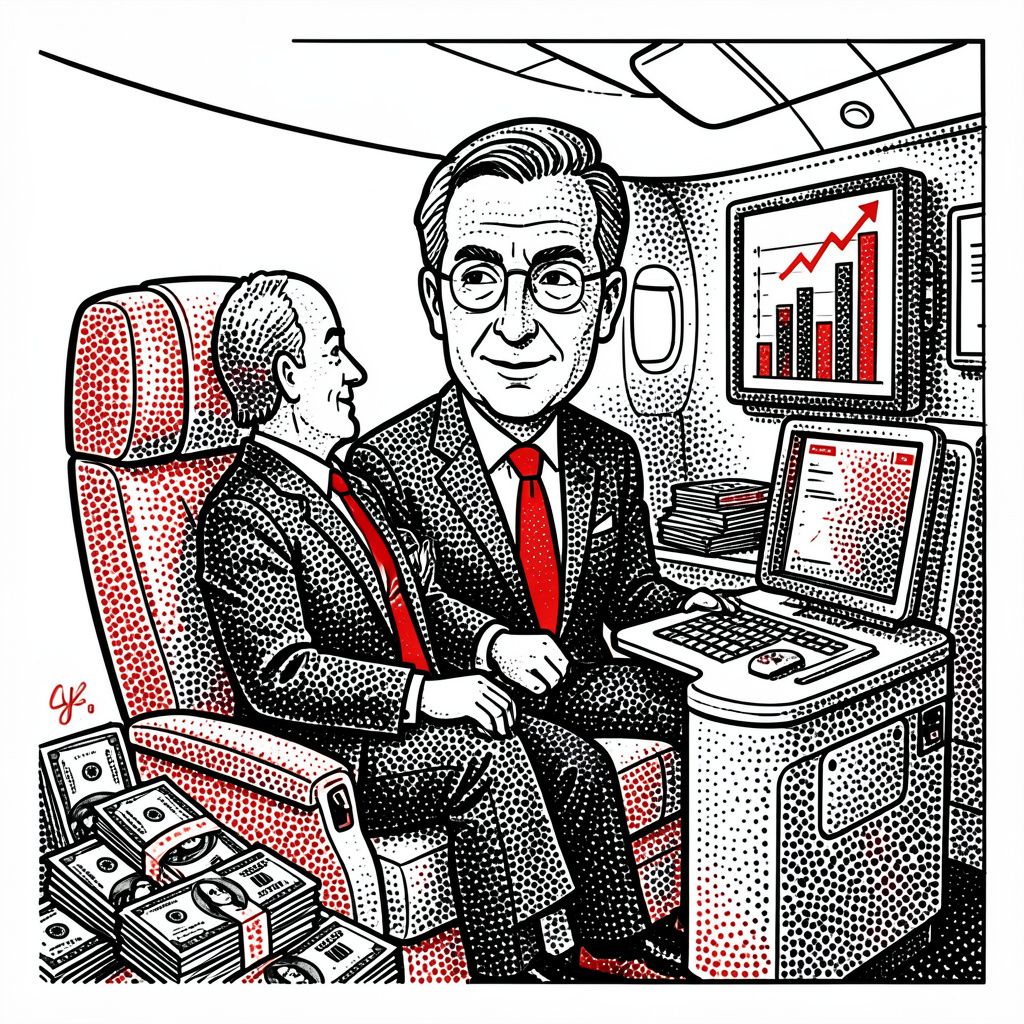
Highlighting executive optics, United CEO Scott Kirby flew first class on rival American Airlines on May 9, 2026, ironically utilizing lifetime perks from the very competitor he frequently criticizes.
A Complicated Corporate History
On May 9, 2026, United Airlines Chief Executive Officer Scott Kirby was observed flying in the first-class cabin of an American Airlines flight bound for Dallas/Fort Worth International Airport (DFW) [2]. While the sight of a major airline executive flying on a competitor’s aircraft is unusual, the journey aligns with Kirby’s personal logistics; despite heading a Chicago-based airline, he continues to reside in Dallas, Texas, where his children attend school [1]. Born in 1967 and raised in Rowlett, Texas, Kirby frequently works from his Dallas home, necessitating regular travel [1][2]. Because his lifetime travel benefits on American Airlines are explicitly designated for personal use, commuting to his family residence falls within the contractual parameters of his exit agreement [1].
To understand the dynamics of this public relations incident, one must examine the intertwined history of Kirby and American Airlines. Exactly 10 years ago, in 2016, Kirby was terminated from his position as President of American Airlines [1][2]. At the time, then-Chief Executive Officer Doug Parker opted to retain Chief Operating Officer Robert Isom over Kirby [1]. Because Kirby’s departure did not include a non-compete clause, he was able to immediately transition to United Airlines in August 2016 as president, eventually succeeding Oscar Munoz as Chief Executive Officer in May 2020 [1][2]. He also departed American Airlines with a substantial severance package valued at approximately $13 million [1][2].
More notably for this recent incident, Kirby’s 2016 exit package vested him with extensive lifetime travel privileges on American Airlines [1][2]. These benefits include unlimited reserved personal travel in any class of service for himself and eligible immediate family members, complimentary access to Admirals Club travel lounges, and an annual allotment of 12 free round-trip passes—or 24 free one-way passes—for non-eligible family and friends [1][2]. Thus, his presence in an American Airlines first-class seat was financially underwritten by the very carrier he now competes against [1].
The Chicago Turf War and Merger Rumors
The optics of the May 9 flight are particularly striking given the escalating rhetoric and strategic maneuvers between the two carriers in 2026. Under Kirby’s leadership, United Airlines has aggressively targeted American Airlines’ market share, specifically initiating a campaign to ‘de-hub’ American’s operations in Chicago [2]. Kirby has not shied away from public confrontation, openly mocking American Airlines’ Chicago operations as part of a broader strategy to assert United’s dominance in the region [1].
Beyond regional turf wars, Kirby has previously explored the ambitious idea of a corporate takeover. In what has been characterized as a potential ‘revenge deal,’ Kirby pitched former United States President Donald Trump on the concept of United Airlines acquiring American Airlines [1]. He even utilized the United Airlines customer database to distribute an email detailing the theoretical benefits of him leading a combined carrier [1]. However, American Airlines has firmly and publicly dismissed any discussions regarding a potential merger with United [2].
Executive Optics and Brand Alignment
From an analytical standpoint, the situation underscores the delicate nature of executive public relations. Over the past decade, Kirby has been credited with successfully rebuilding United Airlines’ domestic network, fleet, and overall product [1]. Yet, when the architect of this revitalization is photographed enjoying the premium cabin of his primary rival, it creates a visual narrative that contradicts his own corporate messaging [GPT]. While Kirby is fully within his contractual rights to utilize the lifetime perks granted by his former employer [1][2], the decision to do so on a highly visible route highlights a disconnect between personal financial prudence and corporate brand alignment [GPT].
In the highly competitive United States aviation sector, brand loyalty is a critical metric for investors and consumers alike [GPT]. American Airlines has reportedly already begun making it more difficult for employees of other airlines to secure confirmed space at discounted rates on their flights [1]. While this policy shift targets standard industry commuting perks rather than executive lifetime benefits, it reflects the increasingly contentious atmosphere between the major carriers [1]. For United Airlines, the challenge moving forward will be ensuring that its leadership’s public actions consistently reinforce the value proposition of its own product, rather than showcasing the amenities of its fiercest competitor [GPT].