Kennedy Center's Tarp Mystery: Why Trump's Name Removal Is Still Hidden
Washington, Friday, 19 June 2026.
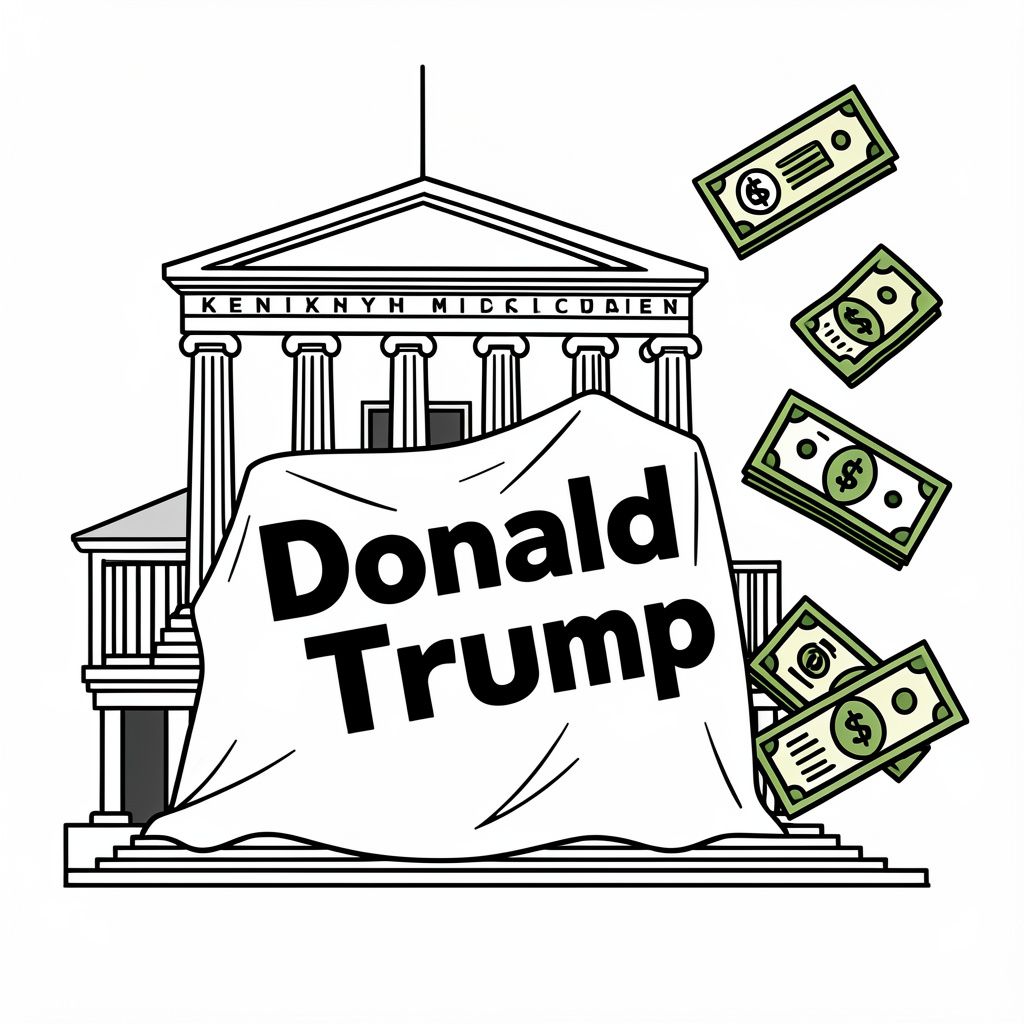
For six days, a massive tarp has concealed the Kennedy Center’s facade after Donald Trump’s name was removed—sparking accusations of a ‘literal coverup.’ Despite court orders and public outcry, officials cite ‘marble repairs,’ leaving the controversy unresolved. What’s really behind the delay?
The Court Order That Sparked a Week-Long Standoff
The controversy began on May 29, 2026, when U.S. District Judge Christopher R. Cooper ruled that the John F. Kennedy Center for the Performing Arts had violated its establishing law by adding former President Donald Trump’s name to its facade without congressional approval [1]. The judge ordered the name’s removal within two weeks, setting a firm deadline that would later become a focal point of political and legal tension [1]. The Kennedy Center, however, did not comply quietly. On June 12, 2026—just hours before the court-imposed deadline—its board launched a last-minute legal challenge to block the order, which was swiftly rejected by both the district court and the appeals court [2]. Despite the legal setback, the center’s lawyers filed documents the following day asserting ‘full compliance’ with the order, claiming they had removed ‘signage that purports to rename the Kennedy Center after President Trump’ [2].
A Tarp Becomes the Center of Attention
For six consecutive days, beginning on June 13, 2026, large tarps have obscured the Kennedy Center’s facade, preventing public confirmation of Trump’s name removal [3][4]. The Kennedy Center has maintained that the tarps are in place for ‘marble facade repairs,’ a claim that has drawn skepticism from lawmakers and the public [3]. The timing of the repairs—coinciding precisely with the court-ordered name removal—has fueled accusations of a deliberate cover-up. Representative Jamie Raskin (D-Md.) took to X (formerly Twitter) on June 17, 2026, to call the situation a ‘literal coverup,’ while Representative Mike Levin (D-Calif.) accused the center of ‘hiding the sign’ with ‘no plans’ to remove the tarp [5]. Representative Joyce Beatty (D-Ohio), who filed the original lawsuit challenging the name addition, posted a video earlier in the week mocking the tarp, asking, ‘Who do they think they’re fooling?’ [5].
Legal Deadlines and Public Access: What Comes Next?
The legal saga is far from over. Judge Cooper has ordered the Kennedy Center to provide an update on its construction project status by June 19, 2026, and to outline steps for ensuring public access and programming after July 5, 2026 [1][6]. The center’s July calendar, however, shows a sparse schedule, with only a National Symphony Orchestra performance on July 26 and a handful of film screenings [2]. The ongoing appeal, which the Kennedy Center’s board voted to pursue on June 11, 2026, could extend the controversy for weeks or even months [2]. Meanwhile, the tarp remains in place, with no official timeline for its removal, leaving the public and lawmakers alike questioning the center’s transparency and motives [3].
Political Fallout and the Broader Implications
The Kennedy Center’s decision to add Trump’s name in December 2025 was controversial from the start, given the center’s status as a federally funded institution and its historical ties to the Kennedy family [1][2]. The board, appointed during Trump’s presidency, voted to honor him for his administration’s arts funding initiatives, a move that critics argued was politically motivated [GPT]. The subsequent legal battle and the current tarp controversy have only intensified the debate over the intersection of politics, culture, and public institutions. Business leaders and political analysts are closely monitoring the situation, as it may signal broader shifts in how corporations and institutions respond to political figures amid evolving public sentiment [3]. The outcome of this dispute could set a precedent for how naming rights and symbolic gestures are handled in the future, particularly for federally funded entities [1].
The Kennedy Center’s Statement and Public Reaction
In response to the growing criticism, Kennedy Center spokesperson Roma Daravi told The Washington Post on June 15, 2026, that the tarp was necessary for ongoing marble repairs and that there was no set timeline for its removal [3]. The statement did little to quell the controversy, with many viewing the explanation as an attempt to deflect from the political implications of the name removal. CNN correspondent Betsy Klein reported on June 15, 2026, that the tarp had become a symbol of the broader political divide, drawing attention from both sides of the aisle [7]. Social media has been ablaze with reactions, with some users mocking the situation as ‘theater of the absurd,’ while others defend the Kennedy Center’s right to manage its property as it sees fit [7]. The lack of transparency has only fueled speculation, with some suggesting the tarp is a deliberate attempt to avoid public backlash until the controversy dies down [alert! ‘No direct evidence supports this claim, but public sentiment reflects widespread skepticism’].
The Financial and Cultural Cost of a Symbolic Battle
Beyond the political and legal ramifications, the Kennedy Center’s ongoing controversy has raised questions about the financial and cultural costs of such symbolic battles. The center, which relies on a mix of federal funding and private donations, has faced criticism for diverting resources to legal challenges rather than its core mission of supporting the arts [GPT]. The legal fees associated with the appeal, combined with the potential loss of donor confidence, could have long-term implications for the institution’s financial health [alert! ‘Exact figures for legal costs or donor impact are not publicly available’]. Culturally, the dispute has reignited debates over the role of public institutions in honoring political figures, particularly those with polarizing legacies. The Kennedy Center’s decision to add Trump’s name in 2025 was seen by some as an attempt to curry favor with the former administration, while its removal has been framed by others as a necessary correction to an overreach of political influence [1][2]. The outcome of this battle may influence how other cultural institutions navigate similar decisions in the future.
Sources
- www.yahoo.com
- www.forbes.com
- www.washingtonpost.com
- apnews.com
- twitter.com
- www.courtlistener.com
- www.instagram.com