Massive Artificial Intelligence Spending Triggers Sharpest Wall Street Drop Since June
New York, Saturday, 31 October 2026.
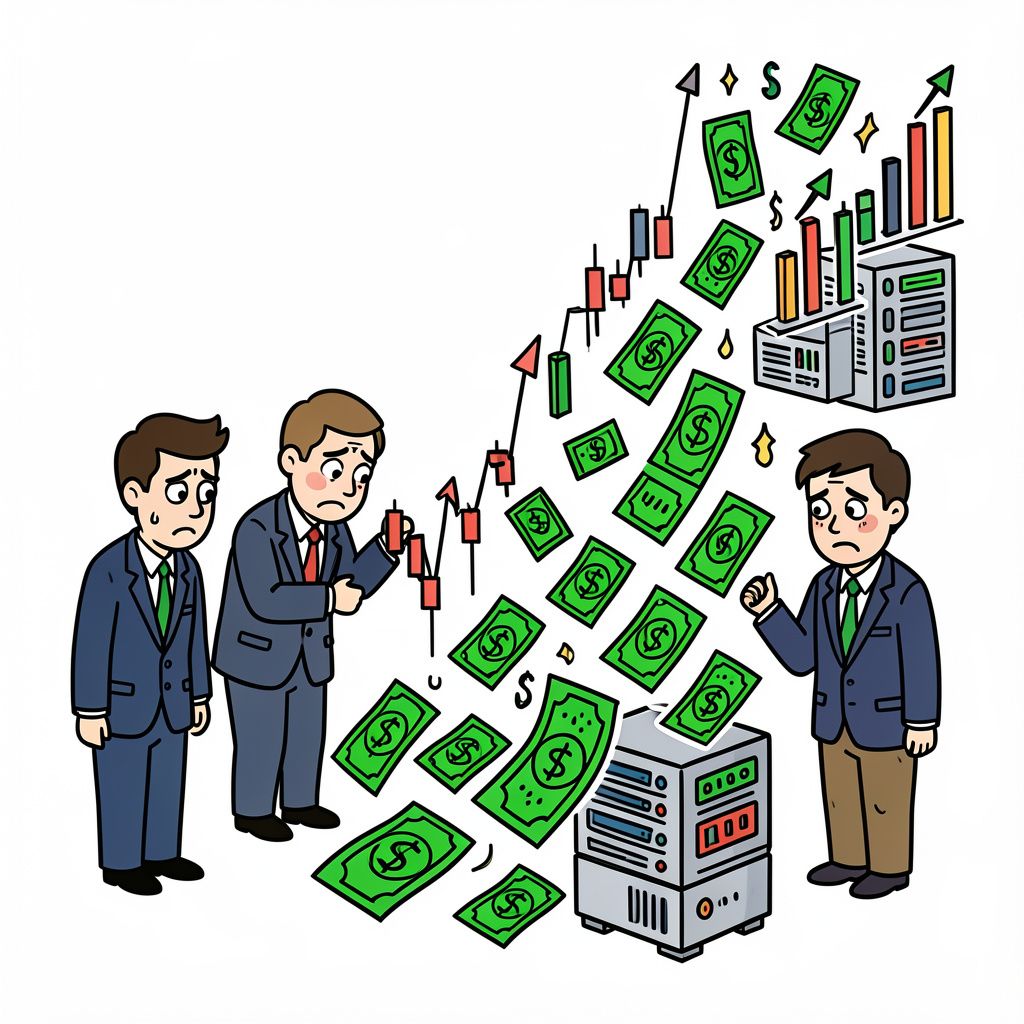
Surging capital expenditures sparked a sharp market retreat, highlighted by four major tech giants committing over $700 billion to artificial intelligence infrastructure despite increasingly skeptical investor demands for immediate returns.
A Market Reckoning: The AI Spending Paradox
The sell-off that began on Friday, October 24, 2026—amplifying into a historic rout by Friday, October 29—exposed a widening chasm between corporate ambition and investor patience. The S&P 500 tumbled 1.8% [1][5][9], the Nasdaq composite fell 2.9% [1][5][9], and the Dow Jones Industrial Average lost 572 points (1.1%) [1][5][9], marking Wall Street’s steepest single-day decline since June 2026. The catalyst? A market-wide reassessment of whether the AI infrastructure boom, valued at over $700 billion this year by analyst estimates—comparable to the GDP of Argentina or Belgium [5]—can deliver returns commensurate with the capital deployed. ‘We’re moving out of the hopes and dreams phase of the AI trade and into the ‘show me’ phase,’ warned Joe Tigay, portfolio manager at Equity Armor Investments, encapsulating the shift from speculative euphoria to fiscal scrutiny [1][5][9][10].
Earnings Reality Checks Unleash a Tech Avalanche
The rout was catalyzed by a cascade of disappointing earnings reports from the very companies leading the AI charge. Alphabet’s shares plunged 12.6% on Thursday, October 23, 2026 [4][8][10], erasing over $500 billion in market capitalization in a single session and dragging the S&P 500 down 0.3% [4]. The company’s quarterly purchases of property and equipment exceeded $51 billion, primarily earmarked for AI infrastructure, exacerbating concerns over free cash flow burn and the sustainability of such aggressive capital allocation [4]. Intel, the semiconductor giant, suffered its worst day since 1974, with shares plummeting 28.6% on October 24 after issuing a weak Q4 profit forecast [1][5][9]. The company cited persistent weakness in the PC market and manufacturing bottlenecks—ironically exacerbated by the AI build-out itself, which has crowded out critical components for consumer electronics [5]. Amazon, despite beating profit expectations for the latest quarter, reported burning through $42.4 billion in free cash flow over the prior 12 months, including $94.8 billion spent on property and equipment primarily for AI technology [1][5][9]. Its stock fell 1.4% as investors questioned whether such expenditures could translate into sustainable earnings growth [1][5][9].
The Domino Effect: From AI Enthusiasm to Sector-Wide Distrust
The sell-off extended beyond individual corporate missteps, morphing into a sector-wide repricing of technology valuations. Nvidia, once the poster child of the AI revolution with a market capitalization nearing $5 trillion, saw its shares drop 3.1–4.2% across multiple sessions [5][7][9], pulling the S&P 500 downward amid concerns that high interest rates could throttle AI data center expansion [7]. The Nasdaq 100, a bellwether for tech growth, wiped out over $2 trillion in market value in October 2026 alone, falling more than 5.8% [7]. Analysts at FHN Financial highlighted the ‘significant growing pains’ afflicting tech giants as they aggressively pursue AI infrastructure, noting that the sell-off reflected not just company-specific issues but a broader market skepticism about the entire sector’s ability to monetize its investments swiftly [5]. Steve Sosnick of Interactive Brokers framed the decline as a reckoning for stocks priced ‘for perfection’: ‘When you price for perfection, anything less than perfect is going to come back and is going to bite you,’ he remarked, underscoring the fragility of valuations built on future promises rather than current performance [5].
Global Reverberations and the Broader Economic Fallout
The impact of the tech rout transcended U.S. borders, sending shockwaves through international markets. South Korea’s Kospi index fell 3.5% [1][5][9], Japan’s Nikkei 225 dropped 2.1% [1][5][9], and Hong Kong’s Hang Seng managed a modest gain of 1.5% [9], as investors grappled with the dual concerns of AI spending sustainability and central bank policy stasis [1][5][9]. The Bank of Japan’s decision to keep interest rates steady alongside the Federal Reserve and European Central Bank added to the uncertainty, reinforcing fears of a prolonged period of high borrowing costs that could stifle both AI infrastructure expansion and consumer demand [1][5][9]. In the commodities sphere, Brent crude oil rose 2.4% to $113.43 per barrel [1][5][9], a reflection of ongoing geopolitical tensions, while the 10-year Treasury yield fell to 4.93% from 4.98% on October 28 [1][5][9], signaling a flight to safety among bond investors. The cryptocurrency market, already volatile, was further roiled by a hack on Binance that impacted over $6 billion in crypto assets, with Bitcoin’s price falling below $77,000—a stark contrast to its peak of over $86,000 earlier in the month [1][5][9].
Investor Sentiment Shifts: From Guilt-by-Association to Strategic Realignment
The market’s abrupt pivot has also exposed the pitfalls of ‘guilt-by-association’ trading, where disappointing results from one company unfairly drag down entire sectors. Jim Cramer, host of CNBC’s Mad Money, argued that investors were ‘punishing the wrong tech stocks’ by conflating weak performance from companies like Fortinet, ServiceNow, Workday, and Salesforce with broader industry trends [2]. ‘Their stocks should be bought, not sold,’ Cramer asserted, emphasizing that the declines in these companies were company-specific rather than indicative of systemic issues [2]. He advised investors to ‘do the homework’ and recognize that short-term penalties often create buying opportunities in fundamentally stronger firms [2]. This sentiment aligns with the broader market’s transition from indiscriminate enthusiasm for AI to a more discerning, data-driven approach—one that prioritizes profitability over potential [2][5].
Policy and Politics: The Looming Shadow of the U.S. Midterms
Against this backdrop of economic turbulence, the U.S. midterm elections scheduled for Tuesday, November 3, 2026, loom large. The elections, which will determine control of Congress, introduce an additional layer of uncertainty for investors already grappling with AI spending skepticism and geopolitical risks [1][5][9]. While markets have historically shrugged off midterm elections in the past, the current environment—characterized by high inflation, elevated interest rates, and a tech sector in flux—heightens the stakes. Strategas, a prominent investment firm, added to the intrigue with reports that its chief financial officer would resign the week of November 2–8, 2026, for personal reasons [1][9], further amplifying concerns about leadership stability in a critical sector [1][9].
Sources
- apnews.com
- www.cnbc.com
- www.google.com
- www.google.com
- apnews.com
- www.theguardian.com
- www.google.com
- www.google.com
- apnews.com
- www.google.com