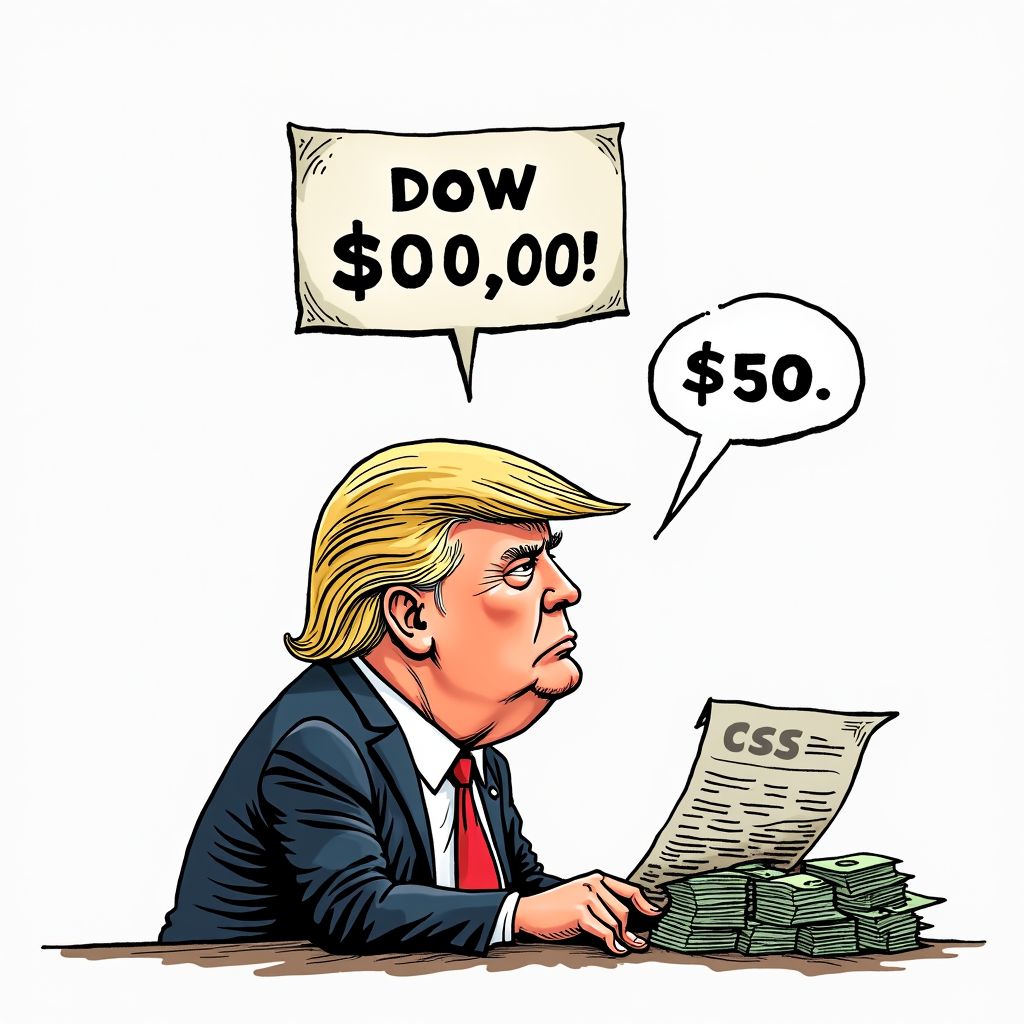
Record Dow 50,000 Milestone Fails to Boost President’s Declining Approval
Washington, Tuesday, 17 February 2026.
Despite the Dow Jones surpassing 50,000, President Trump’s net approval rating has dropped to a second-term low of -15, signaling a deep disconnect between Wall Street gains and voter sentiment.
Market Highs Versus Voter Reality
While the financial markets celebrate a historic milestone with the Dow Jones Industrial Average crossing 50,000, the political landscape for the administration tells a starkly different story. As of February 16, 2026, President Trump faces approval ratings that are lower than those recorded during his first term [2]. Despite the SPDR Dow Jones Industrial Average ETF (DIA) posting a year-to-date gain of 3.1% and a 52-week increase of 10.8%, voters appear unmoved by these equities gains [1]. A recent Morning Consult poll conducted between February 6 and February 9 places the President’s approval at 45% and disapproval at 52% [1]. This sentiment is echoed by broader data showing that 56% of voters disapprove of the President’s job performance, compared to only 41% who approve [2].
Immigration Enforcement and Policy Stalls
Beyond the economy, the administration’s aggressive stance on immigration enforcement appears to be alienating a significant portion of the electorate. An AP-NORC poll released on February 8, 2026, revealed that 6 in 10 Americans now hold an unfavorable view of Immigration and Customs Enforcement (ICE) [8]. Furthermore, a Marist poll found that 65% of Americans believe the agency has “gone too far” in enforcing immigration laws [2]. This backlash coincides with operational shifts, such as the President pulling immigration agents from Minneapolis on February 13 [6]. The intensity of the opposition is notable; as of February 13, 46% of Americans reported they “strongly disapprove” of the President’s job performance [4].
Electoral Risks in the Midterms
These declining metrics pose a tangible threat to the Republican Party as the 2026 midterm election season accelerates. Data analysts warn that the President’s political brand is entering the campaign season at its weakest point in years, with Democrats poised to make substantial gains in both chambers of Congress [8]. In a sign of internal friction, President Trump has refused to endorse vulnerable incumbent Senator John Cornyn in Texas, despite a competitive GOP primary approaching in just two weeks [8]. Harry Enten, a data analyst, noted on February 16 that the President’s approval ratings may not yet have found a floor, stating that in his second term, Trump has “fallen through it to another low level” [8]. With the Gallup organization announcing on February 11 that it would cease publishing presidential approval polls—a service it had offered since 1938—the administration faces this volatile political environment with one less historical barometer to track its standing [7].
Sources
- www.yahoo.com
- www.nytimes.com
- wbznewsradio.iheart.com
- www.nytimes.com
- www.citizen-times.com
- www.independent.co.uk