Wreckage of US Fighter Jet in Iran Sparks Global Economic Concerns
Tehran, Friday, 3 April 2026.
Unverified images of a destroyed US fighter jet in Iran contradict official denials, raising immediate concerns over regional stability and impending crude oil price volatility.
Competing Narratives in Contested Airspace
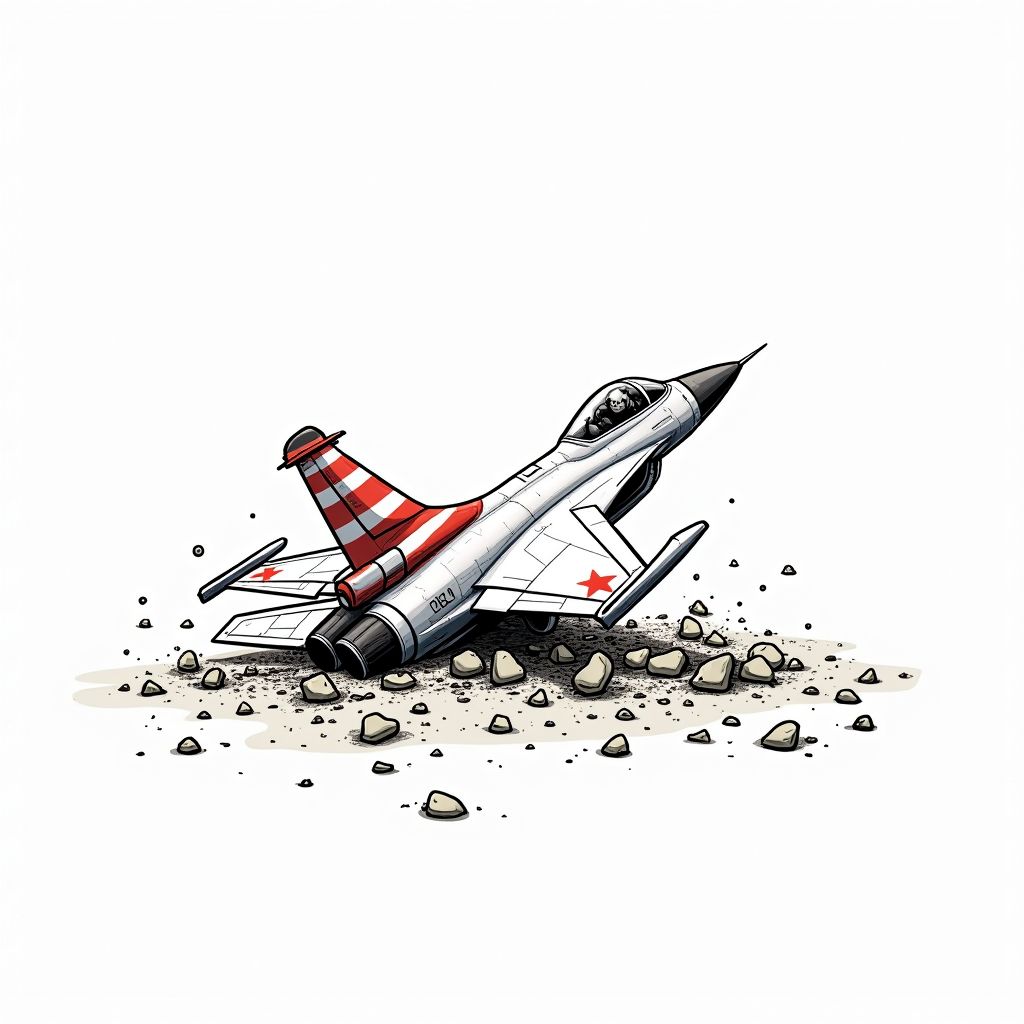
On April 2, 2026, Iran’s Islamic Revolutionary Guard Corps (IRGC) claimed to have downed a U.S. F-35 stealth fighter over central Iran using a newly deployed advanced air defense system [2][3]. However, visual evidence emerging on April 3 contradicts the specific aircraft model cited by Tehran. Analysts reviewing the scattered debris—including portions of the fuselage and a tail fin—have identified the wreckage as belonging to a U.S. Air Force F-15E Strike Eagle assigned to the 494th Fighter Squadron, based at RAF Lakenheath in the United Kingdom [2][3][4].
Search, Rescue, and Escalation Risks
The situation on the ground remains highly fluid and legally complex. Unlike the single-seat F-35, the F-15E operates with a crew of two [3]. Iranian local media reports that at least one pilot ejected over the Kohgiluyeh and Boyer-Ahmad Province, prompting an intense, multi-platform U.S. search and rescue operation involving HH-60 Black Hawk helicopters, HC-130J aircraft, and reconnaissance drones [2][4][5]. Ground evidence, including the discovery of an Advanced Concept Ejection Seat II (ACES II) system, supports the likelihood of a mid-air ejection [2].
Operation Epic Fury and the Ground War
This aerial loss occurs against the backdrop of “Operation Epic Fury,” a large-scale military campaign initiated by the U.S. and Israel on February 28, 2026, following the assassination of Ali Khamenei [5][7]. On March 31, 2026, CENTCOM Commander Adm. Brad Cooper confirmed that U.S. forces are actively striking targets to dismantle the Iranian regime’s security apparatus [7]. A key component of this operation has been the first combat deployment of the Precision Strike Missile (PrSM) [8].
Market Implications of a Prolonged Conflict
The intersection of advanced missile deployments, downed aircraft, and potential hostage situations signals a protracted and unpredictable conflict. The IRGC specifically claimed that an earlier shootdown attempt occurred near Qeshm Island in the Strait of Hormuz [2][3]. Any military engagement near this vital maritime chokepoint—through which a substantial portion of the world’s liquefied natural gas and crude oil flows—threatens to severely disrupt global energy supply chains [GPT]. As military operations intensify, business leaders and commodities traders must price in the reality that regional stability is deteriorating, leaving global markets acutely vulnerable to the next kinetic escalation.
Sources
- wsnext.com
- www.twz.com
- www.yahoo.com
- defence-blog.com
- www.turkiyetoday.com
- www.centcom.mil
- www.centcom.mil
- www.justsecurity.org