Why a Top University Ended Homework Grading in Advanced Mathematics
Berkeley, Sunday, 25 October 2026.
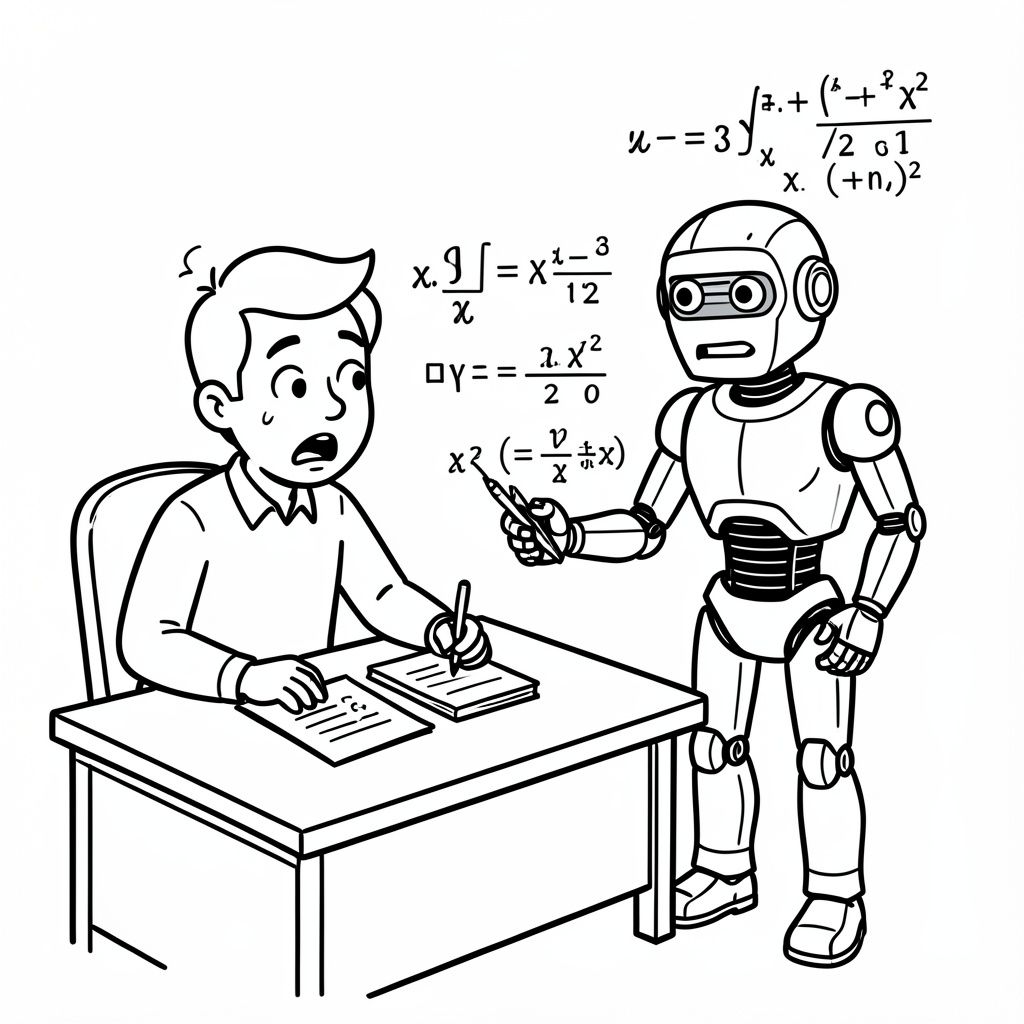
Fields Medalist Richard Borcherds halted grading homework for correctness at UC Berkeley after AI solved complex problem sets perfectly, warning algorithms will soon surpass human mathematicians entirely.
A Paradigm Shift in Mathematical Education
On Tuesday, 21 October 2026, Richard Borcherds, a UC Berkeley mathematics professor and 1998 Fields Medalist, announced he would no longer grade student homework for correctness after observing that generative AI tools reliably produced perfect solutions to complex problem sets [1][2][3][5][8]. Borcherds’ decision reflects a broader reckoning across higher education as AI tools like ChatGPT and advanced language models increasingly render traditional assessment methods obsolete. The move comes just days after OpenAI’s announcement that its AI agents had solved the Navier-Stokes existence and smoothness problem—a milestone in mathematics that had remained unsolved for over a century [1][2][3][5]. The convergence of these events has left academics and industry leaders scrambling to redefine how technical competency is evaluated in a workforce where AI-driven problem-solving is rapidly becoming the norm.
AI’s Ascendancy in Mathematics
Borcherds’ decision was catalyzed by the realization that AI models now outperform human students in solving advanced mathematical problems. In a candid interview with The Daily Californian, he stated, ‘If AI continues to improve at the present rate, then, in a few years, there’ll be nothing human mathematicians can do that AI can’t do better’ [1][2][3][5][8]. This sentiment is echoed by industry observers who note that AI’s ability to process and generate solutions to high-level math problems has reached a tipping point. For instance, Borcherds recounted how AI provided ‘much better answers’ to deep mathematical questions than any human mathematician, including himself [1][2][5]. The implications are stark: traditional homework and exam-based assessments are losing their validity as AI tools become ubiquitous in academic settings.
The Implosion of Traditional Grading
In response to the AI-driven disruption, Borcherds has pivoted to grading homework solely on completion, a system he admits is ‘not a very good system’ but necessary in the interim [1][2][3][5]. This shift underscores a growing dilemma in academia: if AI can produce flawless solutions, what purpose does grading for correctness serve? The UC Berkeley administration has acknowledged the challenge, with Anne Marie Richard, Assistant Vice Provost for Undergraduate Education, noting that faculty are encouraged to include AI use policies in course syllabi [1]. However, she emphasized that policies vary widely by course level and focus area, and standardized AI detection tools like Turnitin and Rumi have proven inadequate for campus-wide implementation [1]. As Borcherds put it, the academic system’s inertia may delay meaningful change for years, much like the continued publication of ‘utterly pointless’ physical journals despite digital alternatives [1][2][5].
A Career Counselor’s Dilemma
Borcherds’ announcement has sent ripples through the mathematics community, particularly among graduate students who now face an uncertain future. He candidly admitted, ‘It’s hard to know what advice to give graduate students because the future is changing in a rather major way’ [1][2][5]. The Fields Medalist noted that AI is already outperforming beginner graduate students in mathematics, and many are dropping out or reconsidering their career paths [1][2][5]. Borcherds himself has even consulted AI tools for career guidance, only to receive equally uncertain responses: ‘I even asked ChatGPT this exact question, and even ChatGPT said it didn’t have any idea what was going to happen’ [1][2][5]. This existential uncertainty extends beyond academia, as corporate leaders and human capital managers grapple with how to evaluate technical competency in an era where AI can outperform humans in problem-solving tasks.
Broader Implications for Industry and Education
The disruption in mathematical education is not an isolated phenomenon but a harbinger of broader changes in how technical skills are assessed and valued. Borcherds drew parallels to historical disruptions, such as the replacement of hand weaving by looms and horses by motor cars, noting that this is the first time such a disruption has occurred in mathematics [1][2][5]. For corporate leaders, this shift signals an urgent need to rethink talent pipelines and credentialing processes. Traditional metrics like grades and standardized test scores may no longer be reliable indicators of a candidate’s problem-solving abilities. Instead, companies may need to adopt AI-augmented assessments or focus on softer skills like creativity and critical thinking—areas where human intuition still holds an edge. The challenge, however, lies in developing new frameworks that can keep pace with the rapid evolution of AI capabilities.
Sources
- www.dailycal.org
- www.dailycal.org
- www.instagram.com
- uclafacultyassociation.blogspot.com
- www.instagram.com
- uclafacultyassociation.blogspot.com
- www.facebook.com
- x.com