Big Investors Quietly Sell Off Artificial Intelligence Stocks Ahead of Possible Market Drop
New York, Saturday, 1 August 2026.
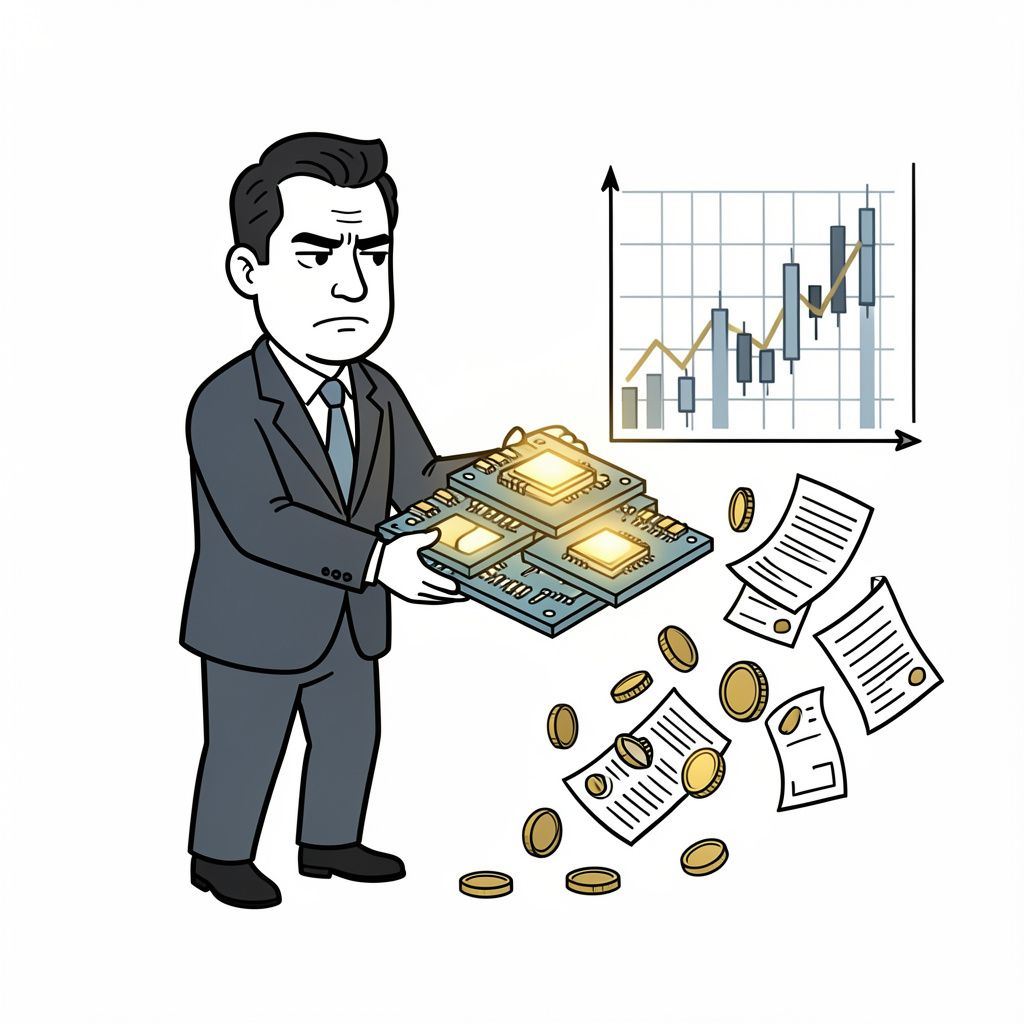
Former White House advisor Jim Rickards warns institutional funds are quietly exiting artificial intelligence equities, signaling a potential market correction as high expenditure fails to deliver near-term enterprise profitability.
Former Advisor Warns of Institutional Exit
Former national security and economic advisor Jim Rickards has issued a stark warning that institutional investors are quietly reducing their exposure to artificial intelligence stocks ahead of a potential broader market correction [1]. On 1 August 2026, Rickards asserted that a ‘Minsky Moment’ is imminent due to banks and sovereign wealth funds rapidly reducing AI stock positions [1]. According to Rickards, this divergence between institutional risk management and retail enthusiasm raises concerns regarding the long-term valuation sustainability of capital-intensive AI technology firms [1]. He stated that money is beginning to move out of AI fast, positioning sophisticated players to profit before the public catches on [1].
Market Performance and Recent Selloffs
Market data from 31 July 2026 supports the notion of volatility, with major indices declining sharply [2]. The Nasdaq fell 1.4%, the S&P 500 fell 1%, and the Dow Jones Industrial Average dropped 0.7% on that day [2]. Semiconductor stocks faced significant pressure, with the SMH index dropping 9.5% between 30 June 2026 and 31 July 2026 [2]. While some chipmakers showed year-to-date growth, the disparity was evident; for instance, Sandisk recorded a 471% increase compared to Nvidia’s 9% increase, meaning Sandisk surged 462 percentage points more than Nvidia year-to-date [2]. This volatility underscores the fragility investors perceive in the sector.
Institutional Divergence and Global Context
The shift in institutional strategy is not isolated to the United States. Global markets experienced a sharp sell-off earlier in mid-July 2026, driven by disappointing earnings from major technology firms [3]. On 14 July 2026, the South Korean KOSPI index fell 6.37%, while Japan’s Nikkei 225 dropped 4.03% [3]. Deutsche Bank analyst Jim Reid noted that fears about rate hikes and persistent inflation remain in the background, contributing to investor skepticism [3]. Torsten Sløk of Apollo Global Management warned that with so much riding on few names, a slower payoff could risk tipping the economy into recession [3].
Economic Implications and Interest Rates
Interest rate expectations are compounding the pressure on AI technology firms. Futures markets indicate a 52% probability of an interest rate hike in September 2026, according to the CME Group’s FedWatch Tool [2]. Potential interest rate hikes later in 2026 threaten to increase borrowing costs for firms developing capital-intensive AI technologies [2]. In the private markets, institutional concerns have centered on the durability of competitive moats for software businesses as AI-generated code raises risks that cheaper competitors could displace established firms [4]. As of 31 July 2026, investors are re-evaluating private market allocations in response to these disruption risks [4].
Future Outlook and Analyst Projections
Despite the turmoil, some analysts maintain a positive long-term view based on micro fundamentals. UBS Wealth Management SVP Charlie Anderson projects the S&P 500 will reach 7,900 by the end of 2026, shifting focus from macro headlines to micro fundamentals [3]. However, Rickards maintains that at this point, it is not a matter of ‘if’ this bubble pops, but simply a matter of ‘when’ [1]. He warned that the situation has the potential to bring the whole economy down, not just AI stocks [1]. Investors are advised to monitor capital flows closely as the situation develops through August 2026 [1].