Surging Fuel Costs and Inflation Drive Widespread Economic Anxiety
Washington, Monday, 18 May 2026.
A May 2026 poll reveals that 57% of Americans feel current economic policies are making them financially worse off, largely driven by inflation and conflict-related gas price spikes.
The Geopolitical Toll on Consumer Wallets
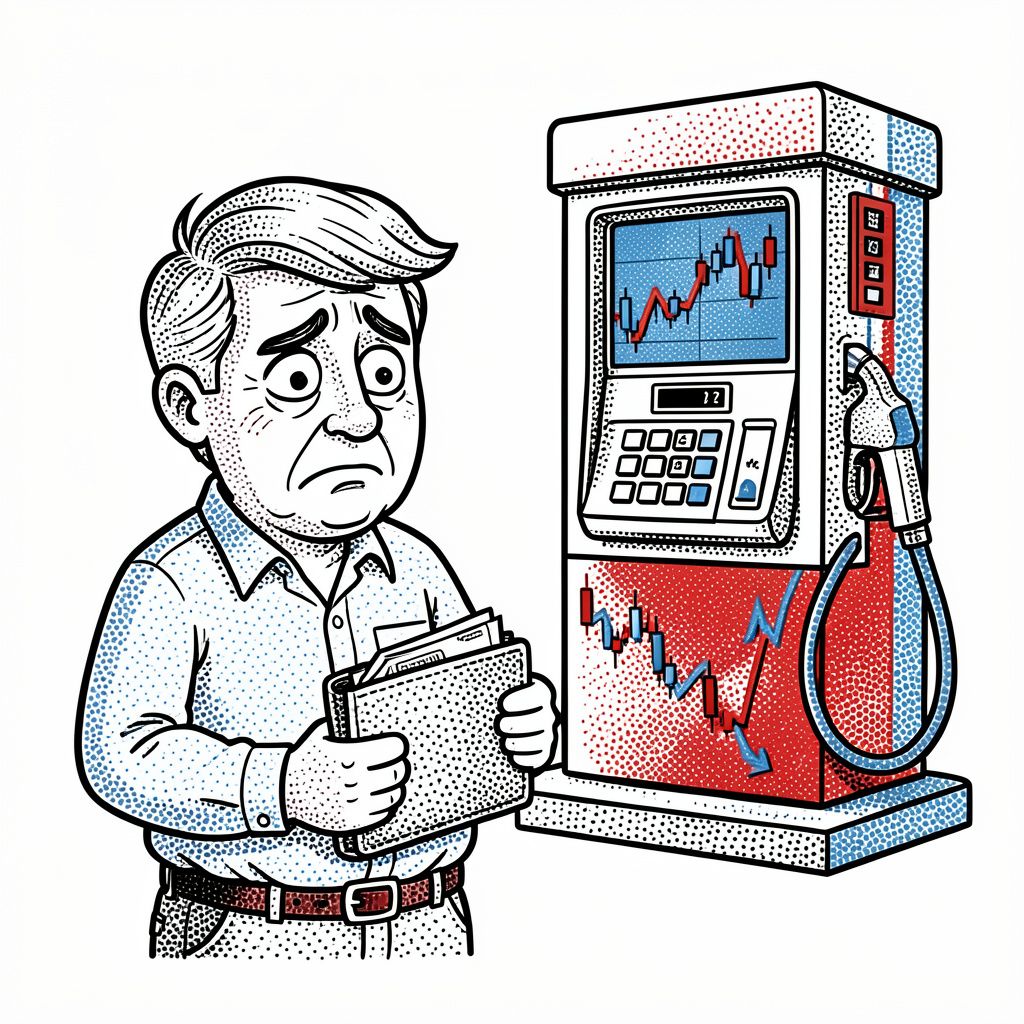
The ongoing conflict with Iran, now approaching its fourth month as of May 2026, has dramatically altered the domestic economic landscape [1]. Central to this disruption is the closure of the Strait of Hormuz, a critical maritime artery for the global oil industry [1]. This geopolitical bottleneck has triggered a severe spike in energy costs, with the national average for a gallon of regular gasoline reaching $4.51 by mid-May 2026, representing a 41.379 percent increase from the $3.19 average recorded a year prior [1]. House Speaker Mike Johnson recently emphasized that these elevated fuel costs are directly linked to the Strait’s closure, warning that the surge in transportation expenses will inevitably cascade down to the grocery store level, further straining household budgets [1]. While President Trump stated in a May 9, 2026 interview that the military action was necessary to prevent Iran from acquiring nuclear capabilities, he framed the economic fallout as “a little pain” and projected a resolution timeline of two to two-and-a-half months [3]. However, the administration’s prediction of a rapid decline in oil prices relies on a swift conclusion to the conflict [alert! ‘The exact timeline for reopening the Strait of Hormuz remains dependent on unpredictable geopolitical military developments’] [3]. Furthermore, a significant portion of the public remains in the dark regarding the conflict’s nuances, with most Americans expressing a lack of clear understanding about the situation in the Strait [2].
Inflation Outpacing Income and Rising Pessimism
Beyond the pump, broader inflationary pressures continue to erode purchasing power. Data from April 2026 shows the annual inflation rate sitting at 3.8 percent, remaining stubbornly above the Federal Reserve’s target of 2 percent [3]. Although the United States economy added 115,000 jobs in April 2026, the tangible benefits of this labor market growth are being overshadowed by the rising cost of living [3]. According to the CBS News/YouGov poll conducted between May 13 and May 15, 2026, a staggering 75 percent of Americans report that their incomes are failing to keep pace with inflation [2]. This disconnect between wage growth and everyday expenses has driven economic sentiment to its lowest point since 2023 [2]. Currently, 65 percent of respondents describe the economy as “uncertain,” 63 percent view it as “struggling,” and 40 percent label the system as “unfair” [3]. Consequently, most Americans now anticipate either a broader economic slowdown or a full recession [2]. This pervasive pessimism is particularly acute among younger demographics; Americans under the age of 50 report feeling worse about their economic opportunities compared to their parents’ generation [2]. Compounding these immediate financial fears is a growing anxiety regarding technological disruption, with approximately two-thirds of voters expressing concern that the rise of artificial intelligence will eliminate jobs [2][3].
Shifting Political Sentiments and Future Headwinds
The convergence of high inflation, geopolitical instability, and technological anxiety has severely impacted the public’s perception of the current administration’s economic stewardship. President Trump’s overall approval rating has fallen to 37 percent, marking the lowest level of his second term as of mid-May 2026 [2][3]. Approval of his handling of inflation is even lower, standing at just 27 percent among the general public, a drop of 6 percentage points from 33 percent in March 2026 [3]. Even within his own party, support is showing signs of erosion; while 85 percent of Republicans still approve of his overall performance, their approval regarding his management of inflation has slipped from 74 percent in March to 63 percent in May 2026, a decline of 11 percentage points [2][3]. Currently, 44 percent of Americans rate their personal financial situation as either “fairly bad” or “very bad,” compared to 49 percent who view it positively [1]. Furthermore, two-thirds of the public believe the administration’s policies are actively worsening the economy in the short term [2]. Despite these frustrations, voters appear disillusioned with the alternatives, as many do not believe either major political party is effectively addressing the cost of living crisis [2]. When asked who has a better approach to the economy, 35 percent favored the Democrats, while 31 percent selected President Trump and the Republicans [3]. For policymakers and market analysts, these figures serve as a critical indicator that consumer spending—a primary engine of the U.S. economy—may face significant headwinds if the underlying causes of this widespread financial distress are not swiftly resolved [GPT].