California Power Grid Shifts to Solar and Giant Battery Systems
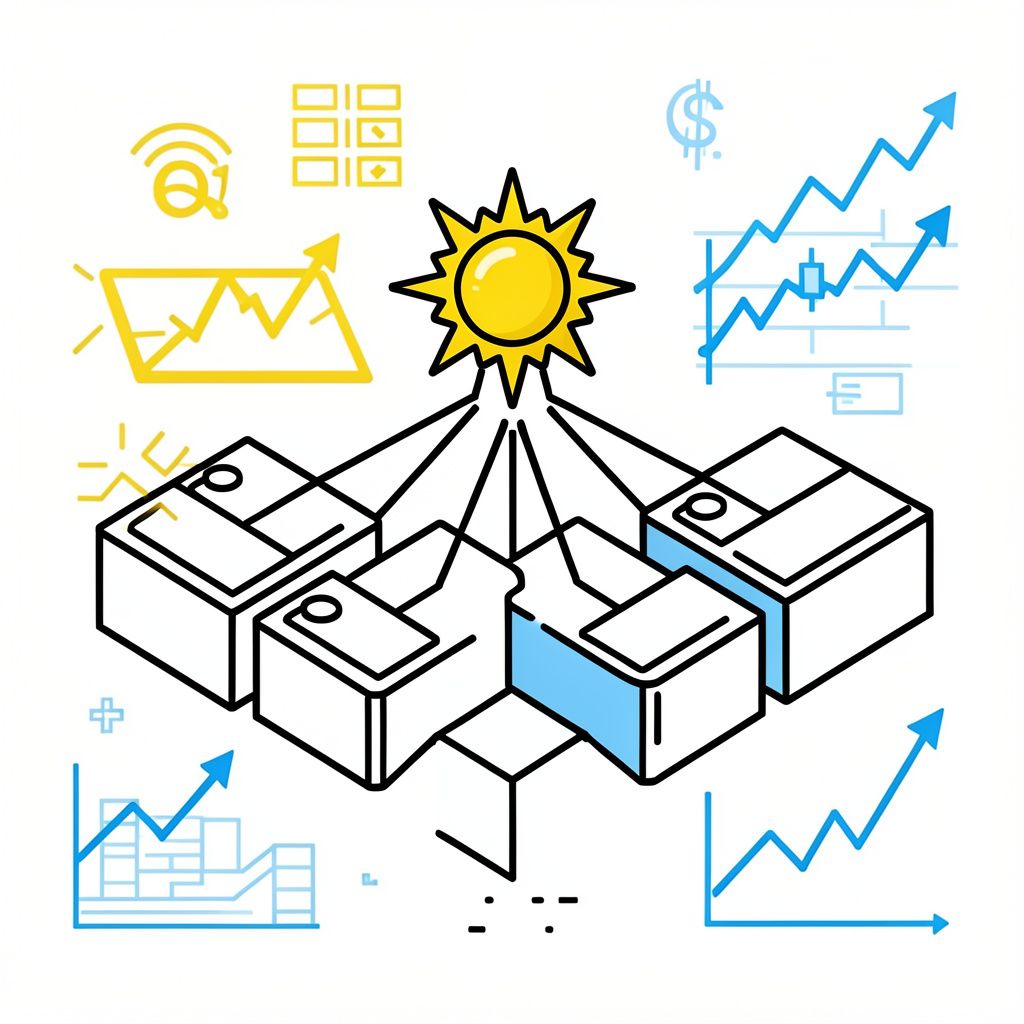
Sacramento, Saturday, 17 October 2026.
Powered by massive battery storage, California’s electricity grid now runs on 62% clean energy, with batteries supplying over 60% of power during peak evening surges.
California Power Grid Shifts to Solar and Giant Battery Systems
California’s state energy grid is undergoing a significant operational transformation driven by a rapid expansion of utility-scale solar installations and battery storage systems [1]. The state has become one of the world’s most important examples of how large-scale solar power can transform an electricity system, combining utility-scale farms with millions of rooftop installations [3]. By 2024, renewable and carbon-free sources provided 62% of the state’s electricity, a substantial increase from 58% in 2023 [1]. Solar energy’s contribution specifically grew to 20% of the mix by 2024, supported by over 2 million homes with rooftop solar installations [1].
Battery Capacity and Peak Demand Management
California currently possesses the largest battery fleet in the country with a capacity of approximately 21,000 MW as of August 2026 [1]. This represents a significant increase from the fraction of that capacity available five years prior [1]. These batteries now supply over 60% of power during evening demand surges in hot months, successfully shifting excess midday solar energy to cover peak demand [1]. Andrew Campbell, executive director of the Energy Institute at UC Berkeley Haas, noted that the batteries alone could probably satisfy about a quarter of the state’s demand at peak times [1].
Historical Shift and Economic Implications
In 2014, natural gas was the primary electricity source in California, with solar contributing only a small fraction of the energy mix [1]. By 2024, solar’s share grew to 20%, marking a dramatic change over the last 10 years driven by utility-scale solar and storage growth [1]. Despite these advancements, California electric rates are currently the highest in the United States, excluding Hawaii, with network infrastructure investments identified as a primary cost driver [1]. The Energy Commission is currently attempting to mitigate future costs by prioritizing energy efficiency improvements and investment in emerging technologies [1].
Reliability Challenges and Clean Energy Hours
The state achieved 1,856 hours of 100% clean energy operation in 2025, a substantial increase from 147 hours in 2022 [1]. This growth represents a percentage increase of 1162.585 in clean energy operation hours over the three-year period [1]. However, CAISO reported a 29% increase in renewable energy curtailment in 2024 compared to the previous year due to over-generation [1]. Balancing this abundance with reliability remains a key focus, as gas plants are still essential for meeting energy needs during the busiest times [1].
Recent Grid Stability and Regional Cooperation
Recent events highlight ongoing stability concerns, with reports on October 14, 2026, indicating 88,000 PG&E customers could lose power including in 5 Bay Area Counties [4]. California is showing how solar, batteries, rooftop systems, and better regional power sharing can work together to reduce reliance on natural gas [2]. Connections with neighboring regions give grid operators more options when demand changes, complementing the state’s internal storage capabilities [2]. This regional approach helps manage the gap between daytime generation and evening demand when solar output falls [3].
Expert Perspectives on Grid Flexibility
Industry experts emphasize the changing nature of grid management, with one commentator noting the grid is becoming more flexible thanks to energy storage [5]. Yann Brandt described the process as “boiling the grid” so that it becomes more malleable and effective for how energy is used today [5]. Andrew Campbell stated that twenty years ago, using electricity in the middle of the day was a very bad idea, but now it is entirely different [1]. The middle of the day is now the best time to use electricity due to solar power generation peaks [1].
Future Demand and Economic Outlook
California anticipates substantial growth in electricity demand over the next two decades driven by electric vehicles, building electrification, and the expansion of AI data centers [1]. Electricity demand in California is projected to increase significantly over the next 20 years due to these adoption trends [1]. Solar power generation peaks during midday hours, making that period the optimal time for electricity consumption in terms of cost and resource availability [1]. The state is encouraging residents to shift appliance usage to these hours to support grid greening and manage the evolving economic landscape [1].