Takaichi Secures Decisive Mandate for Economic and Defense Reforms in Landslide Victory
Tokyo, Sunday, 8 February 2026.
Japan’s Prime Minister Sanae Takaichi has solidified her political standing with a projected supermajority in today’s snap election, February 8, 2026. Exit polls indicate her Liberal Democratic Party (LDP) will secure between 274 and 326 seats, far exceeding the threshold for a simple majority. This landslide provides Takaichi the legislative leverage to unilaterally pursue aggressive fiscal policies and a hawkish defense posture regarding China, despite ongoing trade retaliation. Most intriguingly, the conservative leader has achieved unprecedented support among the youth, polling over 80% with voters in their 20s by leveraging a social media strategy that blends heavy metal drumming with nationalist rhetoric. This victory now sets the stage for a high-stakes summit with U.S. President Trump in March, signaling a significant shift in Asian-Pacific security dynamics.
A “Takaichi Strong” Government
The scale of the Liberal Democratic Party’s (LDP) victory has fundamentally reshaped Japan’s political landscape, creating a dynamic local media are already dubbing “Takaichi 1 Kyo” or “Takaichi Strong” [3]. Exit polls from public broadcaster NHK project the LDP will claim between 274 and 326 of the lower house’s 465 seats, a commanding leap from the 233 needed for a simple majority [1]. When combined with their coalition partner, the Japan Innovation Party (Ishin), the governing bloc is projected to control between 302 and 366 seats [1]. This absolute majority, with the LDP alone securing at least 234 seats—up from a pre-election strength of 198—means the party no longer relies on coalition consensus to govern effectively [2]. The opposition, particularly the moderate reform coalition, suffered a crushing defeat, fracturing into a multiparty system that leaves Takaichi with virtually unchecked legislative power [3].
Fiscal Aggression and the “Double-Hit” Risk
Takaichi’s economic platform, termed “responsible active fiscal policy,” signals a departure from traditional fiscal conservatism [4]. She has floated the possibility of suspending certain consumption taxes, a move that could cost the state treasury over $30 billion annually [2]. This aggressive spending comes as Japan’s economy shows signs of exiting its perennial deflationary cycle. Bruce Kirk, chief Japan equity strategist at Goldman Sachs Research, noted that wages are beginning to grow in tandem with inflation, creating a potential “virtuous cycle” [2]. Economists project consumer prices for February 2026 will dip to approximately 1 percent year-on-year, potentially allowing real wage growth to outpace price increases for the first time in decades [2].
The “Sana-chan” Phenomenon and Global Alliances
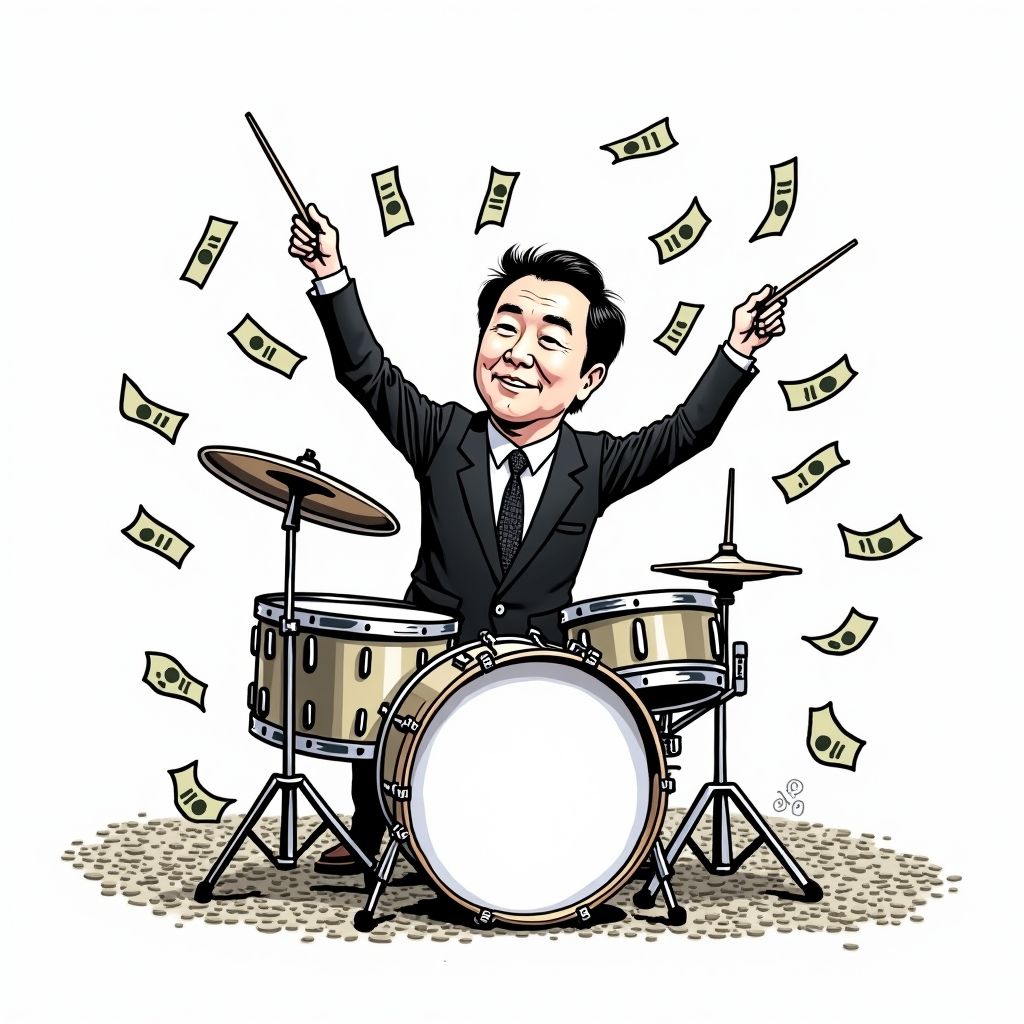
Perhaps the most striking aspect of this election is the demographic shift in Takaichi’s support base. Known affectionately as “Sana-chan” by younger voters, the 64-year-old Prime Minister has cultivated a cult of personality that defies the LDP’s traditional geriatric image [7]. Polling data indicates her support among voters in their 20s ranges from 50 percent to over 80 percent, driven by a social media strategy that highlights her love for heavy metal drumming and motorbikes [1][7]. This image curation extends to international diplomacy; on January 26, she held a televised drumming session with South Korean President Lee Jae-myung in Nara, blending soft power with high-level summitry [6][7]. Her merchandise, including cookies featuring her likeness alongside her political idol Margaret Thatcher, has sold out in souvenir shops across her home prefecture [7].
Sources
- www.nbcnews.com
- www.nytimes.com
- www.asahi.com
- www.jimin.jp
- news.yahoo.co.jp
- dot.asahi.com
- www.cnn.co.jp