China Expands Export Dominance into Premium European Markets
Beijing, Sunday, 27 September 2026.
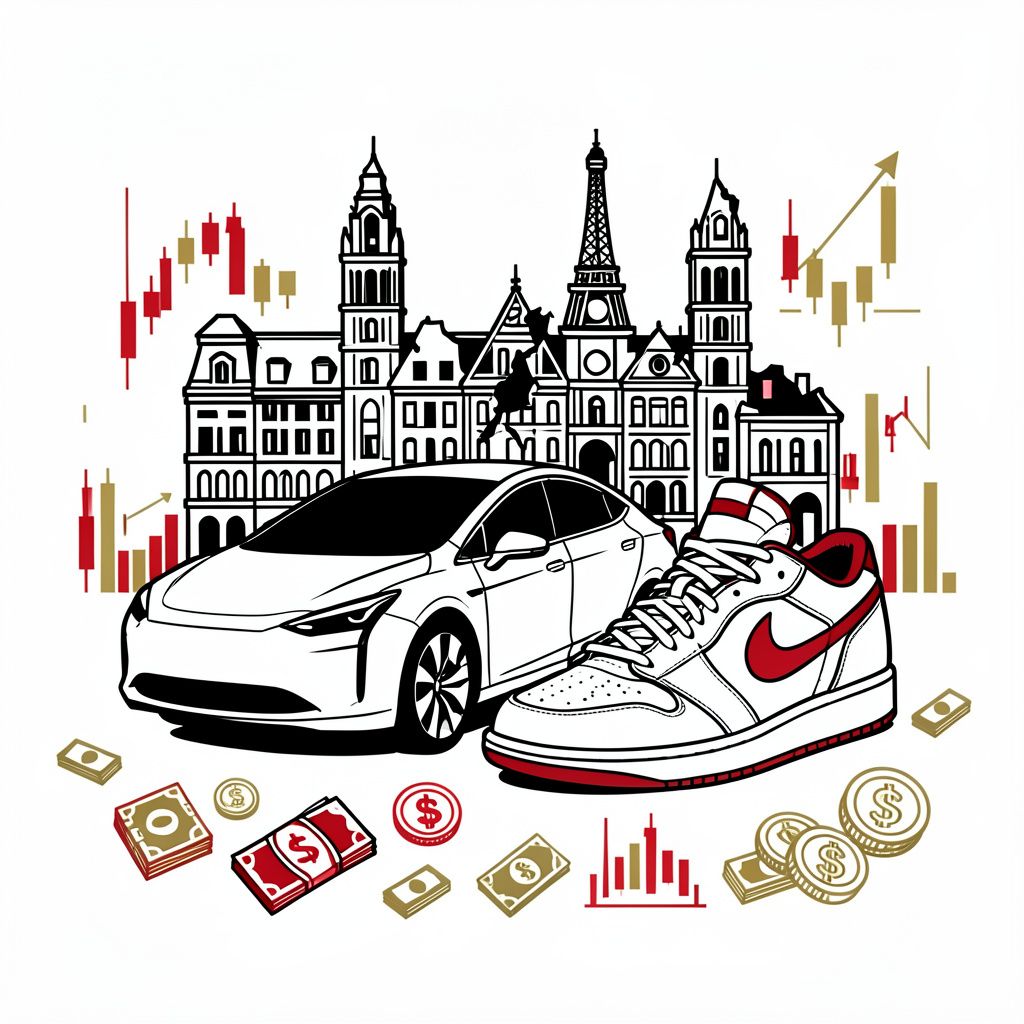
Chinese manufacturing is increasingly displacing traditional European strongholds, with high-end exports ranging from advanced electric vehicles to $1,000 Gucci sneakers pushing the EU trade deficit toward €400 billion.
The Second China Shock
Chinese manufacturing is increasingly displacing traditional European strongholds, with high-end exports ranging from advanced electric vehicles to $1,000 Gucci sneakers pushing the EU trade deficit toward €400 billion [1][4]. This shift marks a distinct departure from the early-2000s wave of low-cost goods, as economists now classify current trends as the “second China Shock,” characterized by exports of high-end industrial machinery and electric vehicles that compete directly with European manufacturers [1]. On 2026-09-24, Gucci confirmed that its new $1,000 sneakers are manufactured in China, marking a significant shift for the 105-year-old Italian brand even as it continues producing other products in Italy [1]. This transition underscores a broader pattern where Chinese producers have refined supply chains and technological capabilities to match European standards, challenging executive leaders and policymakers to navigate shifting global trade dynamics [1].
Escalating Trade Imbalances
The economic data reveals the scale of the disruption, with the EU’s trade deficit in goods with China rising from €306 billion in 2024 to €360 billion in 2025 [4]. Calculations based on Eurostat reports indicate this represents a 17.647 increase in the deficit over that period [4]. Projections suggest the deficit could reach up to €400 billion for 2026, a trajectory European Central Bank economists analyzed earlier this week regarding the increasing overlap between Chinese and German export goods [1][4]. Germany, as China’s largest EU trading partner, saw its bilateral trade deficit reach $61 billion in the first half of 2026 alone, a 39% increase from the same period in 2025 [6]. Furthermore, German car exports to China declined by 33.3% in 2025, while Volkswagen’s Q2 2026 deliveries in China fell 36.6% [1].
Strategic Policy Responses
In response to these imbalances, European Commission President Ursula von der Leyen stated on 16 September 2026 that the EU’s trade deficit with China is €1 billion per day, contributing to deindustrialization in Europe [4]. On 10 September 2026, the European Parliament Foreign Affairs Committee passed a draft resolution demanding action against economic overreliance on China in sectors including critical raw materials, semiconductors, and electric vehicles [4]. The European Council is scheduled to make key decisions on EU-China trade and investment policy on 15–16 October 2026, following a mandate issued on 19 June 2026 to produce tangible results by October [4]. Meanwhile, the EU has shifted toward “sectoral safeguards” as the primary trade defense instrument, which can be implemented within months to address sudden import surges in industries like hybrid cars and machinery [4].
Geopolitical Dimensions
The trade tension extends beyond Europe, with President Trump and President Xi Jinping meeting in Washington during the week of 2026-09-24 to discuss trade policy and China’s industrial overcapacity [2]. Despite Trump administration tariffs, bilateral trade data shows that goods and services trade between the U.S. and China fell 25% in 2025 compared to 2024, though Chinese products continue to enter the U.S. via third-party countries [2]. Social media analysis by geopolitical observers notes that China’s exports to the US have reportedly fallen by 20%, while trade with ASEAN, Africa, and the European Union continues to grow [3]. Additionally, China has reduced its US Treasury holdings from around $1.3 trillion in 2013 to nearly $618 billion today, signaling potential economic decoupling [3].
Industrial Leverage and Future Outlook
Despite the challenges, Germany retains leverage in niche technology sectors, such as high-purity silicon, where China sourced 54% of its supply from Germany in 2025 [6]. However, China maintains deep influence through “bottleneck” dependencies, such as rare-earth metals, of which 88% of Germany’s imports came from China in 2025 [6]. Historical context from Britannica notes that China has maintained a positive balance of trade since 1990, with exports dominated by manufactured goods including electrical machinery and equipment [5]. As the European Parliament is scheduled to adopt a resolution on EU-China relations on 7 October 2026, the systemic competition between the EU and China is reaching a turning point with substantial stakes for both sides [4].