Most Americans Disapprove of Presidential Crypto Profits
Washington, Thursday, 20 August 2026.
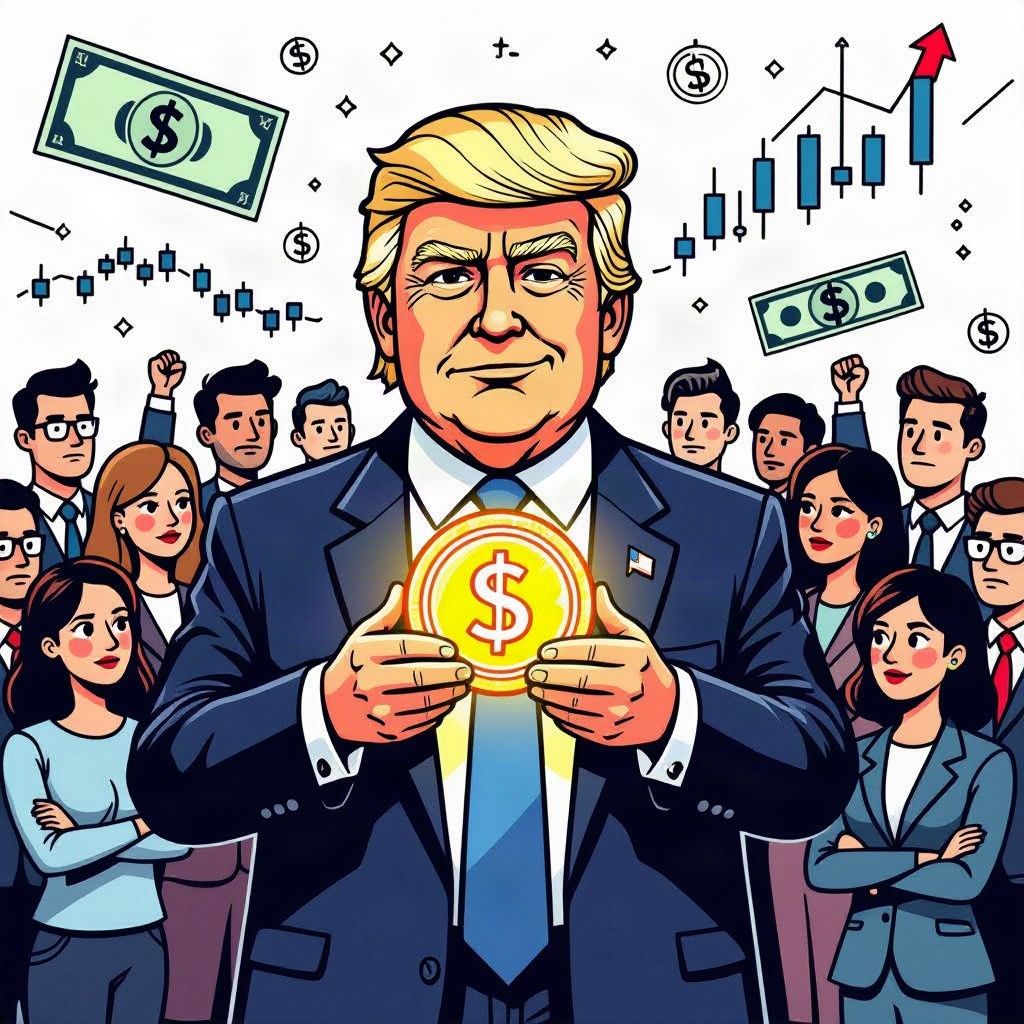
A new poll reveals 63% of Americans consider it inappropriate for President Trump to profit from digital currency, following disclosures showing he earned over $1 billion from crypto ventures.
Public Backlash Over Presidential Crypto Holdings
The four-day Reuters/Ipsos poll, completed on Monday, August 17, 2026, surveyed 1,166 respondents and revealed that 63 percent of Americans believe it is inappropriate for Republican President Donald Trump and his family to profit from cryptocurrency ventures while he is in office [1][4]. Only 32 percent of respondents disagreed, while 5 percent did not provide an answer [1]. The survey, which has a margin of error of 3 percentage points, also highlighted deep public skepticism regarding executive decision-making [1]. Specifically, 69 percent of Americans believe that President Trump’s private business interests influence his official presidential decisions [3]. This sentiment is not entirely partisan; the poll found that 50 percent of Trump’s own Republican base believes he allows his business interests to influence his policy decisions [4].
Inside the President’s Multi-Million Dollar Crypto Ventures
This public concern follows the summer release of the president’s financial disclosures, which revealed he generated more than $1 billion in cryptocurrency-related income during 2025 [1][2]. According to these official filings, the president earned approximately $594 million from World Liberty Financial, a digital asset venture he launched with his sons two years ago in 2024 [1]. Additionally, he accumulated another $635 million linked to his personal meme coin [1], bringing his combined disclosed crypto revenues to 1229 million. In response to these disclosures, Senate Democrats, including Sens. Elizabeth Warren (D-Mass.), Richard Blumenthal (D-Conn.), Gary Peters (D-Mich.), Dick Durbin (D-Ill.), and Ron Wyden (D-Ore.), raised national security concerns last month in July 2026 [1]. They highlighted that unspecified third parties own more than half of World Liberty Financial [1]. However, in early July 2026, President Trump defended his earnings during a CNBC interview, stating there was “nothing illegal” or wrong with his profits and denying any wrongdoing [1].
Democrats Weaponize Anti-Corruption Campaign Ahead of Midterms
The polling results arrive as Democrats actively test an anti-corruption message ahead of the November 2026 midterm elections [2][3]. Shifting away from their 2024 focus on “threats to democracy,” Democratic strategists are now targeting the contrast between average voters’ economic concerns and Trump’s personal business earnings [2]. In April 2026, House Democrats established an “Anti-Corruption and Democracy Reform Task Force,” which was followed in May 2026 by the launch of the “End Corruption Caucus” by Democratic Representatives Jason Crow, Mike Levin, and Alexandria Ocasio-Cortez [2]. If Democrats secure majorities in the upcoming midterm elections, they are preparing to potentially audit Trump’s presidency, building on a resolution introduced in May 2026 [2].
Widespread Public Anger Over Political Corruption
This legislative push is mirrored in the Senate, where Senate Minority Leader Chuck Schumer (D-N.Y.) released a report in July 2026 detailing “the cost of corruption” to expose alleged self-dealing [2]. Democratic efforts align with a broader shift in public sentiment; Ipsos polling from April and May 2026 showed that 37 percent of Americans identify financial or political corruption as a top-three national concern—a decade high [2]. This sentiment is overwhelmingly bipartisan, with 95 percent of Democrats, 92 percent of Republicans, and 87 percent of Independents expressing anger over corruption [2]. A June 2026 survey by the Brennan Center further confirmed this, with 62 percent of respondents categorizing political corruption as a “very big problem” in the United States [2].